
South Tangerang, May 5, 2025 – The Asian Association of Open Universities (AAOU) is consistently committed to advancing open education in the Asian region by featuring leading experts in the field of distance learning. AAOU actively supports the achievement of Sustainable Development Goal 4 (SDG 4) on inclusive and equitable quality education.
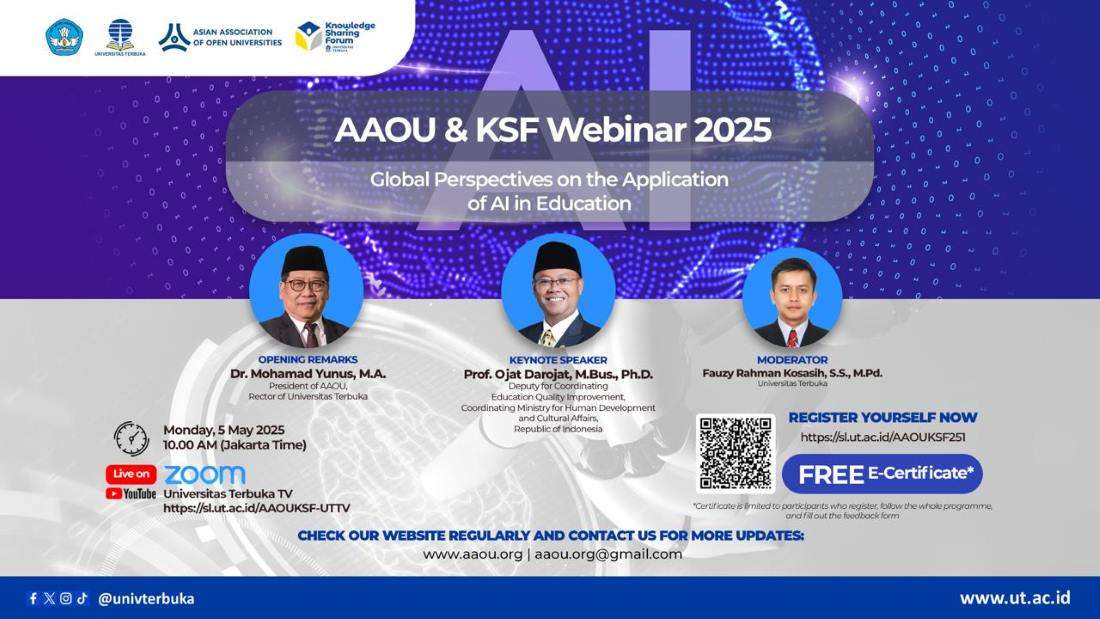
This time, AAOU collaborated with the Knowledge Sharing Forum (KSF) of Universitas Terbuka (UT) to hold a virtual webinar on Monday, May 5, 2025. AAOU and KSF presented an academic forum themed “Global Perspectives on the Application of AI in Education.” This webinar was specifically designed to create a collaborative space for sharing knowledge and experiences, with a primary focus on the development of education and the use of Artificial Intelligence (AI) in learning, which certainly extends beyond Indonesia to a global scale.
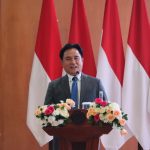
The event was opened with remarks by the Rector of UT and President of AAOU, Dr. Mohamad Yunus, S.S., M.A. He stated that the topic of this webinar was inspired by the ICDE 2024 Quality Network, discussing the role of AI in the transformation of education, including teaching, learning, and in the management of education systems within a university, particularly a distance learning university.
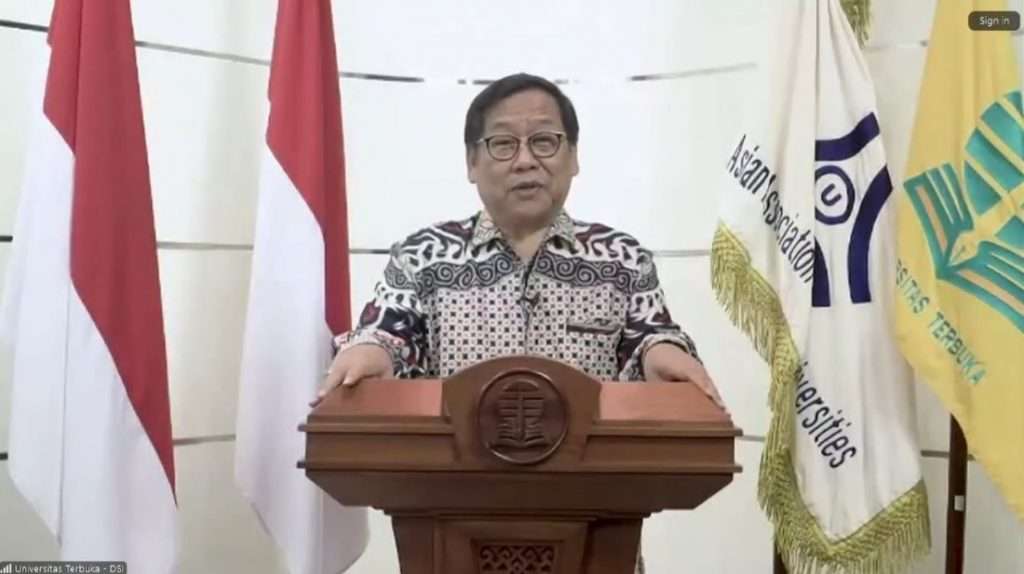
This webinar was also the first during Dr. Mohamad Yunus’s presidency at AAOU, so he expressed his gratitude and appreciation to the speaker, Prof. Ojat Darojat, M.Bus., Ph.D. – who is also a Professor at UT and the Deputy for Coordination of Education Quality Improvement at the Coordinating Ministry for Human Development and Culture Affairs of the Republic of Indonesia.
In his presentation, Prof. Ojat, as the speaker, emphasized the massive development of AI in all fields, especially in higher education. He began his presentation with data related to the development and utilization of AI for distance learning universities worldwide. Many distance learning universities across the globe—in Africa, the Middle East, Asia, Europe, the Americas, and Oceania—have utilized AI in learning and operational support, ranging from the use of AI Proctoring in online exams and the utilization of Large Language Models for decision-making, to the use of AI Voice Chatbots for registration, AI-assisted tutors, and automated assessment systems, as implemented by UT.
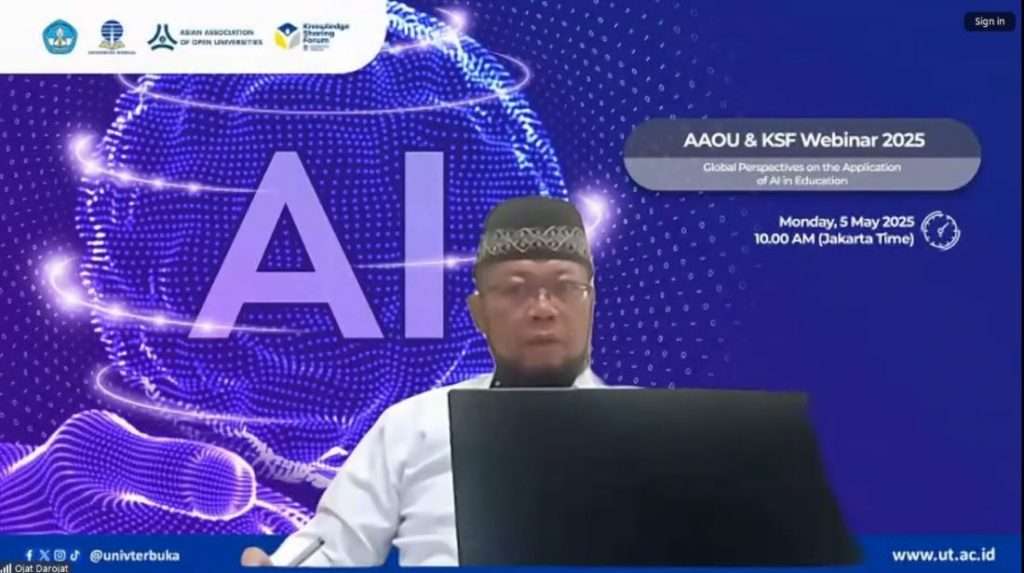
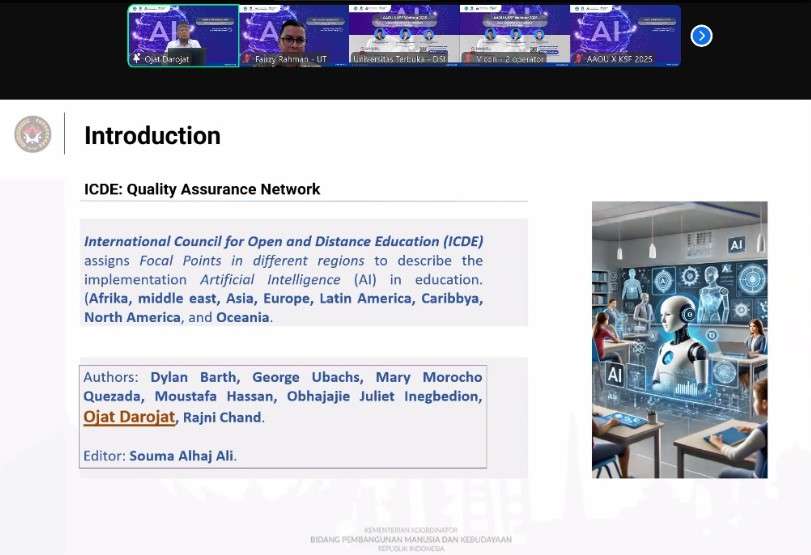
In addition to this data, Prof. Ojat also analyzed the opportunities presented by the use of AI in learning at the higher distance education level. Various opportunities and benefits, such as the possibility of 24/7 learning assistance for students, personalized learning for each student, and increased effectiveness and efficiency in the administrative processes of a university, were highlighted as significant opportunities to be pursued.
Beyond opportunities, the Deputy Coordinating Minister for Human Development and Culture Affairs also emphasized that there are many challenges that need to be addressed. The issue of privacy and personal data exposed in AI databases is one of them. Additionally, a crucial problem is the danger that excessive use of AI can lead to underdeveloped critical thinking and problem-solving skills in students. He stressed the importance of socialization and training related to ethical guidelines in the use of AI in learning. UT and AAOU are consistently committed to supporting the achievement of SDG 4. UT and AAOU demonstrate their synergy through concrete steps in the form of various activities and forums. This forum is not just a routine meeting but a profound effort to enrich academic insights and enhance research capacity among open education practitioners in Asia. AAOU continues to strengthen its role as a platform for experts and practitioners to learn from each other and inspire the advancement of quality distance learning.