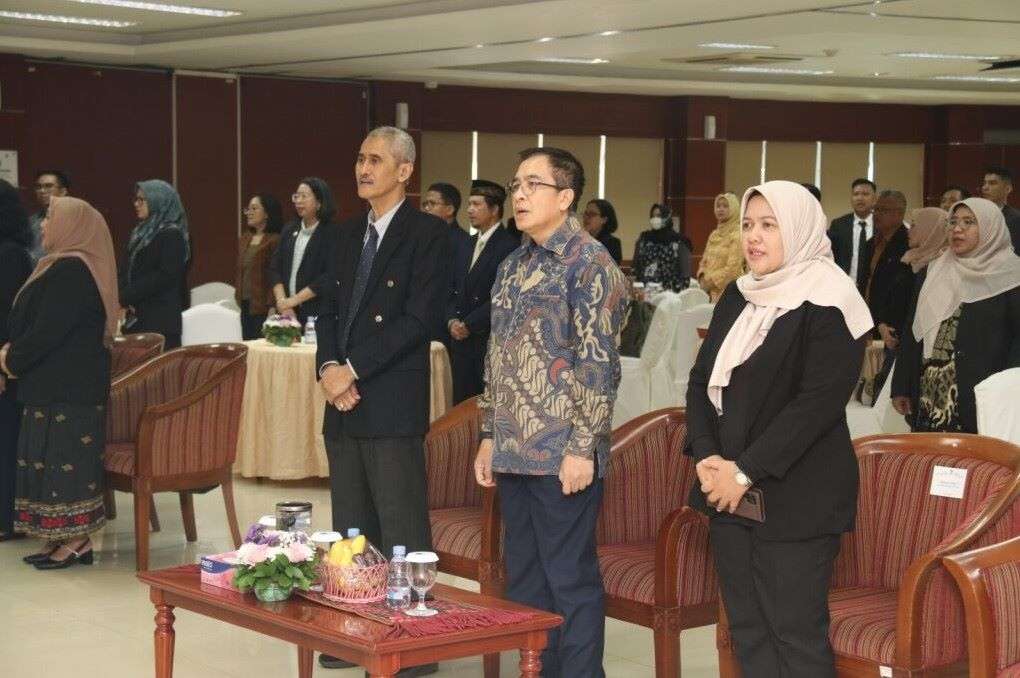

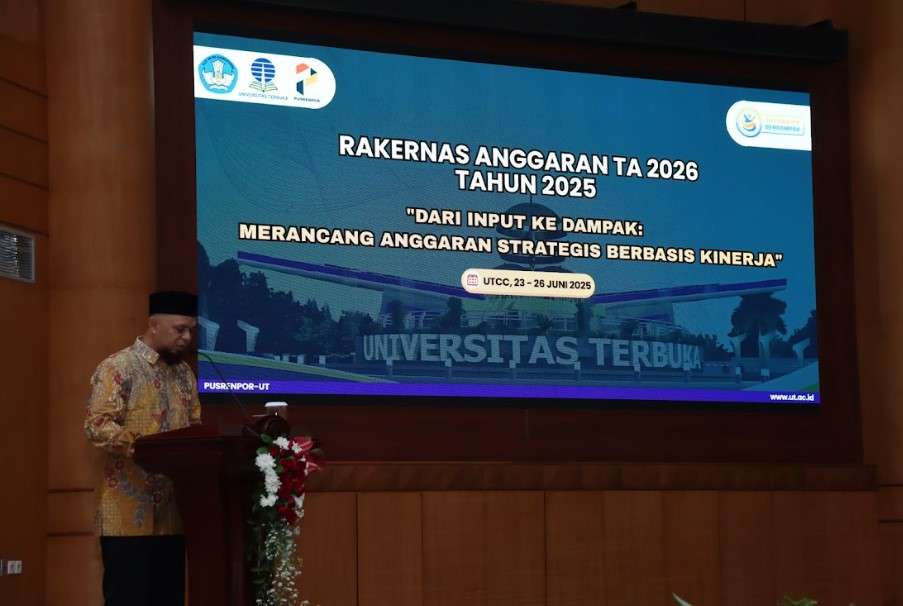
Tangerang Selatan, June 23, 2025 — Today, Universitas Terbuka (UT) officially held its annual strategic agenda titled the National Work Meeting (Rakernas) for the Academic Year 2026 Budget with the theme “From Input to Impact: Designing Performance-Based Strategic Budgeting.” Located at the Universitas Terbuka Convention Center (UTCC), Pondok Cabe, the event spanned four days (June 23–26, 2025), with a combination of in-person and online participation from all leaders at UT Central and Regional UTs.
This Rakernas serves as a crucial forum for formulating UT’s policy direction and budget for 2026, which will be marked by significant changes, particularly the implementation of a new curriculum for Diploma and Bachelor programs, as well as strengthening digitalization programs to support UT’s increasingly impactful performance for all UT stakeholders.
Strategic Direction from Leadership
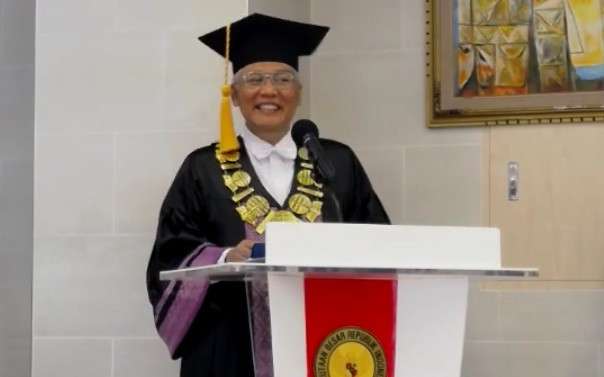
UT Rector, Dr. Mohamad Yunus, S.S., M.A., emphasized the importance of seriousness in formulating a budget that is not merely administrative but also directly impacts educational quality.
“The 2026 budget must address the needs of the new curriculum: new learning materials, new assessment systems, infrastructure support, lecturer training, and the integration of Indonesian and English language diplomas-transcripts,” he stated at the opening of the Rakernas.
This new curriculum also necessitates major updates to the learning system, procurement of learning materials, and digital-based tutorial-practice and assessment systems.
The Rector also raised other strategic issues such as the finalization of online proctoring, strengthening integrated information systems, and the development of physical infrastructure, for example, the new Postgraduate School Building, Vocational School, development of the UT Semarang Building, and expansion of Faculty Buildings, after this year’s inauguration of UT Surabaya, UT Purwokerto, UT Denpasar, and later in late 2025 the inauguration of UT Samarinda.
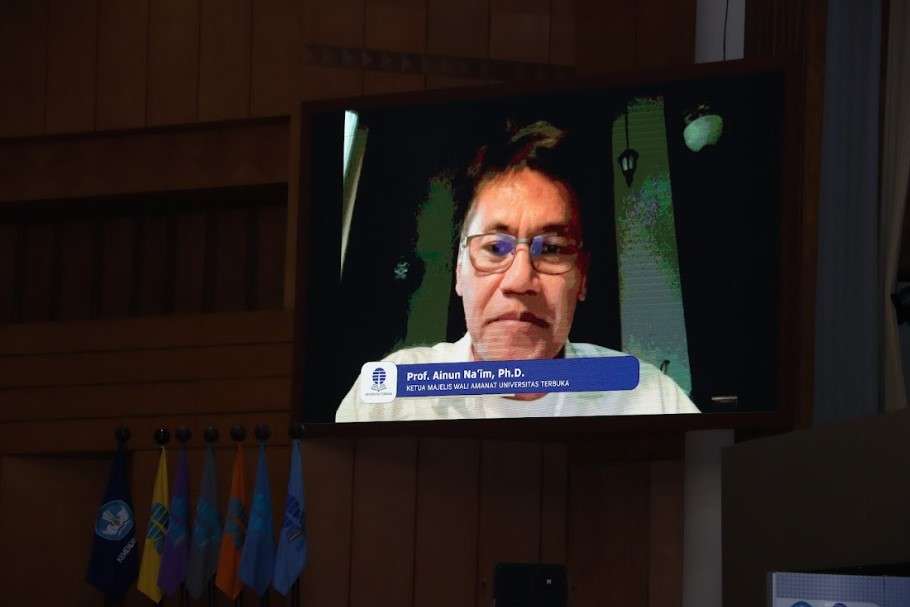
Furthermore, the Chairman of the UT Board of Trustees (MWA), Prof. Ainun Na’im, Ph.D., highlighted the importance of system consolidation and budget governance based on high accountability and quality orientation.
“UT is not just an educational institution but a locomotive of change. 2026 is a transformation point to produce global-ready graduates with strong supporting systems,” asserted Prof. Ainun.
Meanwhile, the Chairman of the UT Senate, Prof. Dr. Chanif Nurcholis, M.Si., emphasized the importance of strengthening the Tridharma and UT’s identity as a pioneer of flexible but quality higher education. “We fully support ensuring that academic quality not only survives but also moves up a class. Therefore, the budget must align with real academic needs and Tridharma quality,” stated Prof. Chanif.
In the leadership policy session moderated by Bambang Hariyanto, the four Vice Rectors presented work priorities that must be the basis for unit budgeting:
- Vice Rector I (Academic Affairs), Prof. Rahmat Budiman, M.Hum., Ph.D., focused on the finalization of the new curriculum, certification, digitalization of assessment, and quality assurance of academic programs. “All planning must address the needs for curriculum alignment, improvement of learning material quality, and hybrid digital learning systems. The budget is not just numbers, but a quality map,” explained Prof. Rahmat.
- Vice Rector II (Finance, HR, and General Affairs), Prof. Dr. Ali Muktiyanto, S.E., M.Si., with the theme “From Input to Impact: Designing Performance-Based Strategic Budgeting,” emphasized spending effectiveness and budget performance optimization. Essentially, UT encourages results- and impact-based budgeting. “We must formulate the budget with a value-based budgeting approach. 2026 is a momentum for more impactful and transparent structural reform,” stated Prof. Ali.
- Vice Rector III (Information Systems and Student Affairs), Prof. Dr. Paken Pandiangan, S.Si., M.Si., emphasized the strengthening of ICT governance and the development of ICT infrastructure to support the Digital Learning Ecosystem (DLE), effective operational systems of supporting units (DAAK, PUSLABA, P3B, PUSJIAN), student policies to enhance student roles, competitiveness and graduate quality, as well as the formation of alumni empowerment units, and the integration of career and alumni tracer systems. “Information systems are the backbone of UT. This Rakernas is a momentum for total consolidation and improvement of UT’s adaptive and secure digital system,” asserted Prof. Paken. “Alumni are not just results; they are strategic assets. We will encourage alumni empowerment to be part of UT’s strength in society,” he added.
- Acting Vice Rector IV (Research, Innovation, Cooperation, and Business), Prof. Rahmat Budiman, M.Hum., Ph.D., discussed the improvement of the quality of research and community service that have an impact, sources of income other than tuition fees, increasing UT’s brand image and brand awareness through digital campaigns to increase student numbers, improving “after-sales” services or customer service to UT students, and prospecting for increasing students/participants in the ICE Institute and UT MOOCs programs. “UT must explore the potential of research and cooperation as new resources. Digital campaigns and good after-sales service are key to expanding student reach and loyalty.”
Rakernas Process: Collaborative, Structured, and Focused
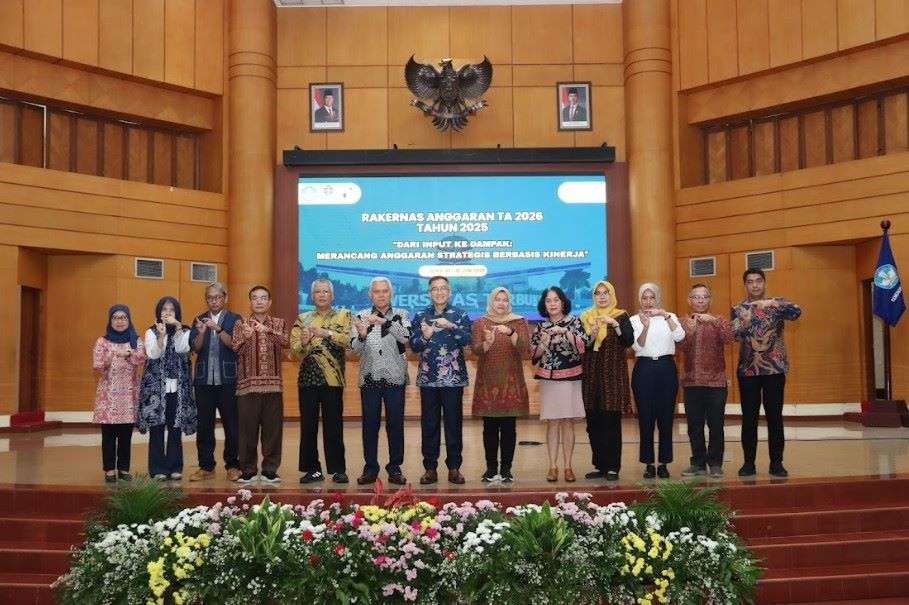
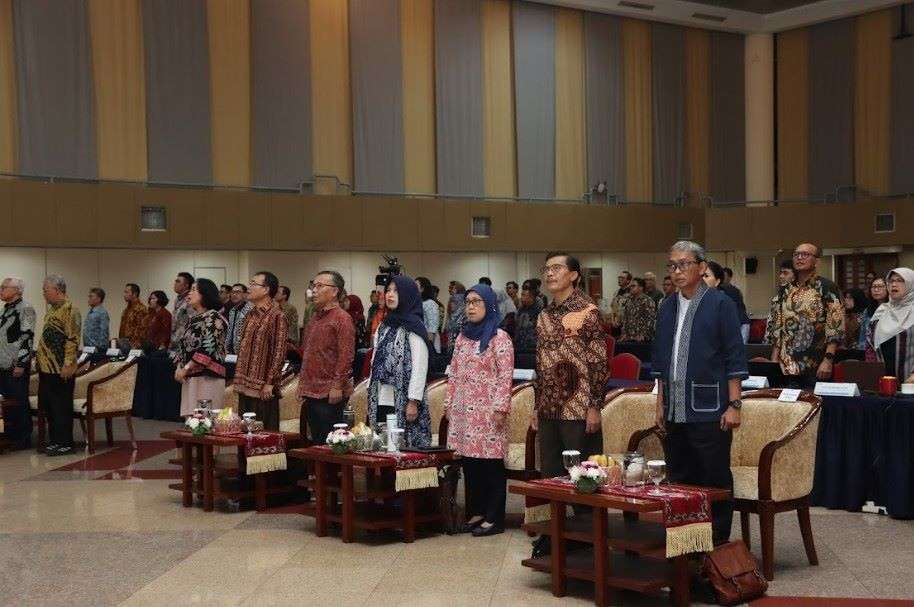
The series of activities for the UT TA 2026 Rakernas in 2025 consists of plenary sessions and thematic working groups. Participants are divided into five working groups according to their functional areas: academic, finance and general, HR, information systems and technology, and student affairs and alumni.
Each group works based on task assignments and strategic topics with the following discussion schedule:
- Day One (June 23, 2025): Official opening by the Rector, directives from WR I–WR IV, and directives from the Chairman of MWA and the Chairman of the Senate.
- Day Two (June 24, 2025): Intensive discussions per working group regarding the 2026 budget needs based on UT’s 2025–2029 Strategic Plan.
- Day Three (June 25, 2025): Presentation of group discussion results, finalization of performance indicators, and proposals for funding strategies.
- Day Four (June 26, 2025): Plenary meeting for alignment of perceptions and closing of the Rakernas.
Participants attend in-person from representatives of central work unit leaders, directorate heads, center heads, and budget team leaders. Meanwhile, Regional UT officials participate in the Rakernas online via Zoom Meeting, including Regional UT Directors and Administrative Heads throughout Indonesia.
Rakernas Objective: One Vision, One Step
This Rakernas serves as a momentum to build shared understanding across work units that every rupiah in the budget is part of UT’s quality system. The Rector emphasized that Rakernas is not just a routine agenda, but a roadmap for UT’s long-term change.
“This Rakernas must answer one important question: how does UT remain relevant, adaptive, and excellent amidst global changes?” he asserted.
Building UT’s Future from Now
The TA 2026 Budget Rakernas is not just about preparing the RBA, but about formulating a new direction for UT towards becoming a world-class digital university. With a new curriculum, cutting-edge supporting systems, and a spirit of academic mutual cooperation, UT is ready to become a pioneer of more impactful, relevant, and proud distance higher education for Indonesia.