
As a State University established by the government in 1984, UT was founded to address educational challenges of that time, particularly to address three main issues: 1) increasing the equalization of access to higher education for the entire Indonesian population in various regions; 2) serving as a platform for enhancing the competence and capacity of workers who have limited time to attend classes at UT; and 3) providing a venue for high school graduates or equivalent who are not accommodated in various leading universities due to cost and academic ability limitations.
UT has gained popularity among the Indonesian population, especially Generation Z and millennials, with the number of UT students for the 2023/2024 Odd Semester reaching 550,050 students spread throughout the country and various parts of the world. To enhance access and the quality of its services, UT continues to innovate in applying teaching technology to satisfy its students better. One of the Asian open and distance education providers established earlier is Korea National Open University (KNOU), founded in 1978. Therefore, in its developmental effort in educational technology innovation, UT observes the best practices in digital technology-based learning processes carried out by KNOU to enhance the quality of UT’s learning in reinforcing distance higher education as the future education model in Indonesia.
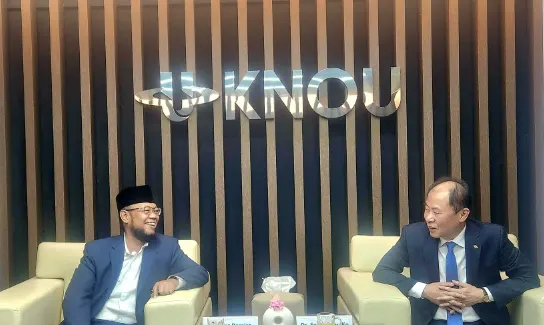
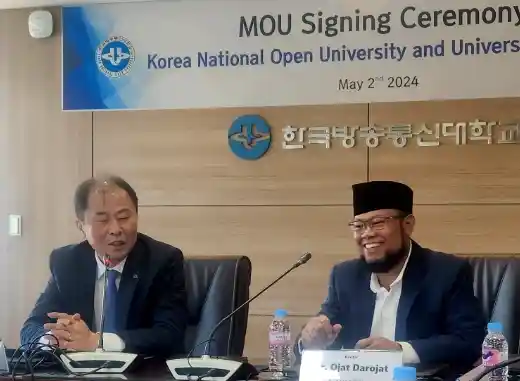
On May 2, 2024, UT Rector Prof. Ojat Darojat, M.Bus., Ph.D., and the UT delegation visited KNOU, Seoul, South Korea, to conduct benchmarking and simultaneously sign a Memorandum of Understanding (MoU) between UT and KNOU. The MoU signing was conducted by UT Rector Prof. Ojat and KNOU Director Prof. Songhwan Ko at the KNOU Campus in Seoul, South Korea, covering collaboration in Tri Dharma Perguruan Tinggi.
Furthermore, a Memorandum of Agreement (MoA) was also signed between the Dean of the Faculty of Economics and Business (FEB) UT Dr. Meirani Harsasi, M.Si., and the Dean of the College of Social Sciences (CSS) – KNOU, Republic of Korea, Dr. Bumsang Yoo. The MoA between FEB UT and KNOU describes cooperation between the two institutions can be conducted in various ways, including 1) exchange of lecturers and staff; 2) student exchange; 3) exchange of publications and scientific information; 4) collaborative research program development or joint interest projects; 5) participation in academic meeting seminars; 6) development of academic material and other information for mutual benefit; 7) development of academic and administrative initiatives, including sponsorship of symposiums, seminars, and conferences; and focus on relevant study programs/departments from FEB UT (Development Economics, Islamic Economics, Management, Tourism, Accounting, Public Financial Accounting) with Programs in CSS KNOU (Law, Public Administration, Management, International Trade, Arts and Media Sciences, Tourism Studies, Social Welfare).
The UT delegation attending the MoU signing event included Dr. Meirani Harsasi, M.Si., as the Dean of the Faculty of Economics and Business (FEB), Olivia Idrus, SE., M.Sc., as the Vice Dean for Student Affairs at FEB, Dr. Maya Maria, S.E., M.M., as an FEB lecturer and Head of the Sub Directorate of Public Relations and Marketing, Prof. Dr. Nafsiah Mohamed as an advisor to FEB UT for international partnership programs, and Halim Dedy Perdana, S.E., M.SM., M.Rech, Ak., CFrA, as an FEB UT lecturer who served as the coordinator for the partnership between UT and South Korea. Meanwhile, from KNOU, the leaders present to meet the UT delegation for the KNOU MOU & MOA Ceremony were Song Hwan Ko (President); Byeong Rae Lee (Vice President); Yun Kyoung Choi (Office of Academic Affairs, Dean); Chung Ki Lee (Office of Student Affairs, Dean); Young Jae Chang (Office of Planning Affairs, Dean); Bum Sang Yoo (College of Social Sciences, Dean); Jae Hyung Kim (Office of International Affairs, Dean); Chang Yeul Yang (Office of International Affairs, Team Leader); Eummi Oh (Office of International Affairs, Program Specialist); and Ahyun Hur (Office of International Affairs, Program Specialist).
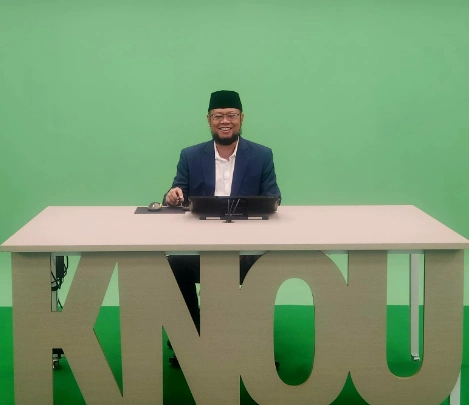
During the visit, Prof. Ojat Darojat expressed his gratitude for the warm reception and stated that KNOU is UT’s older sibling. Prof. Songwan Ko, KNOU Director, also expressed that the brotherhood between UT and KNOU has long been established but not formalized in an MoU yet. During the visit to several development units at KNOU, the UT Rector and delegation gained insight into good practice models of online pedagogical-based learning designed through comprehensive digital learning delivery via multimedia channels such as the 24-hour online campus TV channel by teachers/lecturers, direct delivery of teaching by lecturers through video conferences, or direct radio tutorials in online classrooms.
Indeed, the insights gained from the visit to KNOU provide UT with opportunities for enhancing the quality of distance education based on digital technology. As for the follow-up to the UT-KNOU partnership agreement, various forms of collaboration, such as joint research, lecturer exchange, facilitation of internships for students (exchange of internship students), and facilitation of collaborative development of technology-based digital learning services, will be formulated soon.
In the future, it is hoped that UT will become more qualified and better in its teaching and business processes to strengthen the single-mode ODL model based on online learning as the future education model in Indonesia. The improvement of digital technology-based and multimedia learning is also one of the steps to support the government’s target for increasing the gross participation rate (GPR) in higher education for the Indonesian population. Certainly, this is part of the efforts to enhance the qualifications and competencies of the Indonesian population to support national development towards Indonesia Maju.