
“The transformation of education in Indonesia through Merdeka Belajar Kampus Merdeka policy is in line with UT vision and mission, which is to realize widespread access to quality higher education for the community. Through Kampus Merdeka, students are expected to earn contextual field experiences that can enhance their competencies comprehensively, making them ready for employment or creating new job opportunities.”
Prof. Ojat Darojat, M.Bus., Ph.D.
Rector of Universitas Terbuka
Tangerang Selatan, January 26, 2024 – Merdeka Belajar Kampus Merdeka (MBKM) program, initiated by the Ministry of Education, Culture, Research, and Technology (Kemendikbud Ristek) of Republik Indonesia, has gained massive popularity among students, including those at Universitas Terbuka (UT).
As one of the state universities under the auspices of Kemendikbud Ristek, UT strongly supports the MBKM program. The reason is clear: through MBKM, students have the opportunity for both academic and non-academic self-development, enhancing their experiences within and beyond the curriculum.
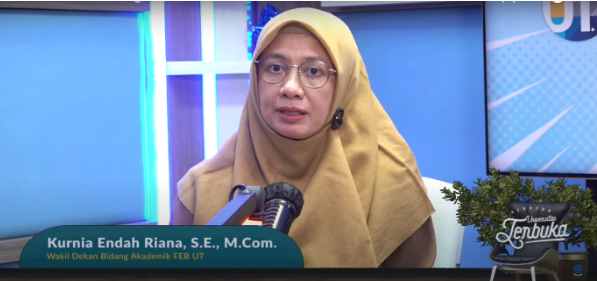
To sustain this momentum, the Faculty of Economics and Business (FEB) at UT actively contributes to the MBKM program. Kurnia Endah Riana, S.E., M.Com., Vice Dean for Academic Affairs at FEB UT, stated on UT Radio broadcast that “MBKM program aims to prepare graduates who are resilient, relevant, and globally competitive.” She added, “MBKM is not an obligation, instead it is a right for students. It is a fitting platform for students to gain experiences, skills from various multidisciplinary fields, and develop themselves beyond the campus.”
Within FEB UT, there are various MBKM program options for students to choose from. Bu Riana conveyed that there is a number of alternative programs available. Generally, it includes flagship programs from Kemendikbud Ristek and others run independently. “Flagship programs from the ministry include Pertukaran Mahasiswa Merdeka (PMM), Indonesian International Student Mobility Award (IISMA), Magang dan studi Independen Bersertifikat (MSIB), Kampus Mengajar, and Wirausaha Merdeka. In addition, there are other MBKM programs such as Research and Thematic Community Service (KKN Tematik),” stated Bu Riana.
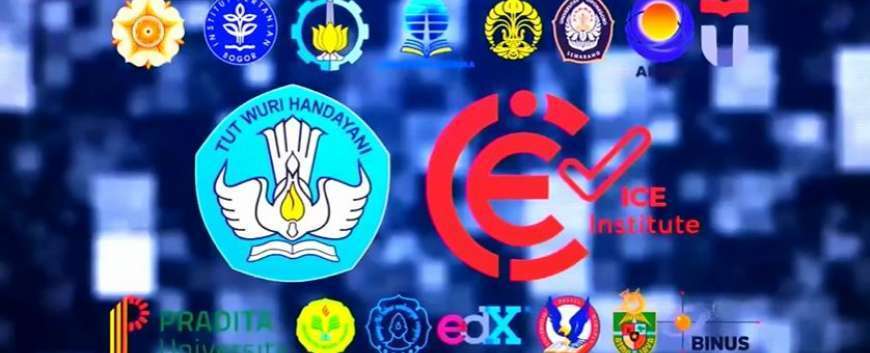
UT is also actively participating in organizing MBKM programs independently. Bu Riana mentioned, “Currently, some faculties have organized independent MBKM programs, namely the Faculty of Science and Technology (FST) and the Faculty of Law, Social and Political Sciences (FHISIP), specifically in the Legal Studies Program.” She continued, “There is an MBKM program which has study scheme in the form of taking online based courses at integrated/collaborated universities with ICE Institute.”
With the MBKM program in place, UT strongly supports its implementation, including determining academic policies for its execution. Bu Riana conveyed the academic policies through a UT Radio broadcast, stating that there are policies related to semesters. Students eligible for the MBKM program are those in their 5th and 6th semesters, effective from the 2024.1 semester. Previously, the requirement was for students in their 5th, 6th, or 7th semesters to participate. However, this changed due to the inclusion of TAP and Karil courses in almost all UT programs in the 7th semester, where students are expected to focus on these courses. Additionally, the academic policy defines that students eligible for the MBKM program are non-RPL students, and the minimum GPA/IPK required for participation is 2.75.
Bu Riana emphasized the importance of students registering for courses that will be converted when applying for any MBKM program. This ensures that students’ participation is recorded in the national education database (PDDIKTI) and UT, so they can convert the SKS according to their registration. UT also provides specific policies to support MBKM students, exempting them from regular lectures (both Tuton and TTM/Tuweb) and Final Semester Exams (UAS). This aims to allow students to fully engage in MBKM program and achieve satisfactory and prideful results.
Currently, UT consistently participates in organizing MBKM, both flagship and independent MBKM programs. Bu Riana explained the simplified process for flagship MBKM, where students only need to fill in data on Kampus Merdeka website for administrative purposes, which is getting a recommendation letter from their home university (UT). The data is then validated by the program study, and upon approval from the UT, students can proceed to the selection process conducted by each program.
Following MBKM program timeline, after completing the program, students apply for recognition by converting grades from the completed MBKM program. Bu Riana provided further details, stating, “To be able to convert grades, students must complete the program and have grades from the MBKM organizer. These grades are usually found on the certificate, which must be reported to the program study. Each faculty has a link for reporting MBKM so that students can monitor it on the faculty website, then select Merdeka Belajar (MBKM) menu and choose the reporting menu, and finally, fill in the available form. The required documents are MBKM certificate, proof of course registration for the current semester, and MBKM report,” She stated.
She concluded the broadcast by motivating fellow students, “I strongly encourage all fellow students, from FEB or other faculties, to join the MBKM program. Through MBKM, students can discover their passion. The program is an avenue to explore one’s identity, including interests, talents, skills, and expertise. Additionally, with MBKM, students build social networks, enrich themselves, and enhance their portfolios and resumes,” she affirmed.
Source: UT Radio Broadcast, January 26, 2024