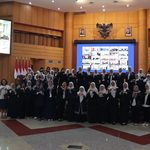

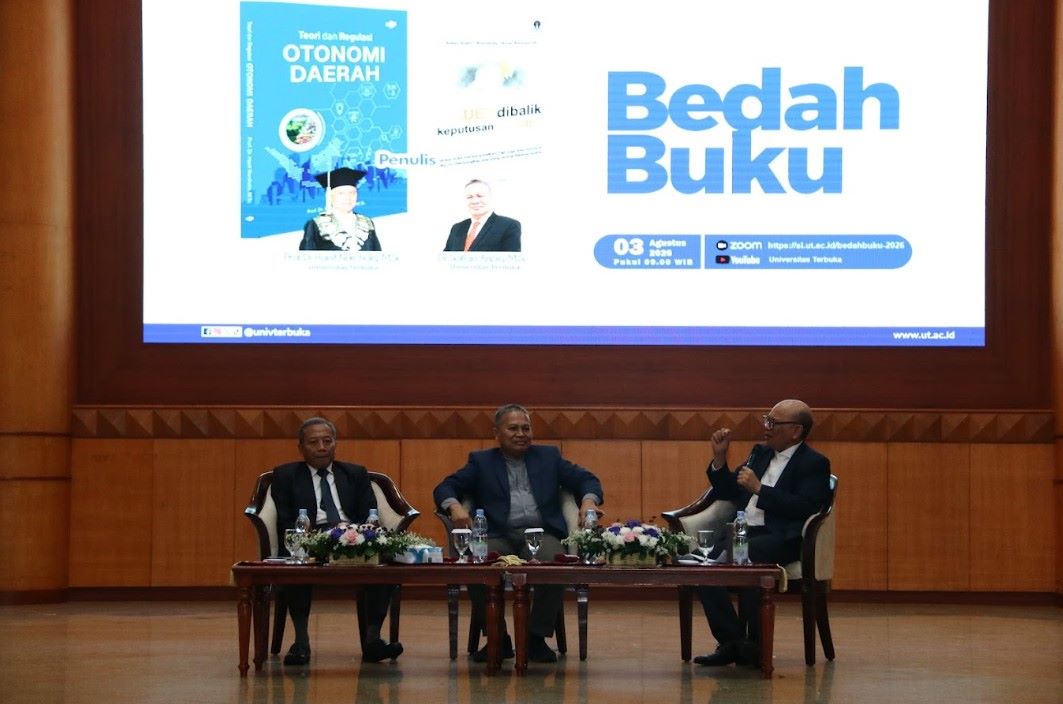
TANGERANG SELATAN – Whenever people access public services, witness development in their communities, or see governments make decisions in unusual circumstances, a lengthy process is often at work behind the scenes. Not every issue can be addressed in black-and-white terms through regulations alone. Knowledge, integrity, and spaces for discussion are needed to generate new ideas. Driven by this spirit, Universitas Terbuka (UT) held its 2026 Book Review, or Bedah Buku, at the Universitas Terbuka Convention Center (UTCC) on Monday (3/8/2026). The event was attended in a hybrid format by academics, practitioners, students, and members of the public from various regions.
Organized by Pusat Penelitian Keilmuan (PPK) under the Institute for Research and Community Service (Lembaga Penelitian dan Pengabdian kepada Masyarakat – LPPM) at UT, the event was part of UT’s Dies Natalis celebrations and served as an academic forum to discuss two recent books written by UT lecturers focusing on governance in Indonesia. The books were Siluet di Balik Keputusan Diskresi by Dr. Sofyan Arifin, M.Si., and his team, and Teori dan Regulasi Otonomi Daerah by Prof. Dr. Chanif Nurcholis, M.Si.
Chair of LPPM UT, Prof. Dra. Dewi Artati Padmo Putri, M.A., Ph.D., explained that the book review was not merely a platform for launching academic works, but also a forum for introducing, exploring, and testing ideas through open dialogue. With governance as its central theme, the discussion was expected to broaden the perspectives of academics and policy practitioners while encouraging UT lecturers to continue producing scholarly works that provide tangible benefits to society.
UT Rector Prof. Dr. Ali Muktiyanto, S.E., M.Si., emphasized that the book review has become an annual event with significance beyond the launch of academic publications. According to him, the forum represents one of the symbols of academic authority that UT continues to build through a culture of writing, research, and knowledge dissemination.
“We continue to promote academic culture at UT as part of our efforts to build academic authority, academic integrity, and academic reputation. One of the functions of a university is to produce knowledge, disseminate it, and make it accessible to society, ultimately contributing to the welfare of the nation and state,” Ali said.
He also expressed his appreciation to Prof. Dr. Chanif Nurcholis, M.Si., and Dr. Sofyan Arifin, M.Si., and his team for presenting new perspectives through in-depth research. According to him, ideas presented in books should not remain merely as library collections, but should continue to be examined through discussion so that they can contribute to improving governance in Indonesia.
The book Siluet di Balik Keputusan Diskresi explores challenges frequently encountered by government officials when regulations are unable to address every situation in the field. Through the 130-page book, Dr. Sofyan Arifin and his team explain that discretion provides public officials with room to make decisions within their authority when there is a legal vacuum or when existing regulations do not provide detailed guidance. However, such discretion is not without limits. Every decision must remain grounded in the public interest, be morally and legally accountable, and uphold integrity and good governance to prevent the abuse of authority.
“This book is expected to serve as a discourse, guide, and reference for government officials to understand and exercise discretion appropriately, so that it does not shift into abuse of power that could instead have a counterproductive impact on governance,” Ali said.
Meanwhile, through Teori dan Regulasi Otonomi Daerah, Prof. Dr. Chanif Nurcholis invites readers to take a deeper look at the fundamental concept of regional autonomy. Rather than merely examining regulations, the book explores the root causes of challenges still faced by local governments, including understanding autonomous regions, fiscal independence, and the importance of balancing authority with adequate resources. These ideas ultimately pursue the same goal: delivering public services that are increasingly effective, high-quality, and responsive to community needs.
The UT Rector hopes the book will continue to stimulate discussions aimed at finding a more ideal framework for regional autonomy. According to him, more than two decades after the beginning of the reform era, relations between the central and regional governments continue to evolve and therefore require new perspectives emerging from the academic community.
The discussion, moderated by Prof. Dr. Maximus Gorky Sembiring, M.Sc., was enriched by speakers from various institutions, including Prof. Dr. Djohermansyah Djohan, M.A., from the Institute of Public Administration (IPDN); Director General of Regional Autonomy at the Ministry of Home Affairs, Dr. Cheka Virgowansyah, S.STP., M.E.; Prof. Dr. Satya Arinanto, S.H., M.H., from Universitas Indonesia; and Prof. Dr. Bambang Supriyono, M.S., from Universitas Brawijaya. Their diverse perspectives allowed the forum to go beyond theoretical discussions and connect academic concepts with the real challenges facing governance today.
For UT, research does not end when a book is published. Instead, that is where an idea begins to find its meaning through dialogue, criticism, and the exchange of perspectives. Through the 2026 Book Review, Universitas Terbuka once again emphasized that research does not stop with publication. Ideas gain greater meaning when they are debated, tested, and developed collectively. In this way, universities fulfill their role not only by producing knowledge but also by contributing solutions to national challenges through continuous academic dialogue.