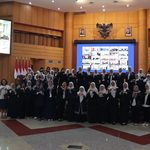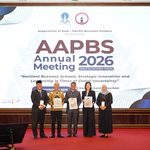

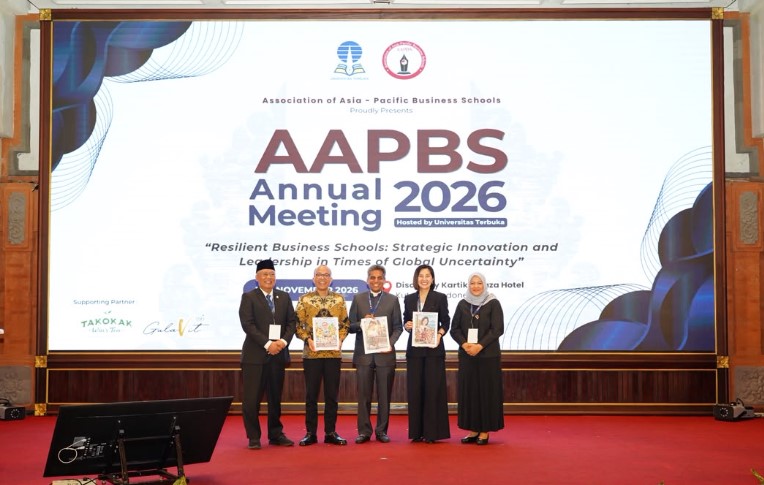
BALI — Geographical boundaries are no longer barriers in the business world. Products from small businesses can reach consumers across countries, while economic changes in one region can affect business activities in other parts of the world. These dynamics require businesses to have human resources with a global perspective, adaptability, and the ability to respond to change. In this context, business education is expected to continue innovating to prepare graduates who meet industry needs. Universitas Terbuka (UT) recognizes the importance of this agenda by hosting the Association of Asia-Pacific Business Schools (AAPBS) Annual Meeting 2026 on November 1–3, 2026, at Discovery Kartika Plaza Hotel, Bali.
Carrying the theme “Resilient Business Schools: Strategic Innovation and Leadership in Times of Global Uncertainty,” the meeting brought together business school leaders, academics, industry practitioners, and government representatives from various countries. The forum provided a platform for exchanging perspectives on the challenges facing business schools, ranging from developments in artificial intelligence (AI) and changing industry needs to economic dynamics and the importance of adaptive and responsible leadership. Efforts to strengthen the quality of business education are also in line with the spirit of SDG 4, which aims to ensure quality education that is relevant to future needs and challenges.
For UT, the opportunity to host the event was more than just the trust placed in the university to organize an international agenda. UT Rector, Prof. Dr. Ali Muktiyanto, S.E., M.Si., viewed this moment as recognition of UT’s vision to become a world-class distance education university. Moreover, UT’s Faculty of Economics and Business (FEB) currently has more than 200,000 students who stand to benefit from increasingly extensive academic and professional connections at the international level.
“Our business students are ready to enter global markets through international exposure and cooperation with AAPBS, particularly in obtaining two things: internationally recognized competency certifications and professional certifications,” Ali stated.
These opportunities align with the diverse backgrounds and activities of UT students. Some pursue their studies while working, building their careers, or even developing their own businesses. Through its open and distance learning system, they can apply the knowledge gained during their studies to their professional activities without having to leave their jobs or ongoing businesses. This combination of theory and practice is one of UT’s educational strengths in expanding access to education while supporting lifelong learning.
Students’ potential in the business sector is also a priority for the university. Ali revealed that approximately 5 percent of UT students are entrepreneurs, either running established businesses or still in the early stages of developing one. Recognizing this potential, UT aims to provide direct mentoring to approximately 2,000 students through collaboration with the Ministry of Micro, Small, and Medium Enterprises (MSMEs).
“We have 5 percent of UT students who are entrepreneurs, ranging from those at the highest level to those who are still learning. Our target is for 2,000 students to receive direct mentoring from the Ministry and become role models for student entrepreneurship in Indonesia,” Ali explained.
This initiative is not only aimed at developing students’ business management skills but also at encouraging the emergence of young entrepreneurs who can create employment opportunities and contribute to an economy aligned with SDG 8, which promotes inclusive, productive, and sustainable economic growth.
Support for entrepreneurship development was also expressed by the Deputy for Entrepreneurship at the Ministry of MSMEs, M. Riza Damanik, Ph.D., IPU. He considered the AAPBS network a potential strategic partner in improving the quality of Indonesian entrepreneurs and MSME players.
“The government hopes that this cooperation will help improve the capacity of entrepreneurs and MSME players, not only in terms of quantity but also quality. Access to financing, markets, partnerships, certification, and business legalization must also become increasingly accessible,” Riza said.
The government aims to enable 10 million people to engage in business and employment by 2029 through the ProKestra Produktif program, with a target of achieving a national entrepreneurship ratio of 3.6 percent. To support this target, one of the ideas raised during the forum was the establishment of the Asia-Pacific Incubator Network, an entrepreneurship incubator network across the Asia-Pacific region. This initiative is expected to strengthen knowledge exchange, develop best practices, and create opportunities for cross-border collaboration in building future MSMEs that are more productive, efficient, and sustainable.
From the international academic community, AAPBS President Prof. Jikyeong Kang encouraged all participants not to let the meeting become merely a forum for discussion and experience sharing. According to her, every institution should take home at least one concrete idea that can be implemented to bring about change.
“Do not let this meeting end with conversations alone. Let us think about what we can actually do to bring about change. If every institution can take one initiative back and implement it on its own campus, I believe AAPBS will have fulfilled its role,” Jikyeong emphasized.
Meanwhile, through a message delivered by a representative, Director General and CEO of the European Foundation for Management Development (EFMD), Prof. Eric Cornuel, highlighted the importance of internationalizing mindsets, creating shared knowledge, fostering cross-border collaboration, promoting values-based leadership, and expanding inclusive access to education. He also emphasized that economic circumstances, geographical barriers, disabilities, and family responsibilities should not prevent anyone from having equal educational opportunities.
These ideas demonstrate that the future of business education cannot be built through classrooms alone, but also through experience, networks, and opportunities for collaboration. For UT, the AAPBS Annual Meeting 2026 represents a step toward connecting students’ potential with broader opportunities while strengthening international partnerships in line with the spirit of SDG 17. When knowledge meets opportunity and collaboration extends beyond national borders, more opportunities emerge for Indonesian students to grow, innovate, and take part in global competition.