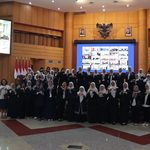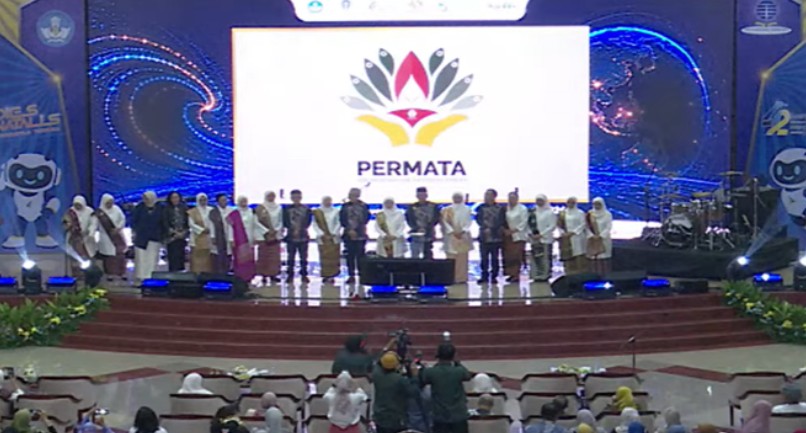

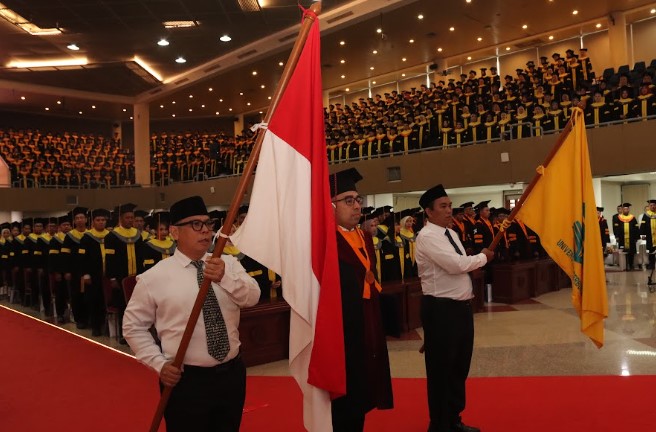
TANGERANG SELATAN — Thousands of graduates with diverse stories and backgrounds gathered for the same occasion: celebrating their success in completing higher education. A total of 1,976 Universitas Terbuka (UT) graduates from 14 Regional UT Offices attended the Second Regional Graduation Ceremony for the First Semester of the 2026/2027 Academic Year at the Universitas Terbuka Convention Center (UTCC), Tangerang Selatan, on Tuesday (November 10, 2026). Amid the celebrations, UT also looked ahead to new initiatives through various innovations aimed at expanding learning opportunities on a global scale.
The graduation ceremony also provided UT with an opportunity to communicate its future development plans. During a press conference, UT Rector Prof. Dr. Ali Muktiyanto, S.E., M.Si., revealed several strategic initiatives currently being prepared, ranging from the launch of English-based study programs in 2027 and the expansion of educational services overseas to the strengthening of AI-based academic services.
Vice Rector for Academic Affairs and Student Affairs, Prof. Rahmat Budiman, S.S., M.Hum., Ph.D., explained that UT is preparing several study programs to be offered through an international scheme, including Management and Sociology. The preparations include translating learning materials, tutorial materials, and examinations into English, as well as developing international admission and registration websites. These programs are expected to reach international students as well as Indonesians who wish to participate in international classes.
The development of these international services is supported by the innovation of LENTERA (Learning Material Application), a digital learning materials application equipped with an AI-based translation feature. This technology enables learning materials to be translated into various languages, making them more accessible to people across countries.
In addition, UT is exploring the expansion of its educational services to Vanuatu and Sub-Aboriginal communities in Australia. Domestically, digital transformation is being strengthened through the development of the semester examination system. More than 90 percent of examinations are planned to be conducted online through various schemes, including online proctoring, automated online proctoring, and mobile-based examinations. Each simultaneous examination session is expected to accommodate between 125,000 and 210,000 students.
According to the Rector, these innovations are intended to ensure that higher education becomes increasingly accessible without requiring students to leave their jobs or family responsibilities. This flexibility is also reflected in the journeys of the graduates attending the ceremony.
One example is Kamarudin Muten, Regent of Belitung Timur, who successfully completed his Bachelor’s degree in Development Economics at UT after beginning his studies in 2021. Amid his busy schedule as a regional leader, he demonstrated that higher education can be pursued without leaving one’s job. He also hopes to encourage civil servants (Aparatur Sipil Negara – ASN) within the regional government to continue advancing their education.
“Looking at the Belitung Timur Regional Government today, I see that many civil servants have not yet pursued higher education. That is why I encourage them and set an example that it is never too late. Even at an older age, we must continue gaining knowledge to shape our future,” he said.
The diverse backgrounds of these graduates demonstrate that higher education can be accessed by anyone, regardless of age, profession, or physical condition. This aligns with UT’s commitment to supporting SDG 4 on Quality Education and SDG 10 on Reduced Inequalities.
“UT is a lifeline for our nation, particularly in accelerating the development of an educated and highly skilled human resource base to support and contribute to Indonesia’s development as we work toward Golden Indonesia 2045,” Ali emphasized.
Through this graduation ceremony, UT reaffirms that educational success is not measured solely by the growing number of graduates, but also by the opportunities created for people to continue learning, developing, and contributing. Supported by technological innovation and expanded international reach, UT continues to strive to provide higher education that is inclusive, flexible, and relevant to communities in Indonesia and around the world.