Imagine an elementary school teacher standing in front of a classroom. Instead of waiting for the English lesson to begin, the teacher incorporates one or two simple English sentences while giving instructions to students. Gradually, words that once sounded unfamiliar become part of everyday life. The children hear them, repeat them, and eventually become accustomed to them.
It is through such small habits that a language-learning culture is built.
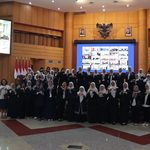
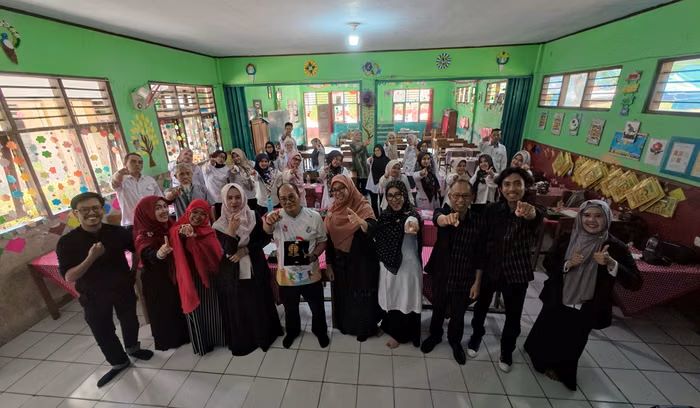
This spirit was brought by the English Language Education Study Program (PBIS), Faculty of Teacher Training and Education (FKIP), Universitas Terbuka (UT), through a Community Service Program (PkM) at SDN 1 Tambakbaya, Kecamatan Cibadak, Kabupaten Lebak, Banten.
Carrying the theme “Strengthening the English-Speaking Environment in Elementary Schools: Building Language Habits from an Early Age,” the activity, held from June 17 to August 5, 2026, was part of UT’s efforts to prepare teachers for the continually changing dynamics of elementary education, including the plan of the Ministry of Primary and Secondary Education (Kemendikdasmen) to make English a compulsory subject at the elementary school level in 2027.
Dwi Rezki Hardianto, Head of the PBIS Community Service Program, explained that the activity was a proactive step by UT in anticipating changes in elementary education policy. More than that, the PkM served as a means of applying academic research findings on strategies for building an English-speaking culture and developing engaging English language teaching methods suited to students’ characteristics.
This is where a larger issue emerges. As English eventually becomes increasingly integrated into the daily lives of elementary school students, teachers will be at the forefront. They will not only be required to understand the subject matter but also need creative approaches to make English feel familiar, enjoyable, and unintimidating for children.
Therefore, the training was designed with a more active approach through gamification and project-based learning (PBL). According to Dwi Rezki, these methods are relevant to the characteristics of participants from Generation Z and the millennial generation.
The evaluation results showed a significant impact. Participants’ average scores increased considerably after completing the training compared with their scores before the activity.
However, for Dwi Rezki, these figures are not the finish line.
He emphasized that true success is not merely reflected in evaluation scores or the certificates participants take home, but rather in how the knowledge they acquire is actually implemented sustainably in their respective schools.
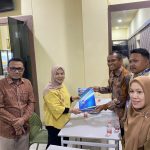
Support for the initiative came from the Kabupaten Lebak Education Office. Iwan Setiawan, S.Pd., M.M., Head of the Language and Literature Personnel Development Division (BKBS), viewed the synergy between UT and the local government as an important investment in educational human resources.
Moreover, approximately 1,000 teachers in Kabupaten Lebak are expected to enter retirement by 2030. This condition makes the presence of competent young teachers increasingly important to maintaining the continuity and quality of education in the region.
For SDN 1 Tambakbaya, UT’s involvement also provided an opportunity to establish broader collaboration. Aat Solihat, S.Pd., M.M., Principal of SDN 1 Tambakbaya, expressed gratitude that her school had been selected as the location for the PkM and hoped that the collaboration could continue and reach more teachers in Kecamatan Cibadak.
For the participants, meanwhile, the benefits were reflected in the way they viewed English language learning. Linda Desti Fatimah, a teacher at SDN 3 Tambakbaya, said she gained a new perspective that English does not always have to wait for a designated lesson period.
According to her, English can be incorporated into daily classroom instructions. In this way, students not only learn English as a theory but also begin interacting with the language in more natural situations.
This teacher competency development program resulted from collaboration between lecturers from the PBIS and Elementary School Teacher Education Study Program (PGSD), FKIP UT, and the Kabupaten Lebak Education Office. The cross-study-program collaboration was an important part of ensuring that teacher competency development was strengthened from both academic and practical teaching perspectives.
Ultimately, major changes in education do not always begin with grand policies. Sometimes, they begin in a simple classroom, with a teacher willing to try a new approach, and with a single English sentence that gradually becomes a habit.
From Tambakbaya, UT seeks to ensure that when English becomes increasingly integrated into the daily lives of elementary school children in 2027, teachers will already have the skills to teach it in more creative and enjoyable ways. They are not merely preparing for change but are beginning to build learning environments in which English feels not like a burden, but rather a window to a wider world.
This initiative also strengthens the commitment to SDG 4: Quality Education through improving educator competencies and creating learning environments that support students in developing the skills they need to face future challenges.