
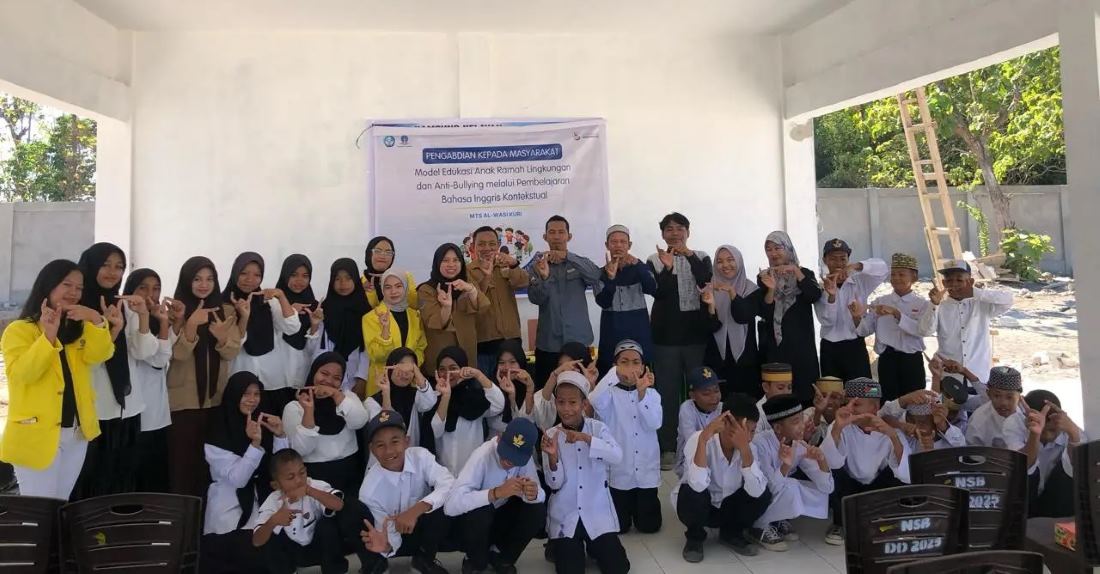
MAROS — Storybooks became the entry point for students at MTs Al-Wasi’ Kuri to learn English. However, the learning did not stop at the pages of a book. They were also invited to engage in discussions, play games, practice ways to respond to bullying, and take their lessons to a mangrove area located near their community.
The learning activities were part of a community service program (Pengabdian kepada Masyarakat – PkM) conducted by Universitas Terbuka (UT), titled “An Eco-Friendly and Anti-Bullying Child Education Model through Contextual English Learning,” in Dusun Kuri Caddi, Desa Nisombalia, Kabupaten Maros.
A total of 42 students from Grades VII to IX participated in the program, which involved UT lecturers, education staff, and students. The activities were conducted in three sessions on July 31, August 7, and August 14, 2026.
During the first session, students learned through bilingual storybooks featuring environmental and anti-bullying themes. They did not simply read the stories but also learned English vocabulary, engaged in discussions, worked together, and completed challenges through a mission-based play method.
Several simple expressions, such as “be kind,” “help your friends,” “stop bullying,” and “protect the environment,” were introduced through situations closely related to the students’ daily lives.
Head of the Universitas Terbuka PkM Team, Nuraziza Aliah, S.Pd., M.Pd., said that English learning could be used as a means of building character while fostering concern for the environment and others.
“Through this activity, we want to show that learning English does not have to be separated from children’s daily lives. The mangrove environment near them, along with the values of respecting others and having the courage to reject bullying, can become part of an enjoyable learning process,” she said.
According to Nuraziza, the program was expected not only to improve students’ English skills but also to build their confidence, environmental awareness, and respect for others.
The learning activities were then extended to teachers. On August 7, 2026, teachers received training on how to use bilingual storybooks through storytelling, games, shared reading, discussions, and simple activities that could be implemented in their classrooms.
The involvement of teachers was intended to ensure that the storybooks and learning methods developed through the PkM program could continue to be used after the series of activities had ended.
Principal of MTs Al-Wasi’ Kuri, Sapri, S.Pd., said the activity provided students and teachers with new experiences and knowledge in viewing English learning as an enjoyable process. One of the teachers who participated in the training also saw the story-based approach as an opportunity to connect English with other areas of learning.
The final session took students outside the classroom. On August 14, 2026, the mangrove area was used as an “outdoor classroom.” Students observed the environment directly and then connected their observations with English vocabulary and the environmental awareness messages they had previously learned.
Anti-bullying materials were also practiced through role-play activities. Students practiced responding to teasing, helping friends, using kind words, and having the courage to reject bullying behavior.
The approach combined Contextual Teaching and Learning, learning through play, storytelling, role-play, and experiential learning. Through this approach, English was not merely treated as a subject but also became a medium for introducing empathy, environmental awareness, the courage to reject bullying, and positive communication.
From storybooks to the mangrove area, the UT PkM program demonstrated how English learning can be brought closer to students’ everyday lives. This approach is in line with SDG 4 on Quality Education, particularly through relevant and inclusive learning that supports the development of both students’ knowledge and character. The program also contributes to SDG 13 on Climate Action by strengthening environmental awareness.