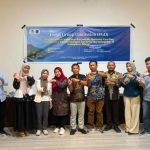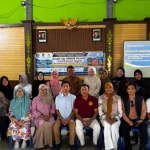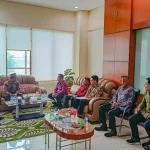

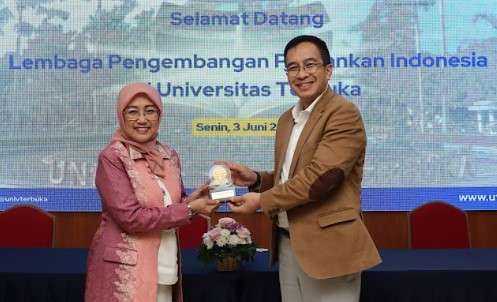
Tangerang Selatan (June 03, 2025) – Who says distance learning can’t be high-quality? Universitas Terbuka (UT) proves just the opposite—that innovation in learning systems can reach all corners of Indonesia while maintaining quality. This is precisely why the Indonesian Banking Development Institute (LPPI) chose UT as a benchmarking destination to explore best practices in the process of developing learning design, on Tuesday (June 3, 2025).
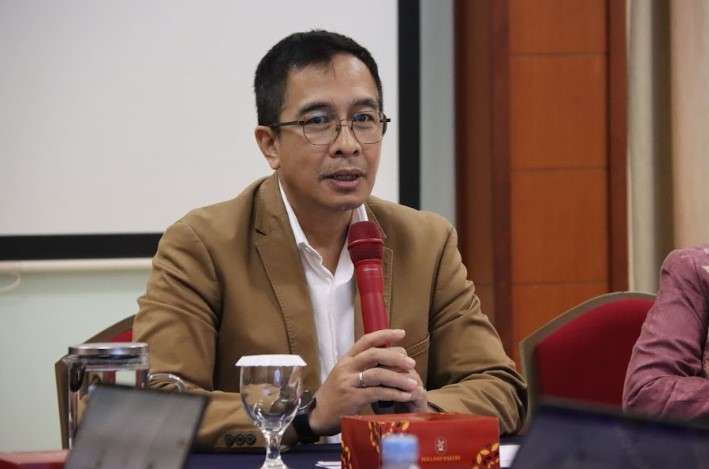
The activity took place in the Mahoni Room, Wisma 3 UT, and began with a welcome speech from the Acting Vice Rector for Research, Innovation, Cooperation, and Business at UT, Rahmat Budiman, S.S., M.Hum., Ph.D. In his address, he extended a warm welcome and profound gratitude to the LPPI delegation for visiting UT Central. Rahmat Budiman, Ph.D. also explained that UT is the only university in Indonesia without a physical campus, yet it has been a pioneer in distance education since 1984.
“UT was founded to address three main challenges at that time: the limited access to higher education, which was mostly available only in Java; the need for workers to be able to study without leaving their professions; and the government’s efforts to improve the qualifications of teachers, many of whom were still high school graduates,” revealed Rahmat Budiman, Ph.D.
With inclusive principles—no entrance exams, no dropouts, and affordable fees—UT provides a flexible and open educational solution for all Indonesian citizens. Supported by information technology infrastructure as its main backbone, UT develops an adaptive learning system, both through Package and Non-Package schemes, with quality assurance through nationally standardized exams and learning materials. Currently, UT has over 600,000 students and almost 800 lecturers, most of whom serve as tutors in various learning methods such as Face-to-Face Tutorials (TTM) and Online Tutorials (Tuton).
During its visit, LPPI stated that this activity was not merely a comparative study, but a collaborative study. “We learn from each other. LPPI learns from UT, and UT also learns from LPPI,” said Rahmar Budiman, Ph.D., emphasizing the importance of exchanging views and collaborating to build best practices.
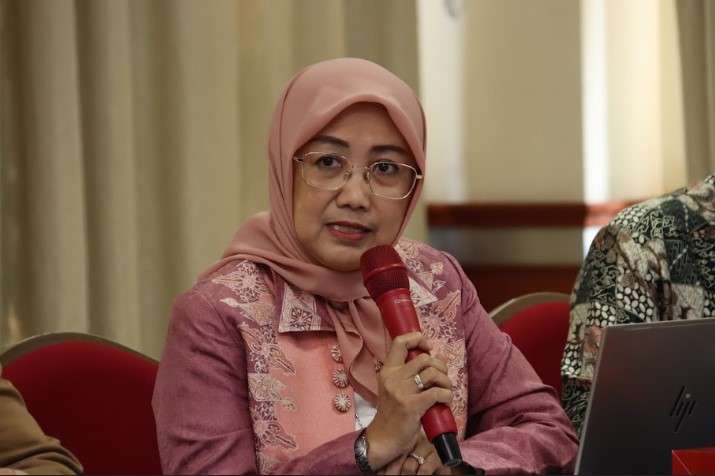
The event continued with remarks from the Director of LPPI, Retno Wahyuni Wijayanti. She expressed her immense gratitude for UT’s warm welcome, and briefly reviewed LPPI’s 66-year journey.
“In the last three years, LPPI has expanded not only in the banking sector but also ventured into the non-banking sector,” she stated. Retno also added that the challenges of post-pandemic learning prompted LPPI to learn from institutions accustomed to distance education, making UT a strategic choice. “We hope to build strong collaboration with UT in the future,” she concluded.
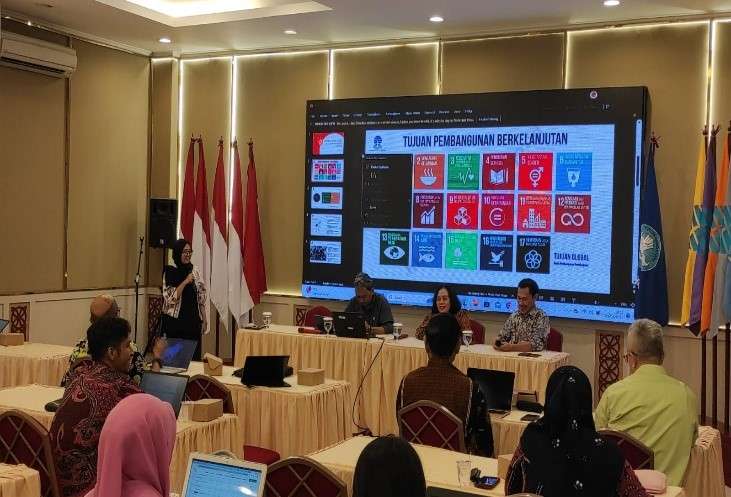
The main session of the event featured discussions with three speakers from UT. Prof. Aminudin Zuhairi, Ph.D., explained the essence of Distance Learning (PJJ); Dr. Muhammad Rif’an, S.T., M.T., elucidated UT’s information system; and Dimas Agung Prasetyo, S.Kom., M.Sc., presented on e-learning development within UT. UT explained how they integrate digital platforms, multimedia content management, and flexible learning systems. This approach enables students from various backgrounds, including those living in 3T (frontier, outermost, disadvantaged) areas, to continue learning actively and effectively.
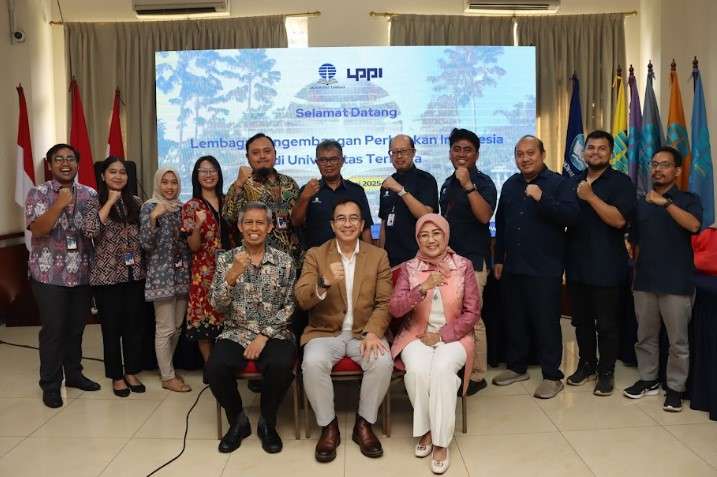
This benchmarking signifies both institutions’ commitment to continuously share best practices. For LPPI, this visit opened new insights into how technology can be maximized in designing quality training. In an era where learning is no longer confined to classrooms, UT proves that quality education can come from anywhere—as long as there is a strong vision, a solid system, and a spirit of collaboration. UT not only hosted this event but also became a source of inspiration for the future of learning in Indonesia.