
As a pioneer of Open and Distance Learning (ODL) in Indonesia, Universitas Terbuka (UT) continues to solidify its role in preparing generations to face rapid technological changes and global demands in today’s ever-evolving digital era. UT consistently maintains its high standards of education, and one concrete step is its accreditation at both national and international levels. In this regard, UT has once again demonstrated its dedication to world-class education through a remarkable achievement.
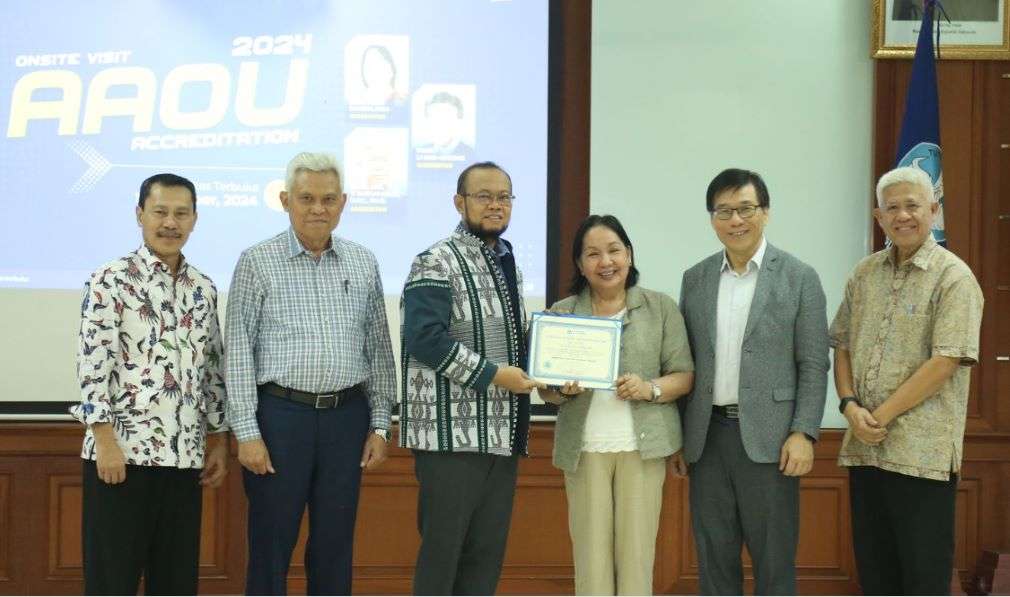
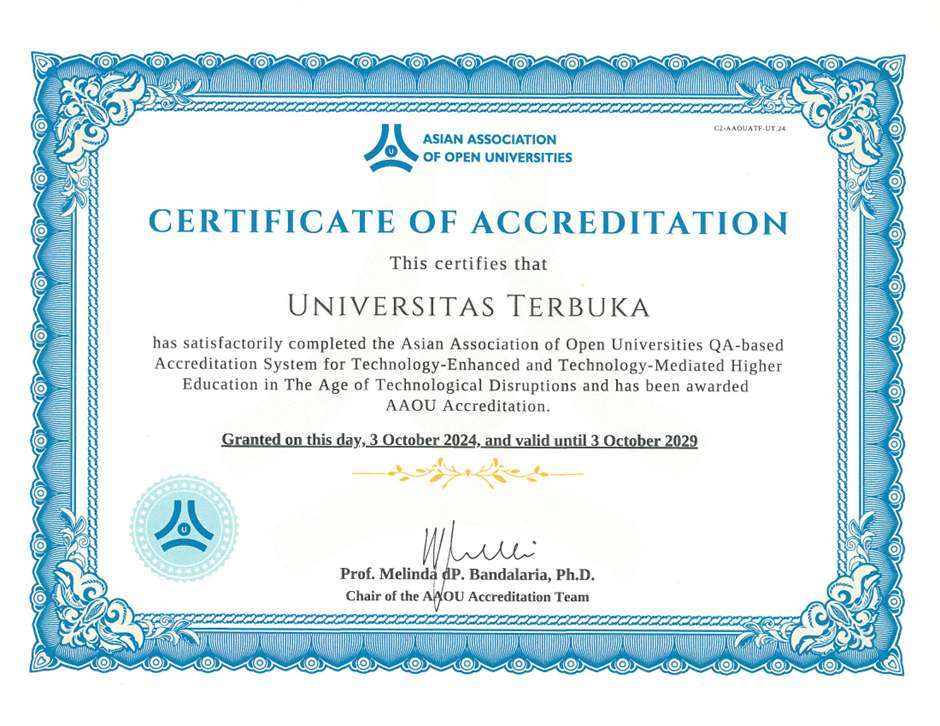
UT has just successfully earned the “Certificate of Accreditation” from the Asian Association of Open Universities (AAOU) on Thursday, October 3, 2024. This achievement confirms UT as one of the open higher education institutions with international standards in Asia and proves its excellence in providing superior distance learning education services.
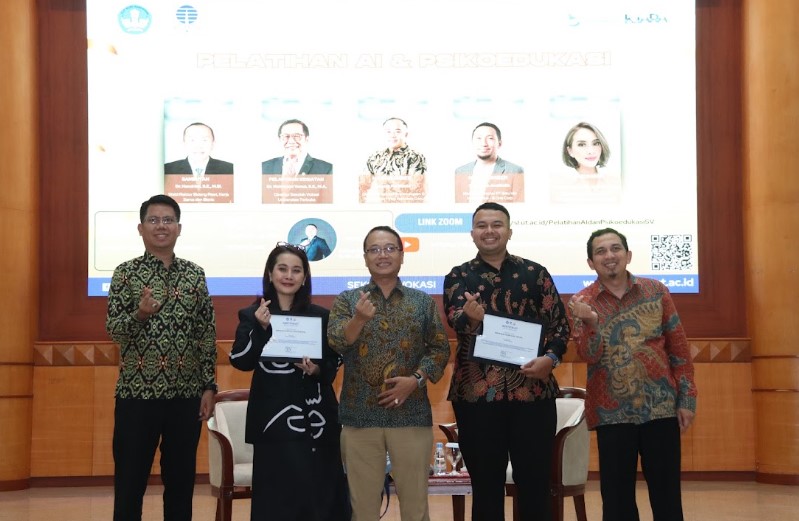
The certificate was handed directly to the UT Rector by Prof. Melinda dP Bandalaria, Ph.D., as the Chair of the AAOU Accreditation Team. This achievement marks a historic moment, as the certificate is the first issued by the AAOU Accreditation System Board, signifying that UT is not only recognized nationally but also has solid international recognition. UT has successfully implemented the high standards required by the AAOU, making it a pioneer of distance education in Indonesia recognized globally. AAOU itself is a non-profit organization consisting of higher education institutions focused on open and distance learning, which aligns with UT’s system.
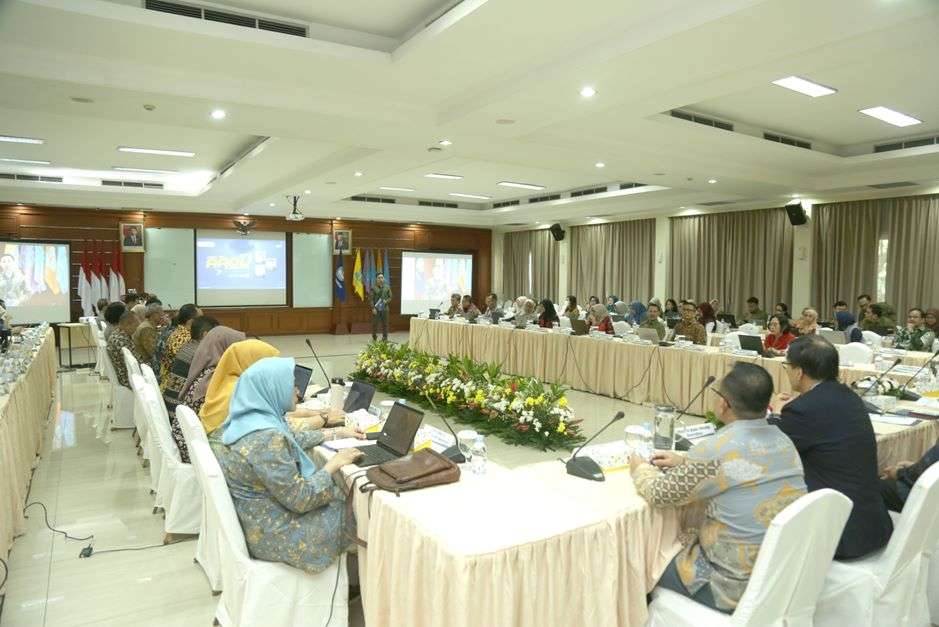
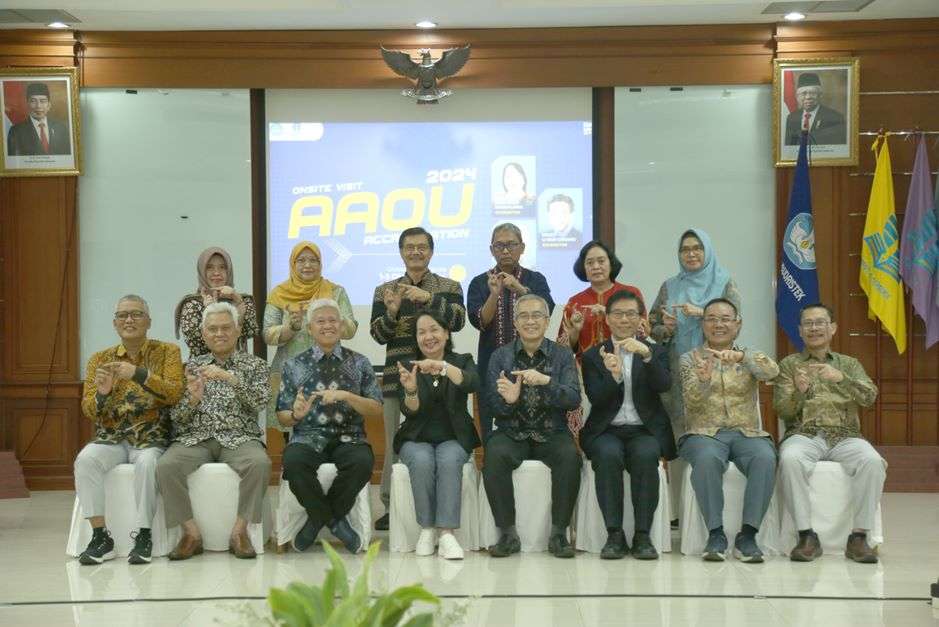
UT’s accreditation process by AAOU took place over three (3) days, beginning with a site visit conducted at UT Central and UT Bogor from Monday, October 1, 2024, to Thursday, October 3, 2024, by the AAOU Accreditation Team, which included Melinda dP Bandalaria (Chair, Chancellor of the University of the Philippines Open University), Prof. Li Kam Cheong (Member, Hong Kong Metropolitan University), and Prof. Drs. T. Basaruddin, M.Sc., Ph.D. (Member, University of Indonesia, Executive Board of BAN-PT).
Obtaining this accreditation certificate is strong evidence that an “internal quality assurance system” is indispensable, as stated by UT Rector, Prof. Ojat Darojat, M.Bus., Ph.D. “Quality is the only way forward for UT to provide the best service to the community and the nation,” emphasized Prof. Ojat. He also stressed the importance of a continuous quality assurance system through SIMINTAS (Integrated Internal Quality Assurance System), which is implemented at all levels and units of UT, both centrally and regionally. With this system, UT can maintain consistency in providing high-quality, inclusive, and flexible education.
In his speech, Prof. Ojat elaborated that with this accreditation achievement, UT demonstrates its excellence in digital and educational technology through the application of the Distance Learning System (PJJ). “UT continues to innovate in providing flexible, easily accessible, and high-quality learning services. This accreditation is concrete proof that UT can keep up with rapid technological changes and meet the needs of students in the digital era,” said Prof. Ojat.
With this accreditation, UT stands on par with other leading open education institutions in Asia, such as the Open University of Malaysia (OUM) and the University of the Philippines Open University (UPOU), which also obtained accreditation in this program. UT has demonstrated its commitment to providing high-quality education for all levels of society, without the constraints of space and time.
The new AAOU accreditation system assesses institutions based on four levels, from Level-1 to Level-4, with each level measuring how far an institution has applied, created, and shared knowledge and innovation in distance education. Level-1 is awarded if an institution or university has knowledge and awareness of Distance Education and/or technology-mediated education. Level-2 is awarded if an institution or university has applied or used Distance Education and/or technology-mediated education. Level-3 is awarded if an institution or university has applied and has the initiative/creativity to create something “new” (application and creation) in the form of technology for Distance Education and/or technology-mediated education. Level-4 is awarded if an institution or university has applied, has the initiative/creativity to create something “new” in the form of technology, and has a culture of sharing, collaboration, and partnership in distance education and/or technology-mediated education. UT was assessed to have reached Level-3, where UT has been able to create new innovations in distance education technology while also supporting a culture of sharing and collaboration.
During the accreditation process, UT was evaluated based on 10 quality criteria (quality areas), which included internal management, learner support, infrastructure, and curriculum development. These 10 criteria were observed and empirically verified by the accreditation expert team to ensure that they are consistently and regularly implemented at all levels and across all UT units, both centrally and regionally.
These 10 quality criteria refer to the AAOU Quality Assurance Framework, which includes: Policy and Planning; Internal Management System; Learners and Learners’ Profiles; Infrastructure, Media, And Learning Resources; Learner Assessment and Evaluation; Research and Community Services; Human Resources; Learner Support; Program Design and Curriculum Development; and Course Design and Development. Furthermore, these 10 quality areas are identified from four (4) quality dimensions: Agility (covering indicators of flexibility, responsiveness, adaptability, timeliness, and relevance); Equity (covering indicators of comprehensiveness, inclusiveness, impartiality, fairness, and accessibility); Sustainability (covering indicators of consistency, resiliency, innovativeness, progressiveness, and creativity); and Excellence (covering indicators of efficiency, effectiveness, distinctiveness, and outstanding).
With the accreditation from AAOU, UT is now better prepared to face future challenges in the field of distance education. UT further solidifies its position as a pioneer in distance education in Asia. This achievement also serves as concrete proof that digital innovation and a commitment to educational quality can have a significant impact, not only for the institution and students but for the broader education world as well. This accreditation is not just a recognition but also a motivation for UT to continue its continuous improvement efforts in delivering the best for its students and making a positive impact on the education sector.