
Raha, Muna – Muna has long been recognized for its rich tourism potential. Its natural landscapes, historical heritage, cultural traditions, and local wisdom provide a strong foundation for becoming one of the leading tourist destinations of Sulawesi Tenggara. However, these assets cannot reach their full potential without integrated planning and cross-sector collaboration. Driven by this shared vision, Universitas Terbuka (UT) initiated a multi-stakeholder discussion to formulate a sustainable tourism development strategy rooted in local wisdom.
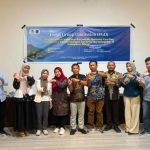
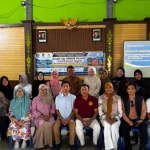
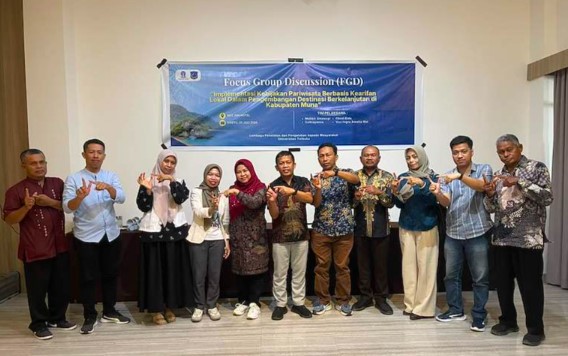
A Focus Group Discussion (FGD) titled Implementing Local Wisdom-Based Tourism Policies for Sustainable Destination Development in Kabupaten Muna, Sulawesi Tenggara was held in Raha, Kabupaten Muna, on July 25, 2026. The event formed part of a research project led by Mohbir Umasugi, S.Sos., M.AP., in collaboration with Dr. Obed Bida, S.Sos., M.P.A., Dr. Vivi Indra Amelia Nasution, S.I.P., M.A., and Sultrayansa, S.I.K., M.I.Kom.
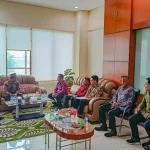
The FGD brought together representatives from the Regional Development Planning Agency (Badan Perencanaan Pembangunan Daerah – Bappeda), the Tourism and Creative Economy Office, the Environmental Office, the Transportation Office, the Public Works Office, and tourism industry stakeholders from Hotel Ness and Hotel Mutiara. Together, participants developed policy recommendations aimed at strengthening the sustainable development of tourism based on local wisdom.
UT Research Team Leader Mohbir Umasugi emphasized that the study reflects Universitas Terbuka’s commitment to producing evidence-based policy recommendations capable of making meaningful contributions to tourism development in Kabupaten Muna.
This view was reinforced by Dr. Obed Bida, who stressed that tourism development should not rest solely on the Tourism Office. According to him, policy implementation will be far more effective when supported by synergy among all government agencies through cross-sector collaboration.
During the discussion, Bappeda of Kabupaten Muna explained that tourism development has been incorporated into the region’s Medium-Term Regional Development Plan (RPJMD), with sustainability serving as its guiding principle. The local government is also coordinating with Indonesia’s Ministry of National Development Planning (Bappenas) to promote Muna Island as a future Geopark. Meanwhile, the Transportation Office outlined plans to develop integrated tourism areas focused on improving accessibility, visitor comfort, and travel safety. From an environmental perspective, the Environmental Office highlighted the importance of effective waste management, sanitation facilities, and community education as essential pillars of sustainable tourism.
Adding another dimension to the discussion, Dr. Vivi Indra Amelia Nasution encouraged participants to embrace the narrative of “Mai Te Wuna” as Kabupaten Muna’s tourism identity. She explained that the region possesses a complete range of attractions, including prehistoric heritage, colonial history, Jati Island as a regional symbol, dramatic karst landscapes, marine tourism, and a rich cultural legacy rooted in local wisdom. The challenge, she noted, is no longer discovering new attractions but mapping these existing assets comprehensively so they can function together within an integrated tourism ecosystem that benefits local communities.
The tourism industry also contributed valuable recommendations. Hotel Mutiara Wisata proposed developing Liangkobori into an integrated tourism area that connects surrounding cultural attractions and destinations. Meanwhile, Hotel Ness advocated for strengthening the “Cinta Nusantara: Wuna Wite Barakati” movement by empowering Tourism Awareness Groups (Kelompok Sadar Wisata or Pokdarwis) as community-based drivers of tourism development.
UT’s experience in community empowerment further enriched the discussion. Sultrayansa explained that the university’s community service initiative, “One Day, One Student, One Content,” successfully increased the online visibility of Meleura Beach. The experience demonstrated that youth engagement through digital promotion can become a powerful tool for introducing Kabupaten Muna’s tourism potential to wider audiences.
The FGD concluded that Kabupaten Muna possesses strong natural, cultural, and social assets to develop into a competitive tourism destination. Going forward, these assets should be connected through sustainable planning, collaborative governance, stronger Tourism Awareness Groups (Pokdarwis), and improved public literacy. These efforts are aligned with the Sustainable Development Goals (SDGs), particularly SDG 11 (Sustainable Cities and Communities) by promoting sustainable regional development and SDG 17 (Partnerships for the Goals) through cross-sector collaboration to accelerate regional progress.