
Starting the year 2024, Universitas Terbuka (UT) is making a fresh breakthrough. As a manifestation of the implementation of Merdeka Belajar Kampus Merdeka education policy, Universitas Terbuka continues to innovate to address the challenges of the development of science and technology to bring out quality graduates ready to compete in the professional world, both national and global scales. One creative form and innovation of Universitas Terbuka is the launch of new study programs to meet the need of the communities.
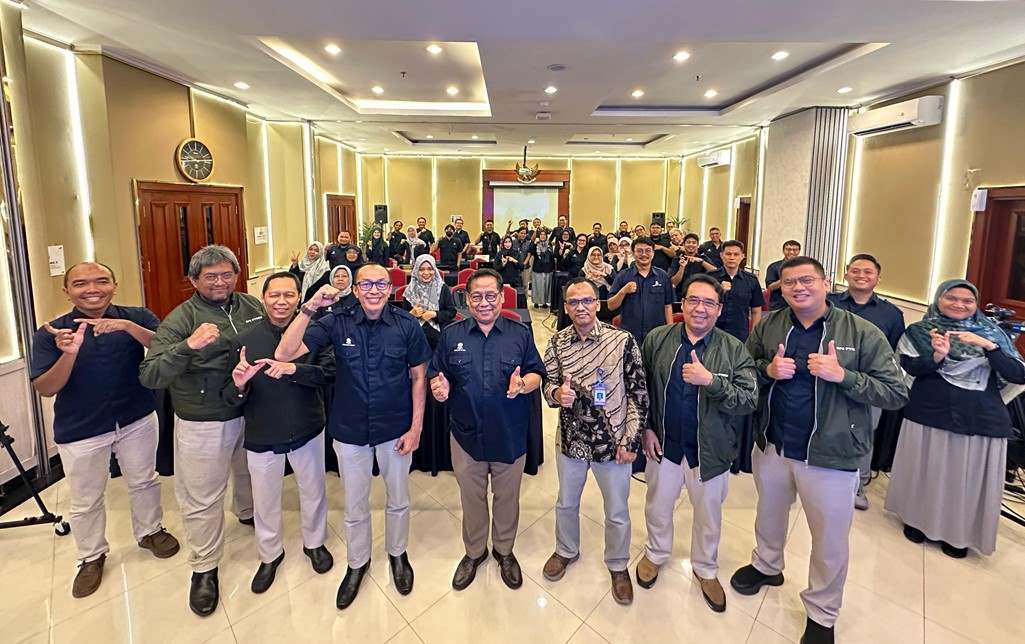
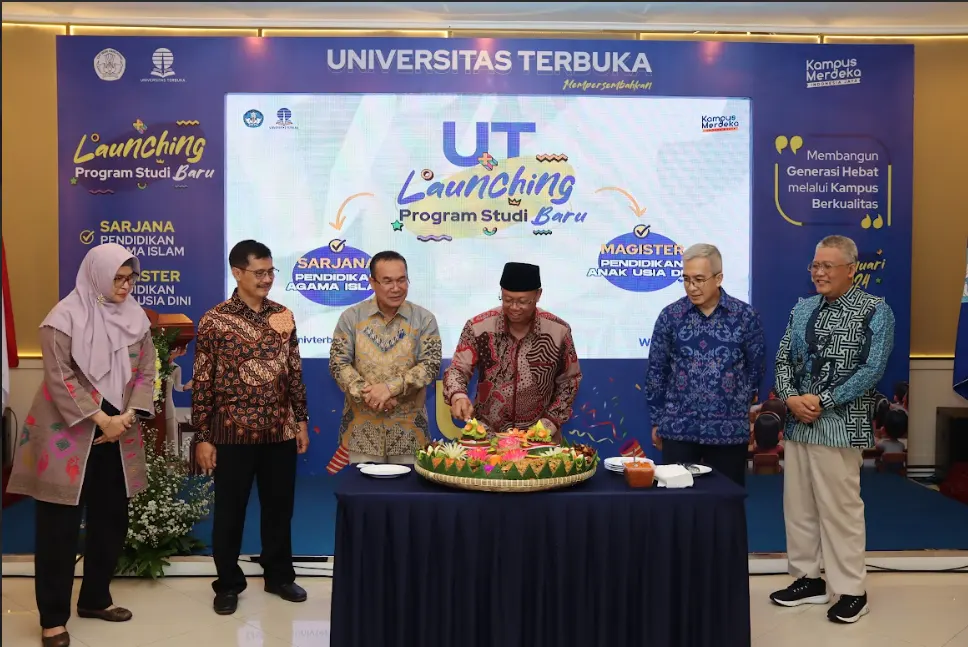
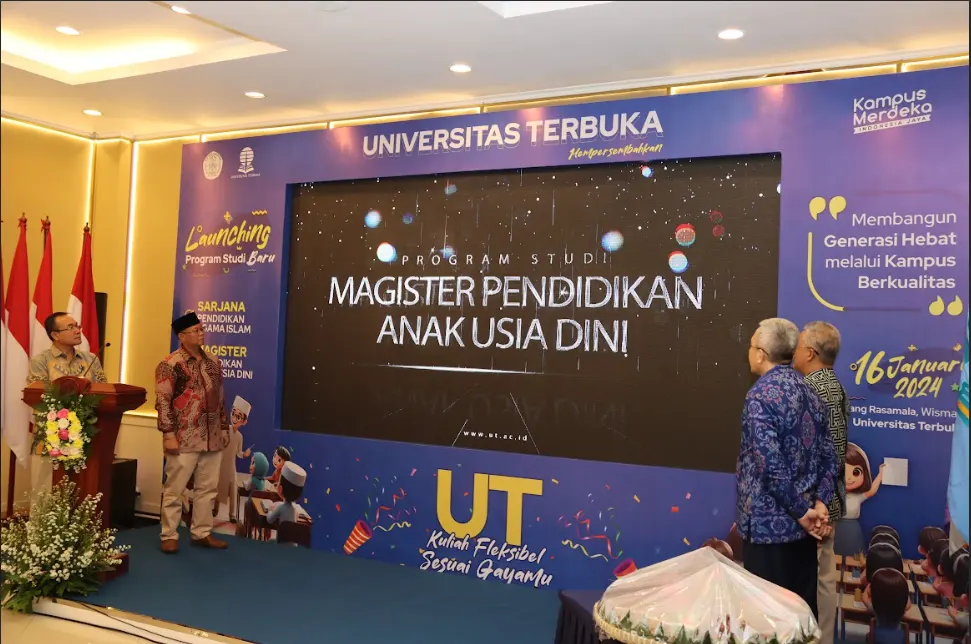
On January 16, 2024, the launch event for two new study programs at Universitas Terbuka took place. These programs are the Islamic Education program (PAI) for the Bachelor’s degree and the Early Childhood Education Master’s Program (MPAD). The event was held both in-person at the Rasamala Room, Wisma II, Universitas Terbuka, and virtually through a Zoom meeting. The event was attended by the Rector of Universitas Terbuka, Vice Rector for Information Systems and Student Affairs, Vice Rector for Research, Innovation, Cooperation, and Business, Chairman of the Board of Trustees, Chairman of the Academic Senate, Head of the Research and Community Service Institute (LPPM), Deans, Director of the Postgraduate School, Director of Central and Regional UT, as well as leaders within Universitas Terbuka. Additionally, the event was attended by several officials, including the Chairwoman of the Indonesian Kindergarten Teachers Association (IGTKI), Mrs. Nur Sriyati, S.Pd, MM, the Chairman of the Indonesian Early Childhood Education Teacher Association (APGPAUD), and the General Treasurer of the Independent Accreditation Institute for Education (LAMDIK), Prof. Dr. Sofia Hartati, M.Si, and Deputy Secretary of the Association of Islamic Education Study Programs (PP-PAI), Dr. Busahdiar, M.A.
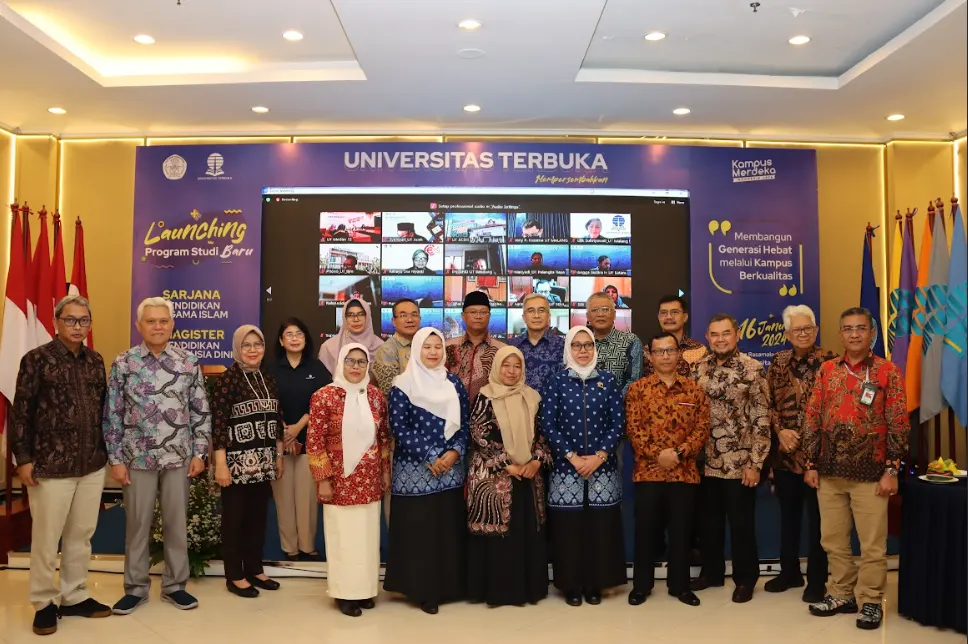
The opening of the new study programs is based on the Ministry of Education, Culture, Research, and Technology Regulation No. 53 of 2023 concerning Quality Assurance of Higher Education and the approval of the Universitas Terbuka Senate. From the result of the initial study, a significant number of respondents showed their interest in studying at Universitas Terbuka. Reasons included UT has acquired international certification for the quality of distance higher education services (PTJJ) and national accreditation for excellent study programs. Moreover, many individuals are attracted to pursuing higher education at Universitas Terbuka due to its academic services and the quality of instructors.
As the 45th State University, Universitas Terbuka has demonstrated extraordinary contributions to education in Indonesia. Universitas Terbuka also carries out the main mission and mandate from the government, which is to provide quality higher education access to all layers of society, symbolized by the motto,
“Making Higher Education Open to All.”
Indeed, this motto is not just a slogan, but a foundation for Universitas Terbuka to continue creating and innovating in delivering the best services in Distance Higher Education (PTJJ).
Furthermore, Universitas Terbuka has achieved a remarkable milestone. On October 20, 2022, Universitas Terbuka officially transformed into a State University with Legal Entity (PTN-BH), previously known as a Public Service Agency higher education (BLU). This transformation is a proud accomplishment for Universitas Terbuka as it now stands alongside other top State Universities in Indonesia that had previously obtained PTN-BH status. Apart from that, by officially holding the PTN-BH status, Universitas Terbuka has broader autonomy, including the authority to open new study programs.
With its current status, Universitas Terbuka seizes the valuable opportunity without hesitation. After thorough studies and processes, Universitas Terbuka has made history by launching two new study programs for the first time since obtaining PTN-BH status. This achievement is surely the result of the hard work and dedication of various parties, both internally and through collaborations with partners.
Currently, the new study programs include the following details:
The Bachelor’s Program in Islamic Education (PAI) is open to all UT regions.
The Master’s Program in Early Childhood Education (MPAD) starts with the opening in five UT regions: UT Bandar Lampung, UT Bandung, UT Denpasar, UT Jember, and UT Semarang.
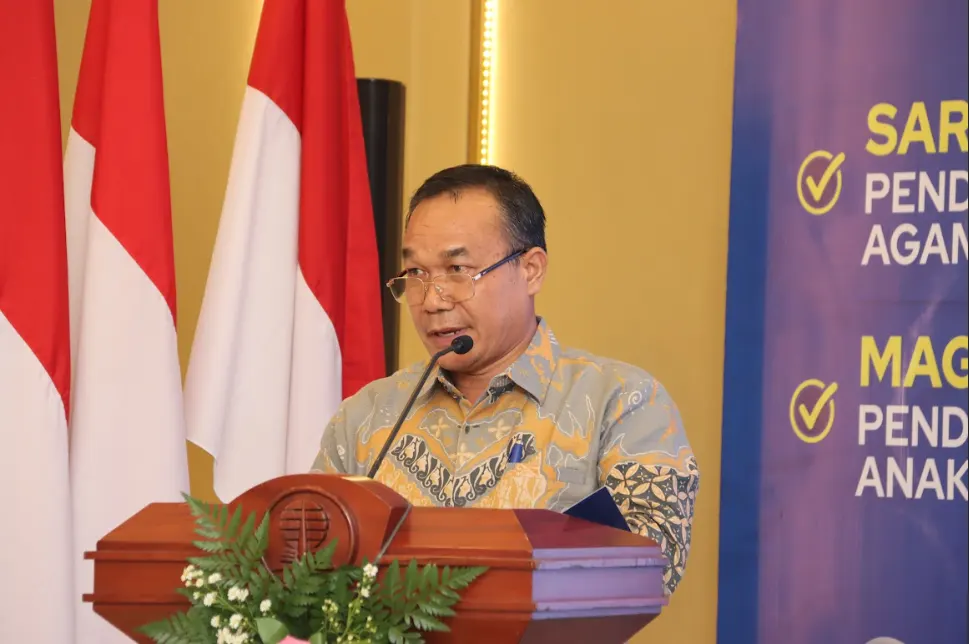
In his report, Vice Rector III, Prof. Paken Pandiangan, explained that MPAD is designed as a master’s program with its unique and excellent study program in five curriculum areas: namely, Curriculum and Learning Development, Child Development, Management, Policy Analysis, and Distance Learning. Regarding sample lesson content for teaching, Prof. Paken stated that UT offers several courses that will develop the skills of teachers and students, contributing to the branding of Early Childhood Education. “Some of the courses to be taught include Innovation Diffusion in Education based on the PTJJ context, supporting the profiles of Consultants & Managers of Early Childhood Education. There is also a Comparative Study of Early Childhood Education that brings in lecturers from partner countries and allows foreign students to take the course. Collaboration has been established with Universiti Teknologi Mara Malaysia (UiTM),” said Prof. Paken.
Furthermore, Prof. Paken conveyed that the basis for opening the Master’s in Early Childhood Education program (MPAD) is based on feasibility study and public demand, particularly from the Indonesian Kindergarten Teachers Association (IGTKI)-PGRI. The association formally requested UT Rector to open the MPAD program, as evidenced by a letter dated April 18, 2017. This request was followed by the signing of a Cooperation Agreement with IGTKI on August 6, 2018, regarding the implementation of the Bachelor’s and Master’s programs in Early Childhood Education at UT.
According to data, the number of graduates from PGPAUD-UT from 2017 to 2023 is 49,401, with the majority not continuing to the Master’s level. Whilst, based on BAN-PT data, there are 149 Bachelor’s Programs in Early Childhood Education (PGPAUD/PIAUD) in Indonesia, but only 13 Master’s Programs in Early Childhood Education (PGPAUD). Therefore, UT plays a strategic role in responding to the community’s desire to improve the qualifications of Early Childhood Education Teachers. UT experience in organizing the Bachelor’s Program in Early Childhood Education, which has received an A accreditation, serves as the foundation for providing a quality Master’s Program in Early Childhood Education. The goal is to produce graduates capable of analyzing various issues in early childhood education with a holistic, integrative, and innovative approach to support continuous education for the realization of the golden generation.
Moreover, the initiation of the Islamic Education program (PAI) was rooted in the preliminary findings that prospective students were inclined towards PAI due to the demand for PAI teachers in madrasah/school, the scarcity of Islamic educators with a technology-based background, and the high number of Islamic boarding school alumni compelled to choose majors beyond their interests.
In response to these initial study, Universitas Terbuka introduced the Bachelor’s Program in Islamic Education (PAI) with unique features. The program aims to produce graduates capable of confronting the challenges and realities of the modern world with deep and connected understanding. Apart from that, the strengths of the PAI Bachelor’s Program at Universitas Terbuka include cultivating a positive attitude towards lifelong learning and independence, integrating information and communication technology in education, demonstrating information literacy skills, and developing media, tools, and teaching materials to the students. Currently, the preparation for the new study program has been well-coordinated, encompassing Human Resources (HR), Tuition Fees (Uang Kuliah Tunggal/UKT), systems, admissions and registrations, teaching materials, learning, assessment, promotional socialization, student involvement in community service, provision of references, and learning resources.
During the launch of these two new study programs, Prof. Sofia Hartati, the Chairperson of the Association of Early Childhood Education Study Programs (APGPAUD), warmly welcomed the introduction of the Master’s Program in Early Childhood Education (MPAD) at Universitas Terbuka. This development brings a new spirit that will enrich the competencies and skills of Early Childhood Education teachers in Indonesia. “Our association expresses sincere gratitude because this adds another member to the group that consistently strives to enhance the quality of Bachelor’s, Master’s, and Doctoral curricula to ensure continuity. We will continue to oversee and assist in promoting it to various Early Childhood Education institutions in districts/cities across the 34 provinces,” she said.
Meanwhile, Dr. Busahdiar, the Deputy Secretary of the Association of Islamic Education Study Programs in Indonesia (PP-PAl Indonesia), stated that, until now, the number of Islamic Education Study Programs (Prodi PAI) in Indonesia is nearly 500. However, the demand continues to grow, in line with the increasing importance of religious education in shaping the character and ethical values of society. “So, I think it’s not enough because there is still evidence that many alumni from Islamic boarding schools have not been absorbed into higher education. This is a great opportunity to realize good values. Islamic education is crucial, especially in activities related to ethical learning as a common goal. We hope UT can design its teaching methods so that ethics are not left behind in the learning process,” explained Dr. Busahdiar.
Regarding the curriculum, Prof. Ojat Darojat, the Rector, explained that the curriculum will be implemented in the two study programs was designed by practitioners in the field, including representatives from the Ministry of Education, Culture, Research, and Technology (Kemendikbud Ristek) and the Ministry of Religious Affairs as well as Professional Associations. “The curriculum and learning content of PAI study program will be designed collaboratively by experts from the ministry according to community needs. Likewise, in developing the content in the modules and the main material books, it will be designed by experts in the field. To strengthen the learning system, experts in media were enlisted to transform and convert the content into teaching materials suitable for distance learning.
In his concluding remarks, Prof. Ojat Darojat expressed his hope that hopefully the launching of MPAD and the PAI Bachelor’s Program would bring many benefits to UT and the community. Meanwhile, Prof. Paken Pandiangan, in the final part of his report, emphasized that, in line with UT current situation, the university would continue to innovate to realize higher education programs for all subsequently. In the current circumstances, Universitas Terbuka primary focus includes expanding the reach of its services to serve communities in all regions, especially those with limited access to education.