
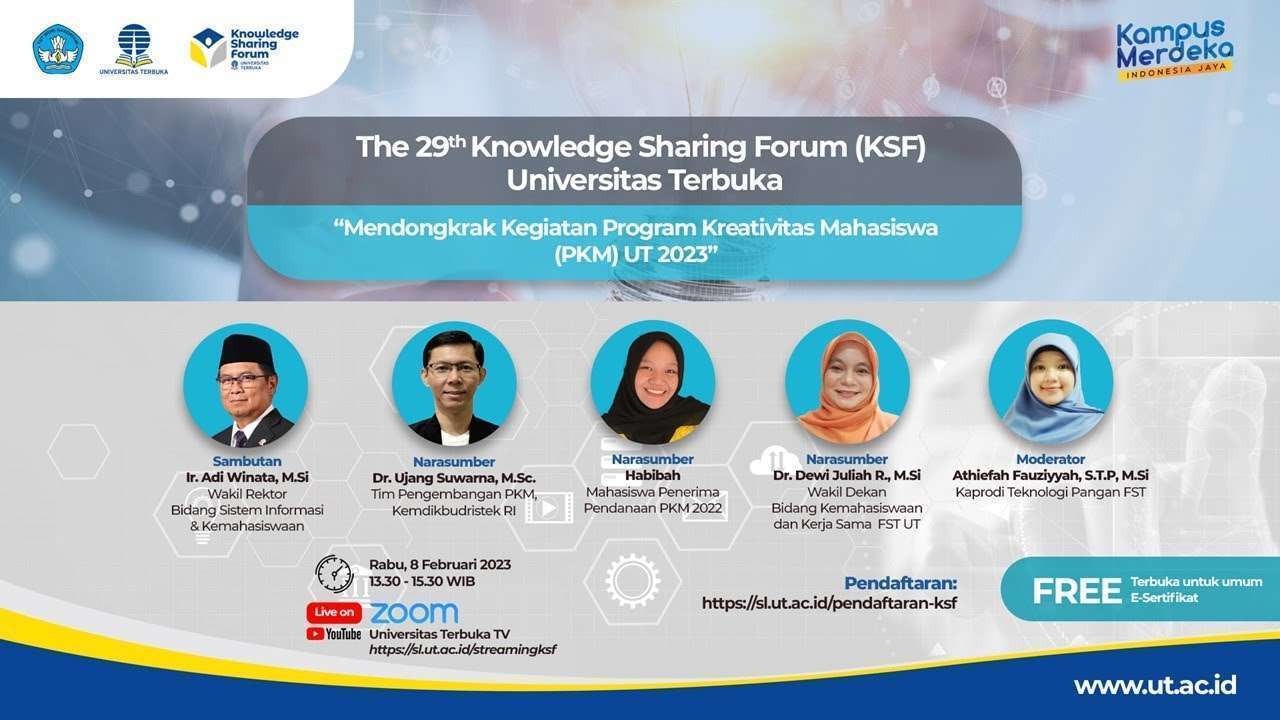
On Wednesday, 08/02/2023, Universitas Terbuka (UT) once again successfully held its 29th Knowledge Sharing Forum (KSF). This KSF focused on the theme “Jacking Up the Universitas Terbuka’s Students Creativity Programs (PKM UT) 2023.” This forum presented the members of the Development Team of the Students Creativity Programs (PKM) and Capacity Building Programs of University Student Organizations, Directorate of Learning and University Students, Ministry of Education Culture Research and Technology (Ormawa Ditbelmawa Kemendikbudristek). Dr. Ujang Suwarna, M.Sc., Deputy Dean for Student Affairs and Partnership, Faculty of Science and Technology, UT, Dr. Dewi Juliah Ratnaningsih, S.Si., as well as Habibah Febrianti, UT’s undergraduate student of Food Technology, served as presenters. The forum was also attended by UT’s Vice Rector for Information System and Student Affairs, Ir. Adi Winata, M.Si., who gave his remarks. The event was broadcast via live streaming on the YouTube UT-TV channel, with more than 320 people watching the program.
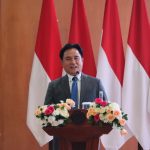
The forum began with remarks from UT’s Vice Rector for Information System and Student Affairs, Ir. Adi Winata, M.Si. He stated that UT provides students with academic skills and knowledge and focuses on developing their non-academic skills through various student activities to enhance their soft skills. Considering the shift in UT’s student characteristics, with the majority being young students under 25 years old, Adi Winata emphasized UT’s efforts to accommodate student affairs and improve their talents, interests, and reasoning. UT does this through the Student Creativity Program (Program Kreativitas Mahasiswa or PKM). Adi Winata highlighted that UT students have been actively participating in PKM in recent years, with some of them even receiving funding. He expressed the hope that this KSF would increase the number and improve the quality of proposals for Student Creativity Programs (PKM) in various fields of study.
The first presenter at the forum was Dr. Ujang Suwarna, M.Sc., a member of the Development Team of the Students Creativity Programs (PKM) and Capacity Building Programs of University Student Organizations, Directorate of Learning and University Students, Ministry of Education Culture Research and Technology (Ormawa Ditbelmawa Kemendikbudristek). He emphasized that PKM aims to nurture and realize students’ creative ideas and innovations. Dr. Ujang Suwarna briefly explained the stages of the PKM process, starting from generating ideas and developing and documenting them into PKM proposals. Subsequently, the proposals can be funded, the programs implemented, and progress assessed through the Progress Implementation Assessment (Penilaian Kemajuan Pelaksanaan PKM or PKP2) by the Directorate General of Higher Education (Monev Dikti). Participating in the National Student Scientific Event (Pekan Ilmiah Mahasiswa Nasional or PIMNAS) is the pinnacle of achievement. He shared tips for success in the Student Creativity Programs – National Student Scientific Event (PKM-PIMNAS), including having creative, innovative, and applicable ideas, error-free proposals, competent and committed teams, and capable program advisors (lecturers) aligned with the proposed programs.
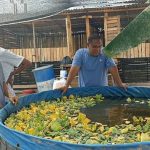
Habibah Febrianti, an undergraduate student in Food Technology at UT, had the opportunity to share her experience. Habibah and her PKM team successfully promoted “Diskies,” a healthy cookie alternative for treating dysentery. They started from the initial stages and received PKM funding in 2022. Habibah’s interest and focus on dysentery led her to conduct multiple trials under the supervision of UT’s Food Technology lecturers, ultimately finding the exact formula for the “Diskies” cookies. She concluded her presentation by sharing tips and tricks, hoping that more UT students would obtain funding for student creativity programs (PKM) and qualify for PIMNAS. Habibah emphasized the importance of maintaining good communication among team members, adopting a proactive approach, regularly consulting advisory lecturers, and evaluating the team’s shortcomings. She advised adhering to PKM rules and guidelines while keeping the faith.
The last presenter, Dr. Dewi Juliah Ratnaningsih, S.Si., Deputy Dean for Student Affairs and Partnership, Faculty of Science and Technology, UT, provided her insights. She highlighted that PKM aims to prepare students as superior graduates who are competitive, adaptive, flexible, productive, and highly competent. Dr. Dewi Juliah, an academician and managing officer on student affairs, explained the stages of UT’s student management. The university conducts socialization on PKM to students, as exemplified by this KSF. Then, the faculty socializes PKM to the departments and identifies the topics for student creativity programs (PKM). The department appoints and assigns advising lecturers or advisors aligned with the program’s topics, conducting intensive advisory tasks.
Throughout each stage, the KSF provides information and disseminates knowledge in various fields. By focusing on the PKM theme, the KSF offers valuable insights for students, who are expected to be competent in both academic and non-academic aspects. UT is committed to facilitating its students’ development to create graduates who are not only academically proficient but also possess broad knowledge, creativity, innovation, and a willingness to serve their communities.