
BANJARMASIN — Having a good idea is not enough to win an essay competition. An idea needs to be presented in strong writing, with a clear point of view and the ability to capture readers’ attention from the very first sentence.
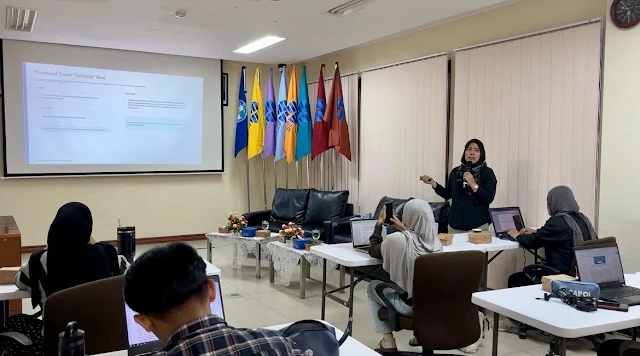
This is the ability that Universitas Terbuka (UT) Banjarmasin strengthened through an Essay Writing Training for students of the Bachelor’s Degree Program in Public Administration. Held in the Tutorial Room on the second floor of the UT Banjarmasin Office on Saturday, September 26, 2026, the activity was aimed at equipping students to participate in essay competitions at both national and international levels.
Deputy Dean for Finance, Resources, and General Affairs (Deputy Dean II) of the Faculty of Law, Social and Political Sciences (FHISIP) at UT, Yanti Hermawati, S.So.I., M.Si., said that strengthening students’ abilities to achieve accomplishments is part of the efforts to develop an Excellent Study Program.
“The students participating in this face-to-face training are selected students. Previously, they had participated in online training to prepare their manuscripts. So, today’s activity is a refinement process so that their writing can be improved further and is ready to be submitted to competitions,” Yanti explained.
According to Yanti, writing skills can also provide opportunities for students to achieve accomplishments outside the academic field. Therefore, students are encouraged to become more confident in developing their abilities and producing work that can compete in competitions.
During the training, students received direct guidance from writing experts, one of whom was Dr. Nur Ambia, M.A.P., a lecturer in UT’s Bachelor’s Degree Program in Public Administration. He explained that a good essay needs to have three main structures: an introduction, a body, and a conclusion.
However, structure alone is not enough. Students were also encouraged to understand how to create writing capable of attracting the attention of judges.
Nur emphasized the importance of addressing current and crucial issues while offering innovative solutions. These solution ideas can even become a key strength in determining the essay title.
“The innovation in the solution can be used as the title. The title must be interesting and clearly show the problem as well as the proposed solution. In addition, the opening sentence in the introduction is crucial. If the opening sentence is not interesting enough and the judges do not get the writer’s point of view, the manuscript will immediately be skipped. It must be able to capture the reader’s attention from the very first sentence,” he explained.
The material then became practical guidance for students to improve the manuscripts they had prepared. Thus, the training not only taught students how to write essays but also how to develop ideas so that they would be stronger and more competitive when submitted to competitions.
For students, these skills also offer longer-term benefits. Hami Maulidia, a sixth-semester student of Public Administration at UT Banjarmasin, said that the training provided her with new knowledge that could be applied directly.
“We learned how to write essays properly so that we can later participate in national or international competitions. Besides supporting our achievements, training like this is very useful for us, especially final-semester students, as preparation for writing academic works in the future,” Hami said.
She hopes that UT Banjarmasin will continue to organize similar training sessions and webinars so that students have more opportunities to develop their capacities.
Through this activity, students’ writing skills are directed not only toward producing works that meet academic requirements but also toward providing them with the ability to convey ideas, participate in competitions, and develop achievements on a broader scale. Efforts to develop student capacity through such training are also in line with the Sustainable Development Goals (SDGs), particularly SDG 4 on Quality Education, through strengthening competencies, developing potential, and increasing students’ capacity to produce quality works and ideas.