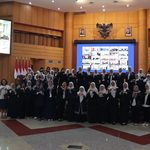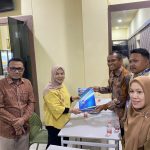

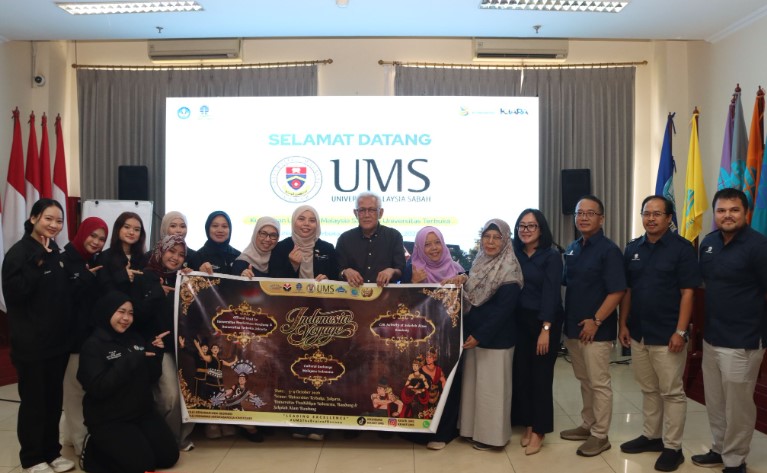
TANGERANG SELATAN — Universitas Terbuka (UT)’s experience in managing distance education (PJJ) has become a reference for Universiti Malaysia Sabah (UMS) in developing its digital learning system. This emerged during a visit by a UMS delegation to UT Central Office in Pondok Cabe, Tangerang Selatan, on Tuesday (October 6, 2026), as part of a benchmarking visit and an exploration of collaboration in the field of distance education.
The UMS delegation, led by Dr. Nurul and accompanied by six students, was welcomed by UT leadership. Also present were Head of International Relations at UT Ing. Mohamad Rajih Radiansyah, B.AS., M.Sc., Expert Staff for Cooperation Cynthia Ayu Manggarani, S.E., M.Sc., education technology expert Prof. Dr. R. Benny Agus Pribadi, M.A., as well as Vice Deans for Student Affairs, Learning Services, and Cooperation from the Faculty of Science and Technology (FST), the Faculty of Law, Social and Political Sciences (FHISIP), and the Faculty of Teacher Training and Education (FKIP).
For UMS, the meeting was an important opportunity to learn from UT, which has been conducting distance education fully and for a longer period. Meanwhile, for UT, the forum opened broader opportunities to build academic networks with higher education institutions in Malaysia.
UT International Affairs Manager, Ing. Mohamad Rajih Radiansyah, welcomed the visit. According to him, the meeting provided an opportunity for UMS to directly observe UT’s experience in developing and managing a technology-based distance education system.
“We are very pleased to initiate this collaboration. UMS students can directly see how we manage distance education operations based on modern technology,” Rajih said.
Meanwhile, for UMS, which is currently developing its Open Distance Learning (ODL) system, Dr. Nurul said that UMS wanted to learn from UT’s long-standing experience in implementing distance education. According to her, the implementation of distance education at UMS is still at an early stage and does not yet cover all study programs.
“Distance education at UMS is still in the early stages of development. Through this collaboration, we hope to learn from the distance education governance scheme implemented by UT and apply it at UMS,” she said.
Prof. Benny A. Pribadi explained the evolution of distance education at UT, from the use of printed learning materials and radio and television broadcasts to the use of a Learning Management System (LMS), which has now developed with the support of digital technology and artificial intelligence (AI).
The exchange of experiences is particularly relevant amid the growing use of technology in higher education. Distance education enables higher education institutions to provide more flexible learning access for students with diverse backgrounds, locations, and needs. Efforts to expand such access are in line with SDG 4 on Quality Education, particularly in promoting inclusive education and lifelong learning opportunities.
This journey demonstrates that educational transformation is not merely about adopting new technologies, but also about higher education institutions’ ability to adapt learning models to evolving student needs. UT’s experience in navigating various phases of learning technology is one of the areas of knowledge that can be shared with UMS.
In addition to receiving a presentation on UT’s distance education system, the UMS delegation also introduced its institutional profile and development. This exchange of information opened opportunities for broader collaboration, including in digital education development and research. The use of technology and the strengthening of educational innovation are also related to SDG 9, particularly in promoting innovation and the use of technology to support sustainable development.
The UMS delegation directly observed various facilities and processes supporting the implementation of distance education, gaining a more comprehensive understanding of distance education management.
Both parties also explored opportunities to expand cooperation through student exchange programs and research collaboration in digital education. This exploration marks an initial step toward strengthening the network of higher education institutions in Indonesia and Malaysia. Through the exchange of experiences, knowledge, and resources, UT and UMS are opening opportunities to build broader and more sustainable educational collaboration, in line with the spirit of SDG 17 on Partnerships for the Goals.