
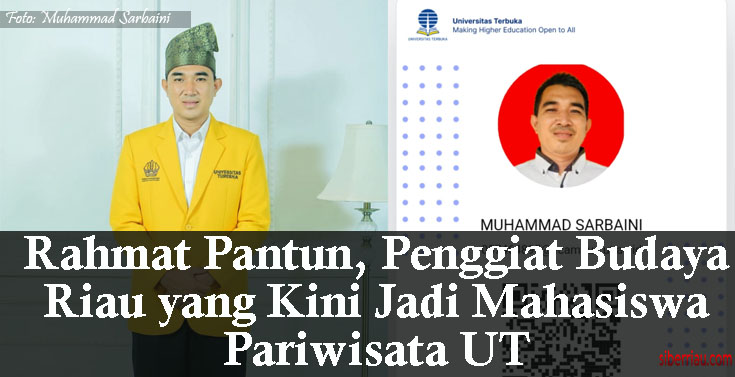
Pantun has become an inseparable part of Muhammad Sarbaini’s life. Widely known as Rahmat Pantun, this cultural activist from Riau has consistently brought Malay pantun into the public sphere through his mastery of words. For Rahmat, pantun is not merely an oral art form, but a cultural heritage that carries moral values, ethics, and the identity of the Malay community—one that must be preserved and passed on.
His dedication to safeguarding pantun has led him to perform at various cultural events and reach wider audiences through digital platforms. This consistency has kept pantun relevant amid social change and introduced younger generations to a meaningful tradition. Recognized as an intangible cultural heritage, pantun serves as Rahmat’s medium to convey the importance of protecting cultural roots in the face of globalization.
Driven by the need to strengthen his knowledge, Rahmat chose to pursue higher education in the Tourism Study Program at Universitas Terbuka (UT). He believes that cultural preservation must be supported by scientific approaches and sustainable management. Through tourism education, Rahmat aims to develop cultural potential as part of regional development that enhances community well-being.
UT’s flexible distance learning system allows Rahmat to continue his cultural activities while pursuing structured and independent higher education. This model reflects UT’s commitment to expanding equitable access to higher education.
As a student, Rahmat integrates his field experience with academic theory, viewing education as a means to strengthen his real contribution to society. The tourism knowledge he gains is expected to support the development of sustainable, inclusive, and locally rooted cultural tourism.
Rahmat’s journey reflects a tangible contribution to the Sustainable Development Goals (SDGs). His studies at UT support SDG 4: Quality Education, demonstrating that lifelong learning is accessible to all. His efforts in preserving pantun and Malay culture also align with SDG 11, particularly in safeguarding cultural heritage and local identity as part of sustainable development.
For Universitas Terbuka, Rahmat Pantun’s story illustrates the institution’s role in supporting students who are already making meaningful contributions to society. Through the synergy of cultural achievement and higher education, UT continues to foster human resources who are competitive, culturally grounded, and committed to national development.