
TANGERANG SELATAN – Distance learning does not always mean being excluded from the world of work. This is the challenge Universitas Terbuka (UT) is addressing through its School of Vocational Education, which marked its first anniversary on September 15, 2026. Vocational education has traditionally been associated with skills and practical training, while UT’s strength for more than four decades has been its open and distance learning (ODL) system. Therefore, UT is seeking to bring these two elements together in a flexible learning model that remains closely connected to the needs of the world of work.
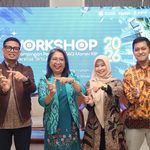
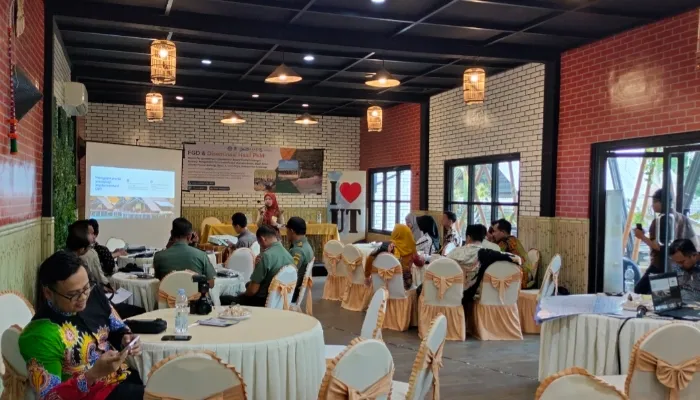
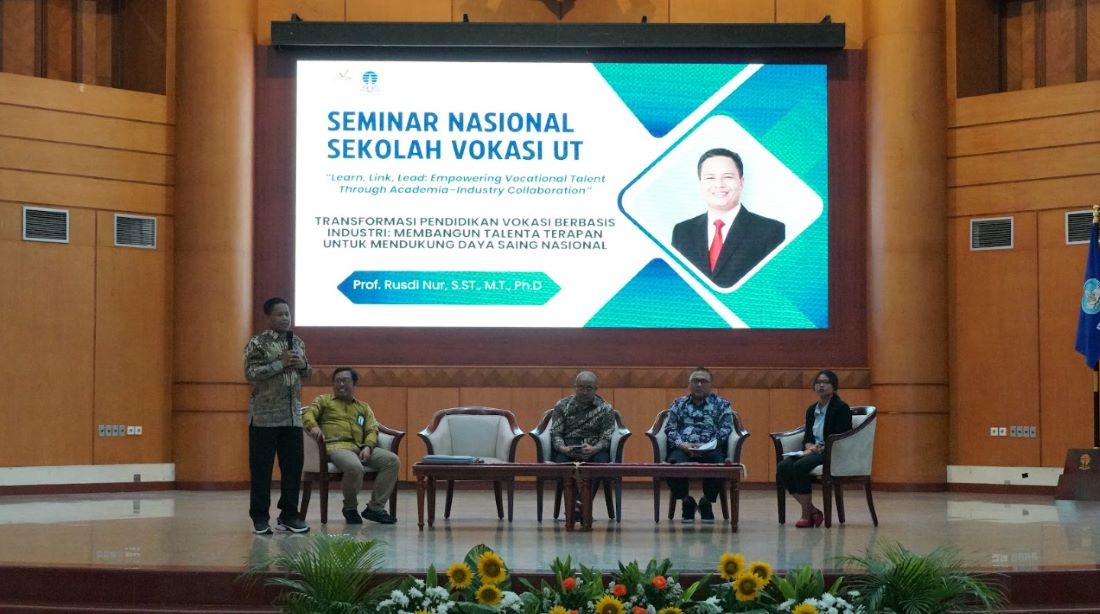
The idea emerged during the 2026 National Seminar of the Universitas Terbuka School of Vocational Education, themed “Learn, Link, Lead: Empowering Vocational Talent through Academic-Industry Collaboration,” on Tuesday (15/9/2026). The seminar was part of the first-anniversary commemoration of the establishment of the UT School of Vocational Education and served as a forum to reflect on the direction of vocational education development within UT. The forum brought together higher education institutions, the government, industry, and various partners to discuss changing competency needs. Through the forum, UT seeks to strengthen the connection between vocational education, the world of work, and evolving competency requirements.
This need is increasingly evident when looking at the condition of higher education in Indonesia. Director of the UT School of Vocational Education Dr. Mohamad Yunus, S.S., M.A., explained that Indonesia has a population of around 288 million, with approximately 3.3 million senior secondary school graduates each year. At the same time, the Gross Enrollment Rate (APK) for higher education stood at 32.00 percent in 2024 and increased to 32.89 percent in 2025. Among vocational high school graduates, the proportion continuing their studies stood at 13.37 percent in 2024 and increased to 18.26 percent in 2025.
“This shows how many of our senior secondary school graduates have yet to attain higher education,” Yunus said. According to him, the figures illustrate the continued demand for access to higher education that can be adapted to people’s circumstances. For some young people, pursuing higher education means facing a choice between continuing to work or leaving their hometowns. There are also groups within society with economic limitations that make it difficult to pursue vocational education through conventional methods.
This is where UT’s experience in providing distance education becomes important. The system allows people to study more flexibly without having to leave their jobs or hometowns. However, flexibility does not mean reducing the core characteristics of vocational education, which require direct experience. Therefore, the UT School of Vocational Education has designed its curriculum with around 60–70 percent practical content, complemented by project-based learning, collaborative learning, problem-solving, conceptual and practical guidance, the use of information technology, and internship or work experience in industry.
“Vocational education with practicality, with a practice component of up to 60–70 percent, is certainly not easy for UT, but it is exciting and interesting,” Yunus said. According to him, the challenge provides an opportunity to establish a vocational education foundation that differs from the learning model UT has traditionally implemented. The School of Vocational Education does not want to simply transfer vocational learning to a distance-learning platform, but instead seeks to design a system capable of maintaining students’ practical experiences. Therefore, development is being carried out gradually so that the foundation of the vocational model being developed becomes increasingly solid.
The challenge also explains why collaboration is an important part of UT’s vocational education. Chair of the UT Academic Senate Prof. Dr. Chanif Nurcholis, M.Si., said vocational education has a different character because it places greater emphasis on skills rather than cognitive aspects alone. Implementing vocational education through distance learning, he said, requires support from partners who can provide students with opportunities for real-world practice. “Vocational education is more about skills, not cognition. The challenge is how those skills can be developed through distance learning,” he said.
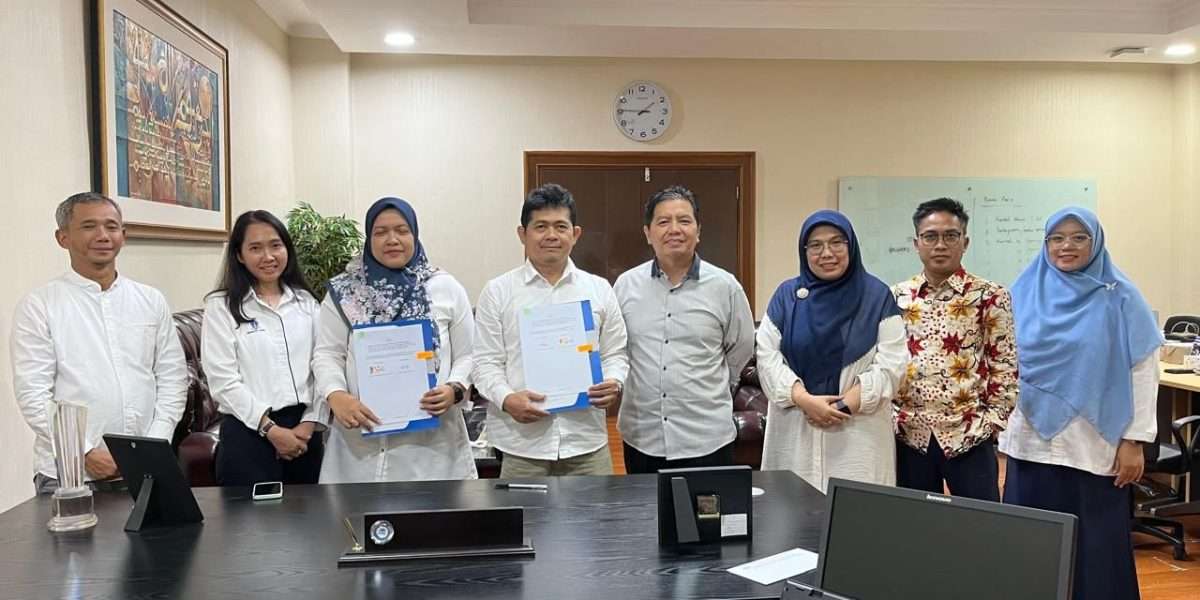
The question was then addressed with the conviction that collaboration can serve as a bridge between distance learning and practical experience. “We have proven that vocational education through distance learning is possible,” Chanif said. For UT, partnerships with industry are not merely complementary, but part of a learning ecosystem that makes students’ competencies relevant to workplace needs. Therefore, the seminar also featured the signing of Memorandum of understanding (MoU), Memorandum of agreement (MoA), and cooperation agreements (Perjanjian Kerja Sama – PKS) with various partners.
Proving that vocational education through distance learning can work, however, is not the ultimate goal. UT Vice Rector for Information Systems, Distance Services, and Alumni Prof. Dr. Paken Pandiangan, S.Si., M.Si., representing the UT Rector, said the next challenge is to ensure that the competencies developed by students truly correspond to changes in the world of work. Developments in artificial intelligence, automation, digitalization, the creative economy, electric vehicles, e-commerce, and logistics transformation have changed competency requirements across various sectors. Therefore, vocational education must continue to move in response to these changes.
“The School of Vocational Education has strategic significance for Universitas Terbuka: bridging expanded access with the development of competencies that are truly relevant to the needs of the world of work,” Paken said. According to him, the relationship between universities and industry should not stop merely at the signing of documents. Industry involvement needs to go further through curriculum development, practitioner involvement, joint projects, student experiences, and strengthening graduate readiness. In this way, the gap between competencies taught at universities and workplace needs can continue to be reduced.
The increasingly dynamic demand for competencies also meets significant opportunities in the creative economy sector. Head of the Human Resources Development Center for the Creative Economy at the Ministry of Creative Economy R. Adi Mukhtar Rivai, representing the Minister of Creative Economy, emphasized the importance of collaboration between the government and academics in strengthening an intellectual-property-based creative economy ecosystem. According to him, an idea should not stop at creativity, but needs to be developed through a value chain ranging from creation, production, distribution, consumption, to conservation. In this way, the competencies possessed by talent can develop into works with economic value.
This approach is also reflected in human resource development through Creative Leadership, Creative Talent, and Creative Preneur. Vocational education is expected to serve as a bridge connecting technical skills with the actual needs of the creative economy. Graduates are not only expected to have the ability to work, but also to build businesses, innovate, and develop their work into an economic force. This perspective makes collaboration among education institutions, the government, and industry increasingly important.
The spirit was then translated by the UT School of Vocational Education through the gradual development of study programs. Currently, the UT School of Vocational Education offers the D3 Taxation and D4 Archival Management programs as its initial study programs. Starting in 2027, UT is preparing to open the D3 Information Technology, D4 Digital Business Accounting, and D4 International Commercial Logistics study programs, followed by D4 Occupational Safety and Health and D4 Automotive Engineering Technology, focusing on electric and conventional vehicles. After that, UT is also preparing to develop programs in Hotel Management, Digital Communication or Content Creation, Culinary, Taxation, Information Systems Security, and Software Engineering Technology.
According to Yunus, the development is not being carried out merely by pursuing the number of study programs. Instead, the School of Vocational Education wants to strengthen its foundation first so that the vocational education model being developed can become increasingly solid. Each student is also expected to obtain two professional or competency certifications, one of five foreign-language options, an international course, and one to two information technology training certificates. These efforts are expected to ensure that graduates not only master theory and skills, but also possess evidence of competencies relevant to the needs of their professions.
Ultimately, what UT is testing is not just the ability of vocational education to be delivered remotely, The bigger question is whether distance should remain a barrier for someone seeking to acquire skills, experience, and opportunities to build a future. For people who need to continue working, live far from educational centers, or cannot leave their hometowns, a flexible education model can create opportunities to continue learning without having to give up the lives they are currently living. This is where quality education becomes more than simply access to higher education, but also a pathway to expanding opportunities and enhancing human capacity.
Therefore, Learn, Link, Lead is not merely the theme of a seminar for the UT School of Vocational Education. Learn means building competencies along with real-world experience, Link means connecting universities with industry, the government, professional associations, and other partners, while Lead means preparing graduates to take initiative, innovate, become entrepreneurs, and lead in their respective fields. When access to learning can meet relevant skills and opportunities for development, education can help create opportunities to improve competencies and expand opportunities in the world of work.