
The public does not simply need documents. They need answers. Answers that can be found when sought, accessed when needed, and accounted for when required. From this perspective, Universitas Terbuka looks back at the meaning of information transparency: not merely ensuring that a document is available, but ensuring that the public can truly access it.
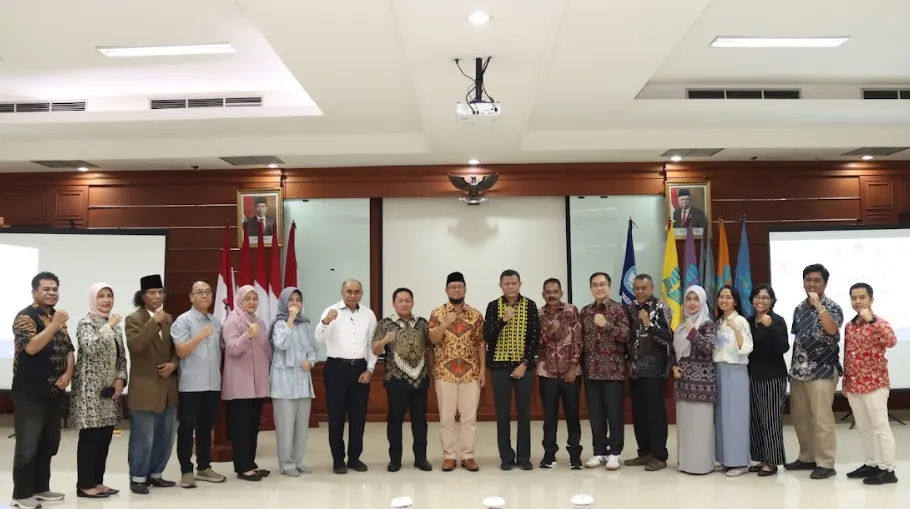
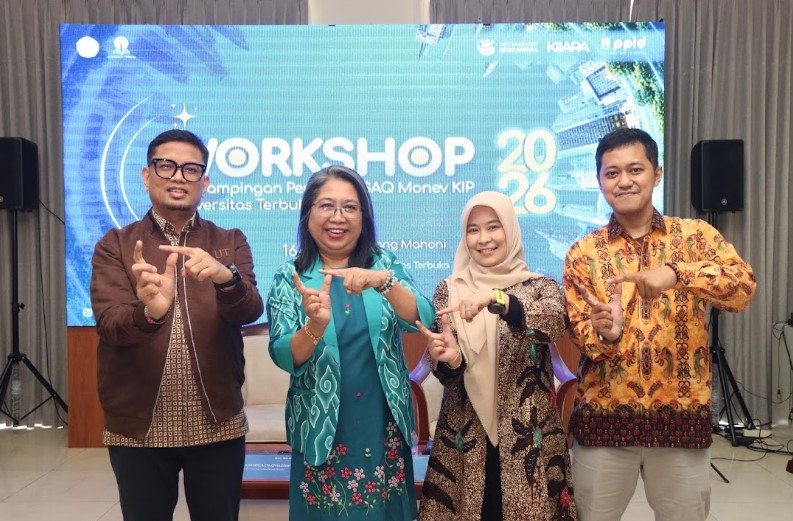
This perspective emerged during the Workshop on Assistance for Completing the Self Assessment Questionnaire (SAQ) for the 2026 Monitoring and Evaluation of Public Information Transparency at Universitas Terbuka, held in the Mahogany Room, Wisma 3 Universitas Terbuka, on Wednesday (16/9/2026). The workshop featured Rini Purwandari, Ak., S.H., M.M., CA., CPA., CPMA., CRMP., Commissioner of the Central Information Commission of the Republic of Indonesia and Head of the Regulation Division, to provide assistance while evaluating UT’s readiness in public information governance.
For Rini, the Monitoring and Evaluation (Monev) of Public Information Transparency should not stop as an annual agenda to pursue the “Informative” rating. Monev is an instrument for assessing public bodies’ compliance with regulations, measuring the effectiveness of document and information management by the Information and Documentation Management Officer (Pejabat Pengelola Informasi dan Dokumentasi – PPID), and identifying data and information governance challenges at both work-unit and regional levels.
Therefore, completing the SAQ during the workshop was not viewed as merely an administrative task. Every answer needs to return to one important question: can the information declared to be available actually be proven and accessed? Rini reminded participants that every claim must be accompanied by relevant supporting evidence, such as documents, active links, or screenshots as required. Even information presented in the SAQ must be discoverable through the normal navigation path from the website’s main page, rather than only through a direct link.
This made the workshop discussion closely connected to people’s everyday experiences. A responsive website, up-to-date information, easily discoverable documents, and services capable of responding properly to information requests ultimately determine whether transparency is genuinely experienced by the public. For UT, which provides open and distance education with a broad service reach, easy access to information is an important part of public service quality.
This view was in line with remarks delivered online by UT Vice Rector for Research, Cooperation, and Business and UT’s Chief PPID, Dr. Hendrian, S.E., M.Si. He said the workshop was a moment to reflect on the implementation of information transparency while identifying areas that still need to be strengthened.
“I hope this activity will not stop at merely fulfilling the assessment instruments, but can further strengthen a culture of information transparency within Universitas Terbuka.”
Hendrian emphasized that information transparency needs to become part of transparent and accountable governance while encouraging improved information services for the public.
This commitment has been accompanied by a number of improvements throughout 2026. UT has updated the PPID website interface to make it more responsive, updated public information, renewed the PPID structure and PPID officers responsible for work units, and updated the Public Information List (Daftar Informasi Publik – DIP) and the Exempted Information List (Daftar Informasi Dikecualikan – DIK). Public Information Transparency education through the PPID Instagram account has also continued, recording growth of more than 1,000 followers each semester.
The workshop, attended by Head of the Public Communication and Cooperation Center Ali Tarigan, S.E., Head of the Subdirectorate of Procurement of Goods and Services Bagus Arif Wicaksono, S.Kom., M.Kom., Manager of Public Relations and Integrated Services Roman Hadi Saputro, S.S., M.IP., as well as PPID officers responsible for work units, also emphasized that transparency must be built collectively, from UT Central Office to UT Regional Offices. This direction is in line with the spirit of SDG 16, particularly in building effective, accountable, and transparent institutions capable of providing public access to information.
UT’s own journey shows that these efforts continue to move forward. After receiving the “Towards Informative” rating in 2024, UT achieved the “Informative” rating in 2025. However, this achievement is not the finish line.
The reason is that the measure of transparency does not stop at ratings or the completeness of forms. The simplest measure emerges when members of the public come looking for information and find what they need without being confused about where to start. As Rini emphasized, “information transparency is not merely about documents,” but rather a foundation that determines whether an institution’s governance is healthy.
And perhaps that is the most tangible meaning of transparency: when the public no longer has to ask, “Where is the information?” because the institution has ensured that the answer is in a place where it can easily be found.