
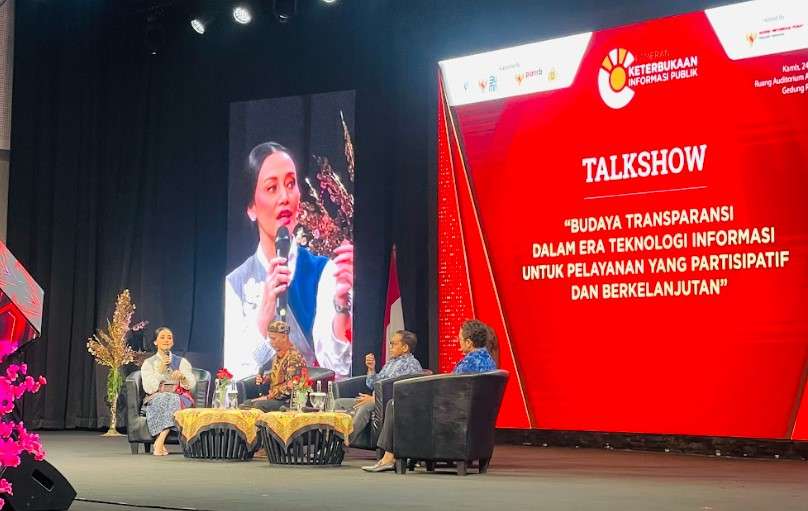
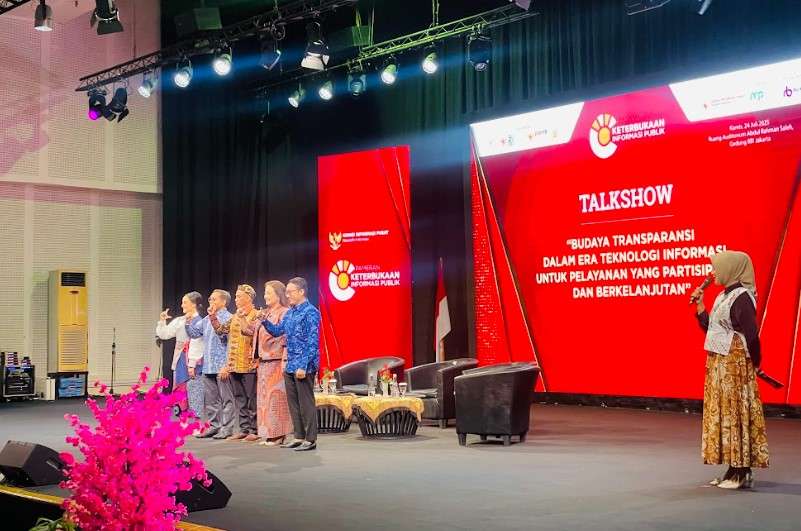
Jakarta, July 24, 2025 – The Central Information Commission (KIP) RI held the Soft Launching & Talkshow for the Public Information Openness (KIP) Exhibition 2025 at the Abdul Rahman Saleh Auditorium, RRI Jakarta Building. The event, themed “Culture of Transparency in the Information Technology Era for Participatory and Sustainable Services,” brought together various stakeholders, from government officials and public communication practitioners to academics.
The event was attended by the Director General of Public Communication and Media, Fifi Aleyda Yahya, Vice Chairman of the Central Information Commission, Arya Sandhiyudha, as well as KIP commissioners, namely Syawaludin (Head of Information Dispute Resolution) and Rospita Vici Paulyn (Head of Research and Communication). Also present were Abdul Rahman Ma’mun (Public Information Openness Practitioner) and Bayu Oktara, a public communication practitioner and an alumnus of Universitas Terbuka (UT).

In his remarks, Arya Sandhiyudha explained that the KIP Exhibition 2025, scheduled for October, is a strategic innovation to increase the efficiency and effectiveness of information openness. “Previously, visits were made to many public bodies across Indonesia; now, all agencies will be present in one forum. This will make it easier for the public to see innovations in information services while strengthening the culture of transparency,” he stated.
The Chairman of the Central Information Commission of Indonesia, Donny Yoesgiantoro, emphasized via video message that this exhibition is an important step in promoting the implementation of Law No. 14 of 2008 on Public Information Openness, as well as strengthening the public’s role in accessing information. He stressed, “Information openness is now not only a citizen’s right but also a fundamental need in modern democracy. We all must build an inclusive and sustainable culture of openness.”
During the talkshow, which was part of the event, it was emphasized that transparency is not just a slogan or administrative compliance but must become a deeply rooted work culture across all lines of public service. They also highlighted the importance of digital literacy so that the public can access, understand, and use information wisely, while actively monitoring and providing input.
Fifi Aleyda Yahya added, “Cross-sector collaboration—ranging from ministries, agencies, local governments, to State-Owned Enterprises (BUMN)—is the main strength in building inclusive openness. Information education and literacy must also be strengthened so that the public not only accesses information but uses it critically and responsibly.”
She emphasized that information openness must be part of a serving government culture, especially in the digital era that allows information to be delivered faster, more transparently, and more relevantly. In this regard, the ongoing revision process of the KIP Law is expected to strengthen institutions, simplify access, and adapt regulations to technological developments.
The event continued with the launch of the Public Information Openness Exhibition 2025 by the Director General of Public Communication and Media, Vice Chairman of the Central Information Commission, Commissioner for Information Dispute Resolution, Commissioner for Research and Communication, and the exhibition implementing partner, PT Murtilah Promosindo.
A particularly engaging part of the event was the talkshow on the theme “Culture of Transparency in the Information Technology Era for Participative and Sustainable Services.” The speakers for the talkshow were Syawaludin (Commissioner for Information Dispute Resolution), Rospita Vici Paulyn (Commissioner for Research and Communication), Abdul Rahman Ma’mun (Public Information Openness Practitioner), and Bayu Oktara (Public Communication Practitioner). The speakers reiterated that transparency is no longer sufficient as merely a slogan or administrative compliance but must become a deeply ingrained work culture across all public service lines. In today’s digital era, information technology is crucial in fostering openness, accelerating access to information, and opening wider avenues for public participation.
The discussion also highlighted the importance of digital literacy for the public, so they are not just passive users but actively monitor, provide input, and wisely exercise their right to information. Technology-based transparency, when well-managed, will strengthen public trust in state institutions and create an adaptive, sustainable public service ecosystem that prioritizes the interests of the wider community.
Through this soft launching and talkshow, KIP RI affirmed its commitment to presenting the KIP Exhibition 2025 as a space for synergy between information technology, a culture of openness, and public participation. The synergy among government, institutions, BUMNs, higher education institutions, and the community is expected to create more open, participatory, and accountable information services. The Public Information Openness Exhibition 2025, to be held in October, will be a concrete manifestation of a shared commitment to building a transparent public information ecosystem relevant to the needs of the times.