

TANGERANG SELATAN — The path to earning a bachelor’s degree is not the same for everyone. Some people work while studying, others return to education after years of building their careers, while some face challenges throughout their educational journey. Amid this diversity, Universitas Terbuka (UT) upholds one message: opportunities to pursue higher education must be open to everyone.
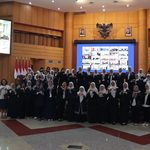
This commitment was reaffirmed by UT Rector Prof. Dr. Ali Muktiyanto, S.E., M.Si., during a press conference for the UT Graduation Ceremony for the First Semester of the 2026/2027 Academic Year, Region 1, at the Universitas Terbuka Convention Center in Pondok Cabe on Tuesday (October 27, 2026). During this semester, approximately 40,000 students had completed the academic requirements for graduation across various regions. Meanwhile, the Region 1 graduation ceremony involved 2,183 graduates from 12 UT Regional Offices, including Banda Aceh, Medan, Batam, Padang, Pekanbaru, Jambi, Bengkulu, Jakarta, Surakarta, Malang, Majene, and Gorontalo, as well as UT Overseas Services.
For Prof. Dr. Ali Muktiyanto, graduation is not merely a ceremony marking the completion of studies, but an official recognition of the qualifications and competencies students have achieved. Moreover, the majority of UT graduates are already working and contributing to community development.
“This also reaffirms UT’s commitment to continuing to make an impact on our nation, particularly by developing human resources who are not merely ready to enter the workforce, but are also prepared to carry the struggle forward,” Ali said.
This spirit is reflected in the growing number of postgraduate graduates. Prof. Dr. Ali Muktiyanto noted that the graduation ceremony included six doctoral graduates and 63 postgraduate graduates. According to him, this achievement indicates that UT’s postgraduate programs are increasingly becoming a preferred choice for the public, including those seeking to improve their qualifications and competencies without interrupting their professional careers.
“This shows that UT’s postgraduate programs are no longer merely an option for supporting career development, but have become a choice in their own right, particularly for people pursuing careers in their respective institutions who want to improve their qualifications and competencies,” he said.
Prof. Dr. Ali Muktiyanto also highlighted the diverse backgrounds of the graduates, reflecting UT’s role as a learning space for people from various professions and life circumstances, ranging from government employees to people in the entertainment industry, including students with disabilities. The Rector also praised one of the top graduates, Dr. dr. Arjaty Wahidah Daud, MARS., who achieved a perfect GPA of 4.00. He said this diversity reinforces the message that differences in circumstances or limitations should not prevent anyone from pursuing higher education and earning an academic degree.
“Nothing is impossible when it comes to earning a university degree,” he stressed.
To keep these opportunities accessible, UT is not simply pursuing an increase in student numbers, it is also preparing its service capacity. UT aims to be ready to serve one million students by 2029 and up to 2.5 million students by 2045. UT currently has approximately 857,000 students, with the number projected to approach 950,000 in 2027.
“UT’s actual target is not one million, two million, or any particular number of students. Instead, UT aims to make itself capable of serving up to 2.5 million students by 2045,” Ali said. He emphasized that this preparedness includes improving service quality so that student growth does not compromise the quality of learning.
These efforts are being implemented through investments in technology and learning, including the development of mobile-based online examinations and automated online proctoring. UT is also continuing to strengthen quality recognition through accreditation by the Asian Association of Open Universities (AAOU), a Quality Review by the International Council for Open and Distance Education (ICDE), and efforts to obtain international recognition for its study programs.
This commitment to expanding access while maintaining quality aligns with SDG 4 (Quality Education), particularly its emphasis on inclusive education and lifelong learning opportunities.
For UT, the graduation gown does not mark the end of the learning journey. Instead, it signals a new beginning, as the knowledge gained returns to society to strengthen professional practice, open up opportunities, and benefit the nation.