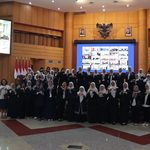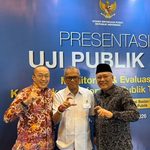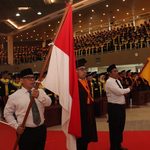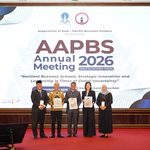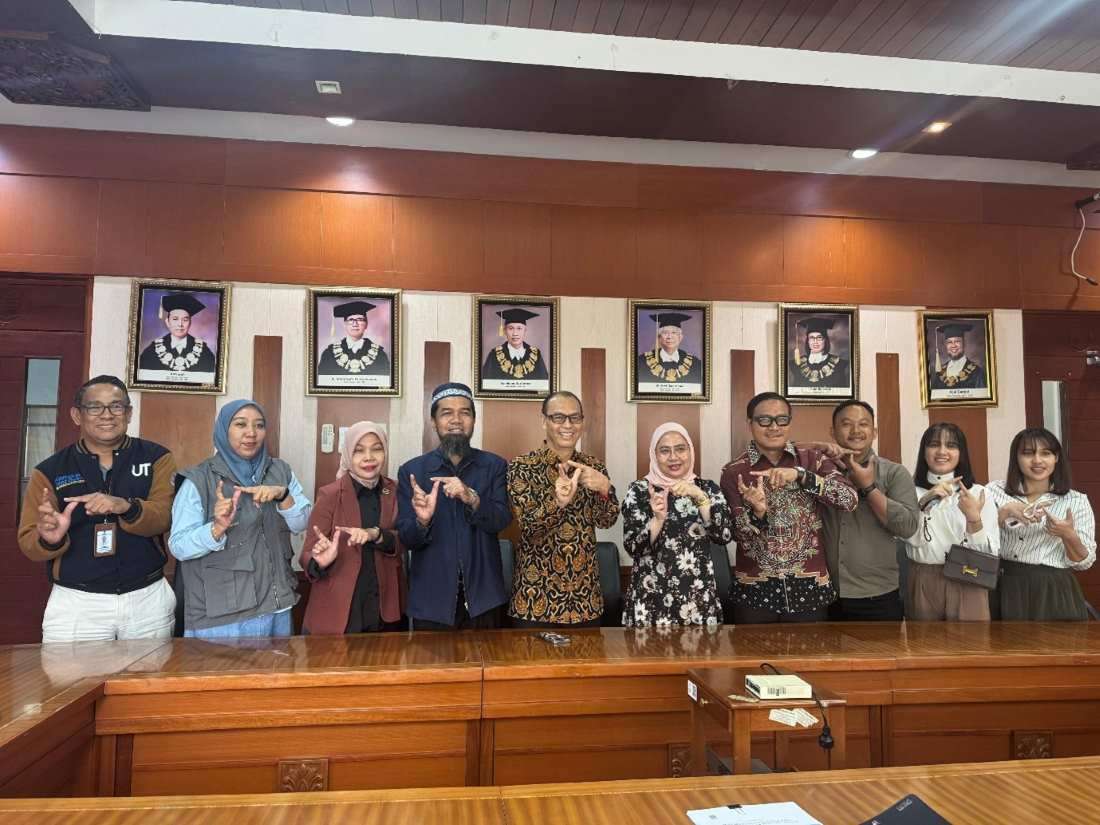

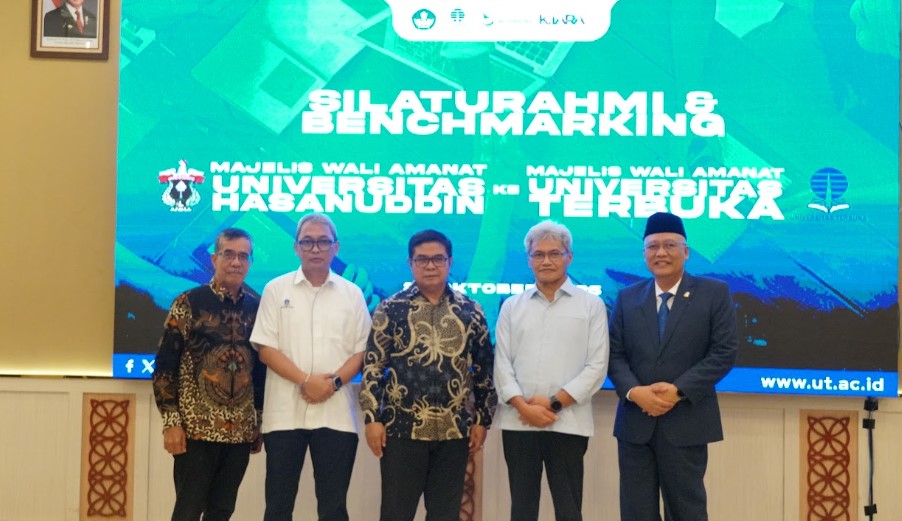
TANGERANG SELATAN – Every university has its own journey, challenges, and approaches to development. However, amid the increasingly dynamic changes in the world of education, best practices become even more valuable when shared and learned from together. This need prompted the visit of the Board of Trustees of Hasanuddin University (MWA UNHAS) to Universitas Terbuka (UT) on Wednesday (October 28, 2026), at UT’s Pondok Cabe campus.
UT Rector Prof. Dr. Ali Muktiyanto, S.E., M.Si., welcomed the visit as an opportunity for the two State Universities with Legal Entity Status (PTN-BH) to exchange knowledge. He explained that UT has its own distinctive characteristics as a provider of open and distance learning (ODL). However, UNHAS’s experience in managing a university also offers valuable lessons that UT can draw upon to support its continued development.
“UT is actually somewhat unique, Professor, because it provides open and distance learning and only recently attained PTN-BH status compared with UNHAS. Nevertheless, this visit provides an opportunity for discussion and mutual learning. We also want to understand the practices implemented at UNHAS and identify lessons that UT can apply in the future,” Ali said.
This spirit of mutual learning aligns with the perspective of UT Board of Trustees Chair Prof. Ainun Na’im, Ph.D., regarding the strategic role of universities in supporting national progress. He observed that social and economic transformations in several countries have been closely linked to the strengthening of the education sector, including higher education. These efforts are also essential to realizing “Indonesia Emas 2045” (Golden Indonesia 2045).
“If we look at the social and economic transformations in various countries, such as South Korea and China, we can see that they have consistently been accompanied by transformations in education, including higher education,” Ainun said.
According to him, the experiences of these countries demonstrate that strengthening education must go hand in hand with development. Therefore, universities need to continuously improve their quality and governance to address society’s needs while preparing for future challenges.
For UNHAS, the visit provided an opportunity to explore three areas considered important for institutional development. Deputy Chair I for General Policy, Development, and Partnerships of the UNHAS Board of Trustees, Prof. Dr. Ir. Muh. Arsyad Thaha, MT., IPM., explained that his delegation wanted to learn about endowment fund management, the application of information technology in learning, and the development of modules and teaching materials to support UT’s open and distance learning system.
These three areas are closely related to universities’ efforts to strengthen institutional sustainability while developing academic services. Endowment fund management forms part of efforts to enhance financial independence, while the use of information technology and the development of teaching materials support learning delivery that adapts to students’ needs.
In this regard, UT’s experience as an open and distance education provider offers relevant practices to explore. Through this system, UT strives to make higher education accessible to people from diverse backgrounds. This effort aligns with SDG 4 on Quality Education, which emphasizes the importance of access to inclusive and high-quality education.
Arsyad emphasized that benchmarking should involve more than simply observing the practices implemented by other universities. More importantly, the process should generate insights that can be adapted to each institution’s characteristics and needs.
“We recognize that UT has its own experience and strengths in delivering open and distance education,” Arsyad said. He expressed hope that the visit would broaden UNHAS’s perspectives while opening up opportunities for more concrete and sustainable cooperation between the two institutions.
In addition to exchanging experiences, the meeting also provided an opportunity to discuss potential collaboration among PTN-BH institutions through business and learning consortia. UT Rector Ali explained that one of the ideas currently under discussion involves the recognition of academic credits between universities. Under this scheme, students could have the opportunity to take courses at other universities, with the credits recognized by their respective institutions. However, the proposal remains under discussion and has not yet become a joint agreement.
If developed further, a learning consortium could expand opportunities for students to attend courses across different universities. Such collaboration also reflects the importance of partnerships in strengthening the higher education ecosystem, in line with SDG 17 on Partnerships for the Goals.
The meeting highlights the importance of openness and a willingness to continue developing in response to the evolving dynamics of higher education. By drawing on their respective strengths and experiences, UT and UNHAS are expected to play strategic roles in advancing higher education in Indonesia.