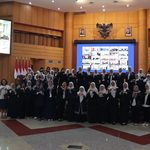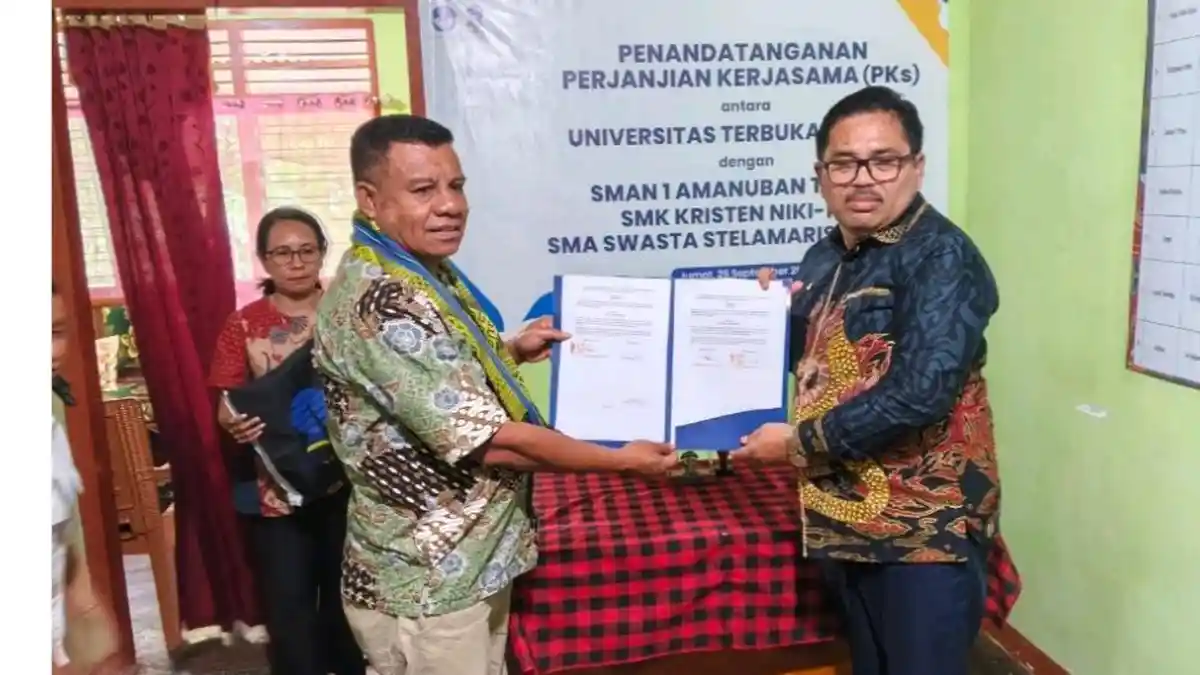


TANGERANG SELATAN – Graduation day may last only a few hours, but the journey to reach that point takes much longer. For the 2,052 graduates of Universitas Terbuka (UT) Jakarta, the graduation gowns they wore symbolized a learning process undertaken amid various responsibilities and commitments.
That experience also serves as valuable preparation as they return to their respective environments. Amid rapid technological changes and increasingly demanding workforce requirements, the ability to continue learning and adapt has become an important part of the journey after earning an academic degree.
This spirit emerged at the UT Jakarta Graduation Ceremony for Period II of 2026, held at the Universitas Terbuka Convention Center (UTCC), Pondok Cabe, Tangerang Selatan, on Sunday (September 27, 2026). Carrying the theme “Building an Adaptive Mindset in Facing the New World Order,” the event was attended by 2,052 graduates.
Based on the reported graduate data, there were 4,488 graduates included in Decree No. 698: 4,397 of 2026 and Decree No. 1099: 91 of 2026. They came from various educational levels and fields of study.
UT Rector Prof. Dr. Ali Muktiyanto, S.E., M.Si., said the graduates were part of UT’s contribution to expanding the impact of education on society. One indication of this can be seen in the high proportion of students who were already employed before or by the time they completed their studies.
“The most tangible impact is that statistically, when UT students join, on average, 80% are already working. By the time they are approaching graduation, that figure is 90%. This is based on an internal survey, 90% are employed,” Prof. Ali said.
Meanwhile, around 10 percent had not provided information regarding their employment status. Some of them chose other activities, including becoming homemakers.
For students who are not yet employed, UT provides competency development through training and certification. This policy is intended to ensure that graduates have more measurable skills when entering the professional world.
“One of the forms of preparation we provide is that, starting this year, we are making it a requirement. Perhaps it does not yet apply to those graduating now, but going forward, students who are about to graduate will have at least four competencies, meaning four certifications,” he said.
These efforts go hand in hand with the development of UT’s learning ecosystem. At UT Jakarta, which now has nearly 100,000 students, the “Jakarta 2” service is being developed using a full digital approach to meet the needs of younger generations while expanding convenient access to educational services.
This development is part of UT’s transformation from Open and Distance Learning (ODL) toward Open Distance Digital Flexible Learning (ODDFL). The learning system is strengthened through an Outcome-Based Education (OBE) curriculum connected to industry needs, a Learning Management System covering the process from registration to examinations, integrated modular learning materials with micro-credentials, and mobile-based online examinations.
“Hopefully, Gen Z will feel comfortable with and suited to full digital distance education. Hopefully, in this way, we can continue moving forward rapidly so that we are the ones shaping the future rather than waiting for the future to arrive,” Prof. Ali said.
Of the 2,052 graduates in attendance, 38 were postgraduate graduates, consisting of two doctoral graduates and 36 master’s graduates. Meanwhile, the Faculty of Economics and Business (FEB) contributed 1,841 graduates, the Faculty of Law, Social and Political Sciences (FHISIP) 1,412 graduates, the Faculty of Science and Technology (FST) 280 graduates, the Faculty of Teacher Training and Education (FKIP) 558 graduates, and the Vocational School 359 graduates, consisting of 48 D4 graduates and 311 D3 graduates.
Among the thousands of graduates, several students recorded notable academic achievements. Juliani from English Literature, Translation Studies, earned a GPA of 3.87, Nurul Safitri from Accounting earned a GPA of 3.78, Melvin Marthin Pattinaya from Information Systems earned a GPA of 3.71, while Diah Mustika Ratih from the In-Service Teacher Input Program in Elementary School Teacher Education recorded a GPA of 3.84.
Director of UT Jakarta Drs. Moh. Muzammil, M.M., said the experience of studying at UT played an important role in developing students’ ability to face professional dynamics. The flexibility of the learning process also requires students to manage their studies responsibly, an experience they can carry into their workplaces and daily lives.
Now, thousands of these graduates are returning to their respective environments with diverse backgrounds, professions, and goals. Their educational journey continues in different forms, through their work, contributions, and service to society. The education they have pursued does not end with earning a degree but is expected to add value to their lives and to society. This spirit is in line with SDG 4 on Quality Education, which places access to education and lifelong learning as important components of sustainable development.