
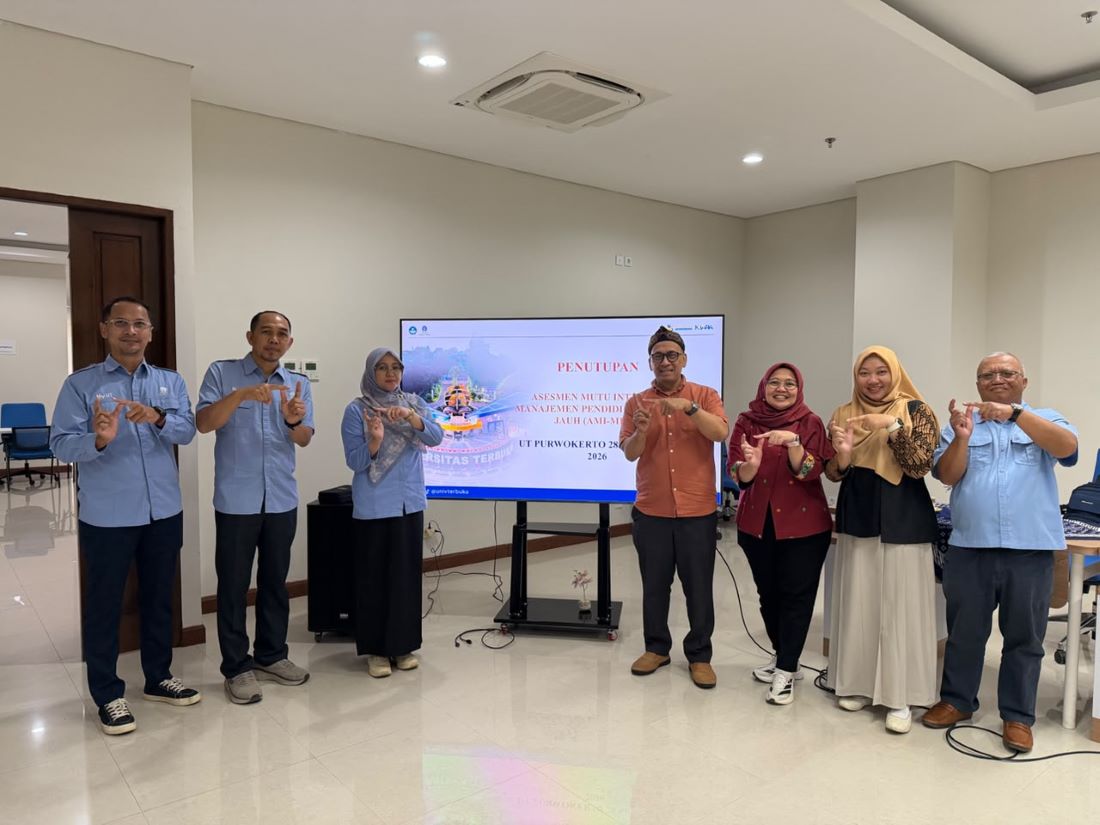
PURWOKERTO – Student growth is not merely about increasing numbers. Behind it lies the challenge of ensuring that every student continues to receive quality, responsive, and continuously improving academic services. This spirit was the focus of Universitas Terbuka (UT) Purwokerto during the Internal Quality Assessment (Asesmen Mutu Internal – AMI) for Distance Education Management (Manajemen Pendidikan Jarak Jauh – MPJJ) on September 29–30, 2026.
The activity was part of UT Purwokerto’s commitment to maintaining and continuously improving the quality of distance education. The assessment involved a team of assessors from UT’s Quality Assurance Office (Kantor Penjaminan Mutu – KPM), namely Dr. Rini Dwiyani Hadiwidjaja, S.E., M.Si., Drs. Yos Sudarso, M.Pd., and Suci Nurhayati.
The MPJJ AMI is part of UT’s quality assurance system to ensure that the implementation of distance education complies with university standards, indicators, supporting documents, and regulations. However, the process does not stop at document inspection. The assessment also provides an opportunity to examine the connection between program planning, implementation, evaluation, and follow-up.
Through this process, work units can identify strengths, find areas for improvement, and ensure that educational services continue to develop in line with the increasingly diverse needs of students.
Student Growth Must Go Hand in Hand with Quality
During the activity, Director of UT Purwokerto Dr. Prasetyarti Utami, S.Si., M.Si. presented the conditions, achievements, challenges, and strategic direction of UT Purwokerto’s development under the theme “Accelerating Student Growth: Student Data Mapping, Human Resources Readiness, and Strategic Steps.”
According to Prasetyarti, student growth needs to go hand in hand with improvements in service quality. Therefore, UT Purwokerto continues to strengthen the quality of academics and tutors, the implementation of learning and examinations, human resources, the academic environment, and collaboration among teams.
“The growth in the number of students must be accompanied by strengthened service quality, human resources readiness, and improved governance. Regular evaluation is important to ensure that every program is implemented in a focused manner and delivers tangible impacts,” was the substance of the strategic direction presented in her presentation.
UT Purwokerto is targeting more than 35,000 students, accompanied by efforts to strengthen academic quality, services, networks, and academic reputation. The optimization of SALUT, expansion of networks with local governments and partners, expansion of educational access, increased interaction with students, and development of academic activities are part of this strategy.
Efforts to expand access while maintaining quality are important in distance education. The more students are served, the greater the need to ensure that learning processes, academic support, and educational services remain capable of meeting their needs.
AMI Becomes a Momentum to Strengthen the Quality Culture
For Indah Setia Utami, S.E., M.Si., a lecturer in the Accounting Study Program at the Faculty of Economics and Business at UT Purwokerto and a member of the Quality Control Group, AMI serves as a momentum to strengthen the quality culture at the work-unit level.
“AMI is not merely a process to see whether documents are available, but a momentum to ensure that the processes we carry out genuinely support improvements in the quality of distance education services. For us at the study program and quality control group levels, the assessment results can serve as material for reflection to continuously improve the processes.”
According to her, a quality culture needs to become part of the organization’s daily activities, especially as UT undergoes its transformation into a State-Owned Legal Entity Higher Education Institution (PTN-BH) and pursues the World Class University (WCU) agenda.
“When a quality culture has become part of the way we work, assessments are no longer viewed as something that needs to be prepared for ahead of an audit, but as part of the daily work process,” she added.
The two-day MPJJ AMI at UT Purwokerto resulted in a final rating of “Very Good.” This achievement serves as both an appreciation and a reminder that quality standards are not a final destination but a foundation for continuous improvement.
With continued efforts to increase student numbers, UT Purwokerto places quality as an inseparable part of expanding access to education. Strengthening services, human resources readiness, continuous evaluation, and a quality culture are ways to ensure that broader learning opportunities are accompanied by an increasingly better educational experience for students.
This effort also strengthens UT Purwokerto’s contribution to SDG 4 on Quality Education, not only by expanding access to higher education but also by ensuring that such access is supported by continuously improving learning processes and educational services.