
Every day, information arrives without pause. News, social media posts, opinions, and various public narratives compete to fill the digital space. Amid this overwhelming flow, the challenge is no longer simply obtaining information, but understanding what lies behind it.
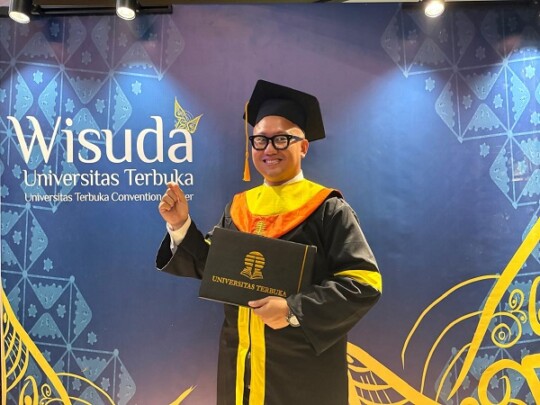
This issue caught the attention of Imam Pesuwaryantoro, a graduate of the Communication Studies Program at Universitas Terbuka (UT). Rather than seeing the overwhelming flow of information merely as a challenge, Imam turned it into an opportunity for innovation.
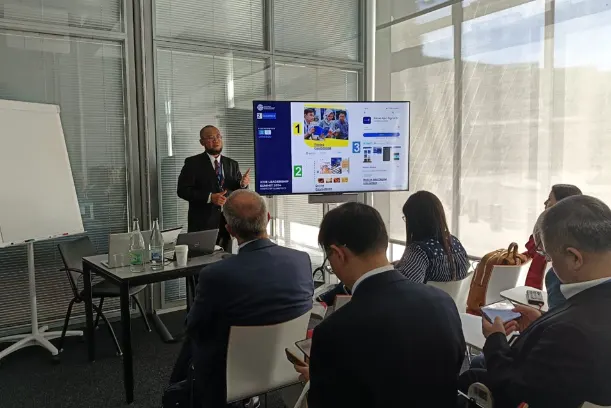
He developed an Artificial Intelligence (AI)-based Media Aggregator designed to collect, process, and analyze information and public perceptions in a more systematic manner. The idea subsequently earned him an award at the Japan International Youth Innovation Summit (JIYIS) 2025 in Tokyo, Japan.
For Him, the achievement is not merely about receiving an award. More importantly, the innovation has become a space for bringing together two fields that increasingly intersect: communication and technology.
“I developed this AI-based Media Aggregator not only as an academic work, but also as a creative business opportunity,” said Imam Pesuwaryantoro.
The idea emerged from a reality that is increasingly close to people’s daily lives. The growing volume of information makes the ability to identify, categorize, and understand information increasingly important. Moreover, the flow of information is also closely related to the formation of public opinions and perceptions.
He then utilized AI technology to help address these challenges. Through the Media Perception & Engineering approach, the innovation he developed goes beyond merely collecting information and is instead directed at helping read the dynamics of information and perceptions developing in the public sphere.
Behind the innovation lies a broader perspective. Imam views the development of digital technology as an opportunity for the younger generation not only to become users, but also creators of solutions.
According to him, technology can be developed into products and services that have economic value. This also opens up new opportunities for young people to remain productive and competitive amid uncertain economic conditions.
“In an era of economic uncertainty, technology-based side hustles are an answer to remaining productive and competitive,” he said.
His journey demonstrates that Communication Studies has increasingly broad opportunities in the digital era. The ability to understand messages, information, and public behavior can be combined with technological advancements to produce solutions relevant to the needs of industries and communities.
On the other hand, the story also serves as an example of how education can become one of the foundations for developing innovation. Knowledge gained in higher education does not have to remain theoretical, but can be taken beyond the classroom to address real-world problems and even developed into entrepreneurial opportunities.
This spirit is in line with SDG 4 on quality education, which promotes the development of relevant skills for the future, as well as SDG 8, which emphasizes the importance of employment opportunities and productive economic growth.
From the classroom to the international stage, Imam demonstrates one simple thing: big ideas do not always begin with something big. Sometimes, they emerge when someone is perceptive enough to see problems around them and brave enough to turn those concerns into a creation.
Today, the idea that began with the overwhelming flow of information has reached Tokyo. Carrying Indonesia’s name, Imam proves that when communication studies meet technology and the courage to innovate, the boundary between the academic sphere and the global stage becomes increasingly thin.