
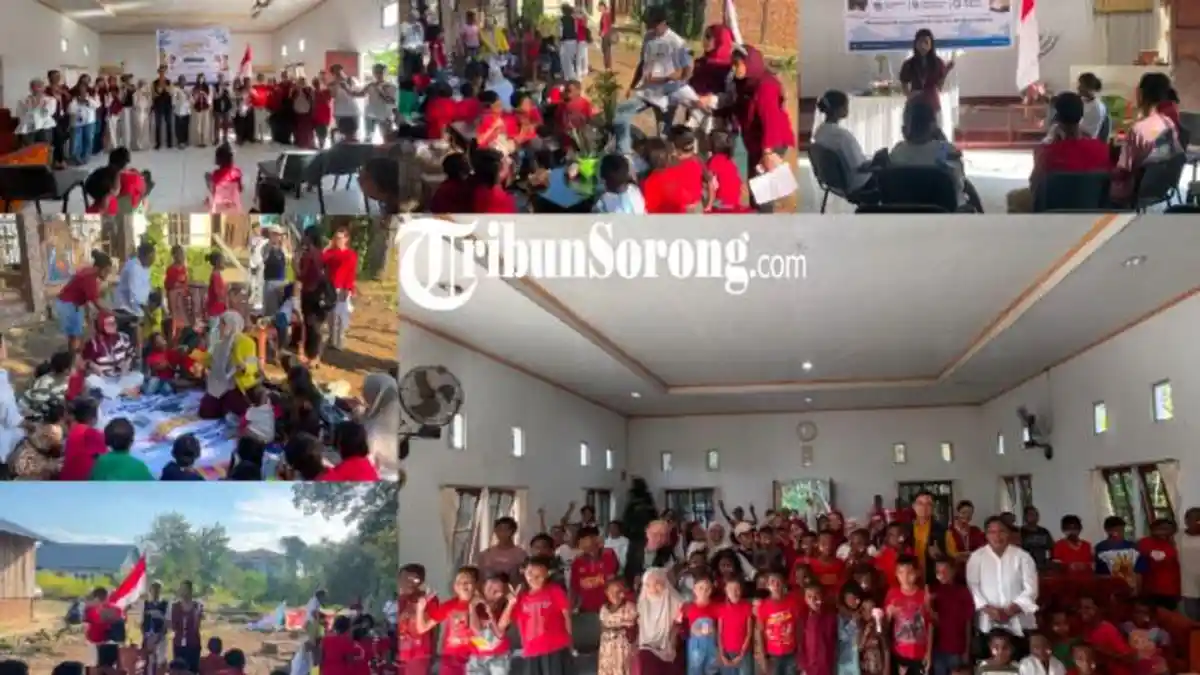
SORONG — For some children, a book may be nothing more than a collection of pages filled with words and pictures. But at the Taman Baca or Reading Park Manaspur (TBM) in Kota Sorong, Papua Barat Daya, books and knowledge have become a gateway to discovering a wider world while opening their imagination about the future.
That spirit was evident when students from Universitas Terbuka (UT) Sorong who are members of the Student Organization (Organisasi Mahasiswa – Ormawa) came to the Taman Baca with the “Ormawa Teaches and Inspires” activity on Saturday (Aug. 22, 2026). Rather than simply coming to teach, the students invited the children to learn about various topics closely connected to their everyday lives.
Children from different levels of education were divided into several groups to take part in learning activities together. The topics were diverse and interactive, ranging from bullying, balanced nutrition, self-potential development, HIV/AIDS, to stunting. This approach made the activity feel less like formal classroom learning and more like a relaxed, accessible space for sharing knowledge.
Behind the activity was a much bigger message: education does not always have to wait for children to sit at school or for university students to be on campus. Knowledge can also grow when higher education institutions come directly into communities and create spaces for learning together.
Chair of the UT Sorong Student Organization, Kristie S. Liando, led the activity. Director of UT Sorong Michel Jacson Nalawo Potolau, along with a number of lecturers, also attended and provided support.
Michel praised the initiative by UT Sorong students to engage directly with children through the activity. According to him, Ormawa Teaches and Inspires is one concrete manifestation of the university’s role in educating the nation while creating an impact on society.
“Today, Universitas Terbuka Sorong, through its student organization, is holding the Ormawa Teaches activity at the Taman Baca Manaspur, Kompleks Rufai, Kota Sorong,” Michel said.
He said the activity was in line with the mandate of the 1945 Constitution to educate the nation, as well as the spirit of higher education institutions to provide benefits that can be felt by the community.
“Through this activity, our friends from the UT Sorong Student Organization can have a positive impact on children, from kindergarten, elementary school, junior high school, senior high school, and vocational high school levels,” he said.
According to Michel, literacy and education are important foundations for preparing Papua’s younger generation for the future. Therefore, he hoped activities like this would not stop as a one-time event, but could develop into a regular program of the UT Sorong Student Organization.
“Through this activity, the UT Sorong Student Organization shares knowledge with the children at the Taman Baca. Hopefully, the children here can improve their literacy, develop a greater interest in reading, and eventually become the golden generation that will build Papua in the future,” he said.
That hope carries even greater meaning because the children who are currently in kindergarten through vocational high school will eventually become part of Papua’s future. The knowledge and learning experiences they gain can become valuable provisions for their educational journeys ahead.
“We want to provide knowledge to our children so that they are ready to compete with other children. With the knowledge they possess, they will be ready to build Papua in the future,” Michel said.
Through a simple initiative at Taman Baca, UT Sorong has shown that the contribution of a higher education institution does not always have to come in a large form. Sometimes, an impact begins with a single learning space, a single book, a piece of new knowledge, and a child who goes home believing that their future is worth striving for. This spirit is also in line with efforts to promote inclusive and quality education, as reflected in SDG 4 on Quality Education.