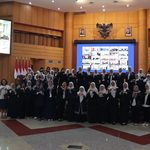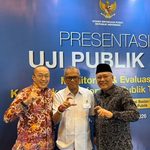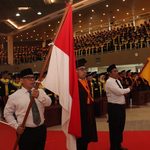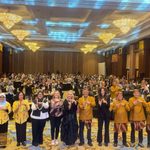

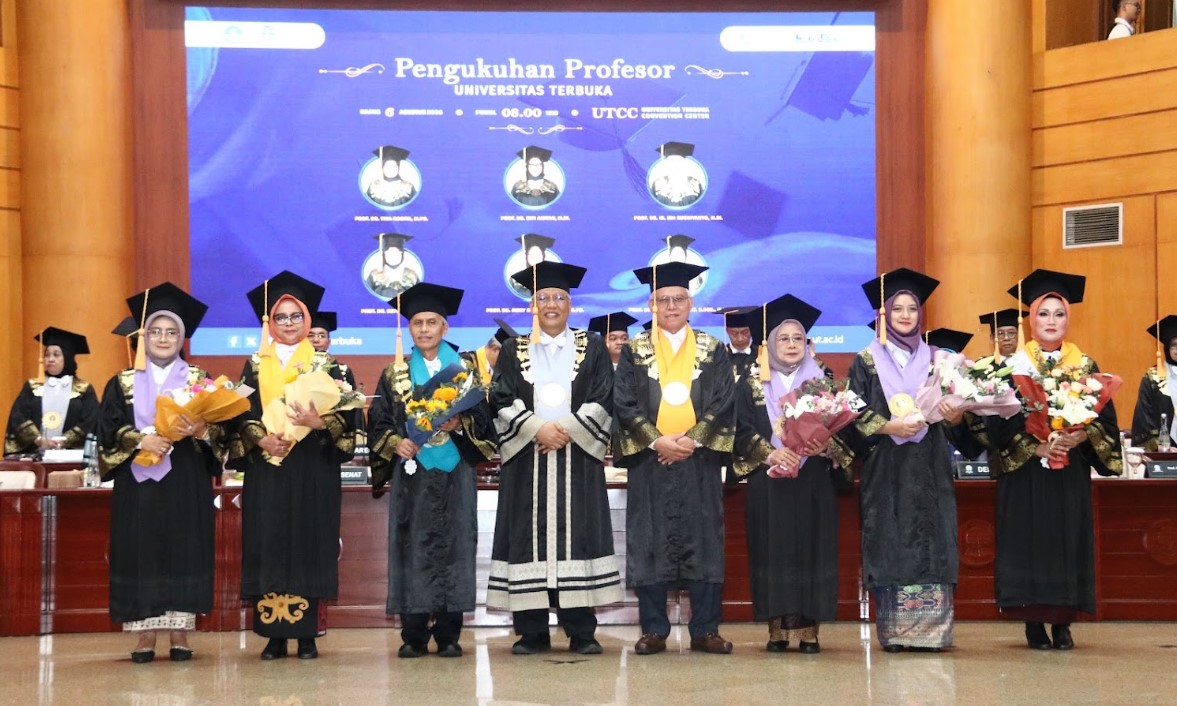
Tangerang Selatan, August 6, 2025 – If knowledge remains merely theoretical, its benefits will never truly be felt by society. For this reason, Universitas Terbuka (UT) inaugurated six professors whose expertise spans education, literacy, artificial intelligence (AI), public governance, urban environments, and migrant worker protection. These six fields of expertise are united by one commitment: turning research findings into real solutions for society through quality and open higher education accessible to all.
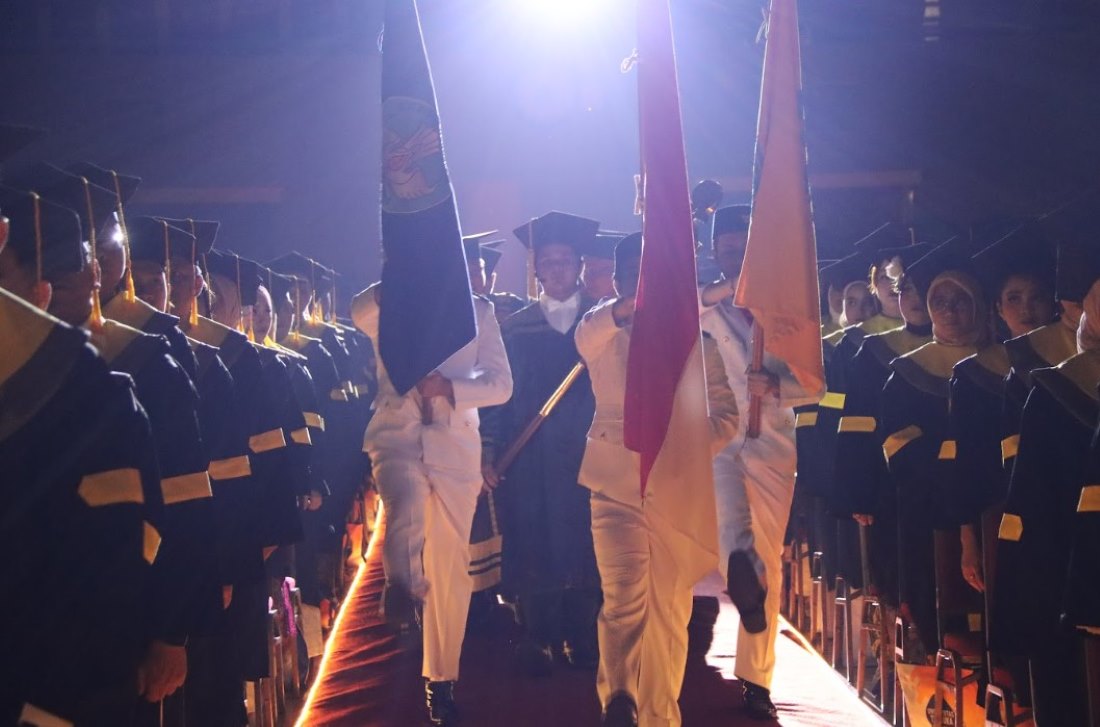
The milestone took place during the Universitas Terbuka Professorial Inauguration at the Universitas Terbuka Convention Center (UTCC), Tangerang Selatan, as part of the 42nd Dies Natalis anniversary celebrations of UT, themed “Mendunia dengan Inovasi, Berdampak untuk Negeri” (Going Global through Innovation, Making an Impact for the Nation). More than an academic ceremony, the inauguration reaffirmed that an open and distance higher education institution can produce strategic ideas relevant to future challenges while expanding access to quality higher education regardless of space, time, age, or background.
This spirit became the common thread running through the six scientific orations delivered by the newly inaugurated professors. Each professor offered solutions based on their respective fields of expertise, but all shared the same goal: ensuring that research findings do not remain merely academic achievements, but can be applied to improve people’s quality of life.
In the field of education, Prof. Dr. Tita Rosita, M.Pd. highlighted the importance of developing an adaptive 21st-century learning ecosystem through strategic management, the use of digital technology, learning analytics, and artificial intelligence. According to her, the education of the future requires learning systems that are not only technology-based but also remain centered on students’ learning experiences in a humanistic manner. This idea further strengthens Universitas Terbuka’s position as a pioneer of open and distance higher education that continues to innovate so that quality education services can be accessed by people wherever they are.
This educational transformation was complemented by Prof. Dr. Suparti, M.Pd., who presented literacy-learning strategies using brainstorming, free writing, and teacher feedback. These approaches are considered capable of developing students’ critical thinking and creativity while improving their writing skills in the digital era. Meanwhile, Prof. Dr. Meri Noviyanti, S.Si., M.Pd. proposed a new approach to mathematics education through the use of Python Virtual Lab, interactive GeoGebra, and AI to strengthen educators’ competencies while developing computational thinking skills needed by future generations.
The professorial inauguration also demonstrated that Universitas Terbuka’s research extends beyond education to address challenges in public governance and increasingly complex social issues.
Prof. Dr. Siti Aisyah, M.Si. introduced the concept of smart governance as an approach to creating faster, more transparent, and data-driven public services through digital technology and collaboration among stakeholders. In line with this, Prof. Dr. Rahmat Hidayat, S.Sos., M.Si. presented a collaborative reporting model based on digital applications to strengthen the protection of Indonesian migrant workers from the threat of forced scamming, a form of transnational cybercrime that continues to evolve.
Environmental issues also received attention. Prof. Dr. Ir. Edi Rusdiyanto, M.Si. introduced the River–Settlement Symbiotic System (RS3) approach, which views rivers and residential areas as a single ecosystem that must be managed in an integrated manner. Through this concept, urban development is no longer oriented toward addressing problems sector by sector, but instead through multidisciplinary collaboration aimed at improving environmental quality while reducing disaster risks in urban areas.
Taken together, these ideas demonstrate that every field of knowledge has a role to play in addressing the nation’s challenges. Education, public governance, technology, the environment, and the protection of vulnerable groups are interconnected in building a more sustainable civilization. This is the significance of the inauguration of the six Universitas Terbuka professors this year: ensuring that knowledge does not remain confined to academic spaces but delivers benefits that can be experienced by society at large.
This commitment was also emphasized by Rector of Universitas Terbuka, Prof. Dr. Ali Muktiyanto, S.E., M.Si. According to him, the addition of six professors brings the total number of professors at UT to 45. They are expected to serve as role models, drivers of innovation, and leaders of research groups capable of overseeing the downstreaming of research findings so that they ultimately generate tangible benefits for society. Supported by an increasingly robust research system, Universitas Terbuka continues to strengthen its role not only as a university that expands access to quality higher education without boundaries, but also as an institution that produces innovations addressing Indonesia’s present and future needs.
This spirit is aligned with the Sustainable Development Goals (SDGs), particularly SDG 4 (Quality Education) through equal access to higher education, SDG 9 (Industry, Innovation and Infrastructure) through the strengthening of research and technology, SDG 11 (Sustainable Cities and Communities) through innovative approaches to urban environmental management, and SDG 16 (Peace, Justice and Strong Institutions) through the development of adaptive governance and the protection of vulnerable groups.