
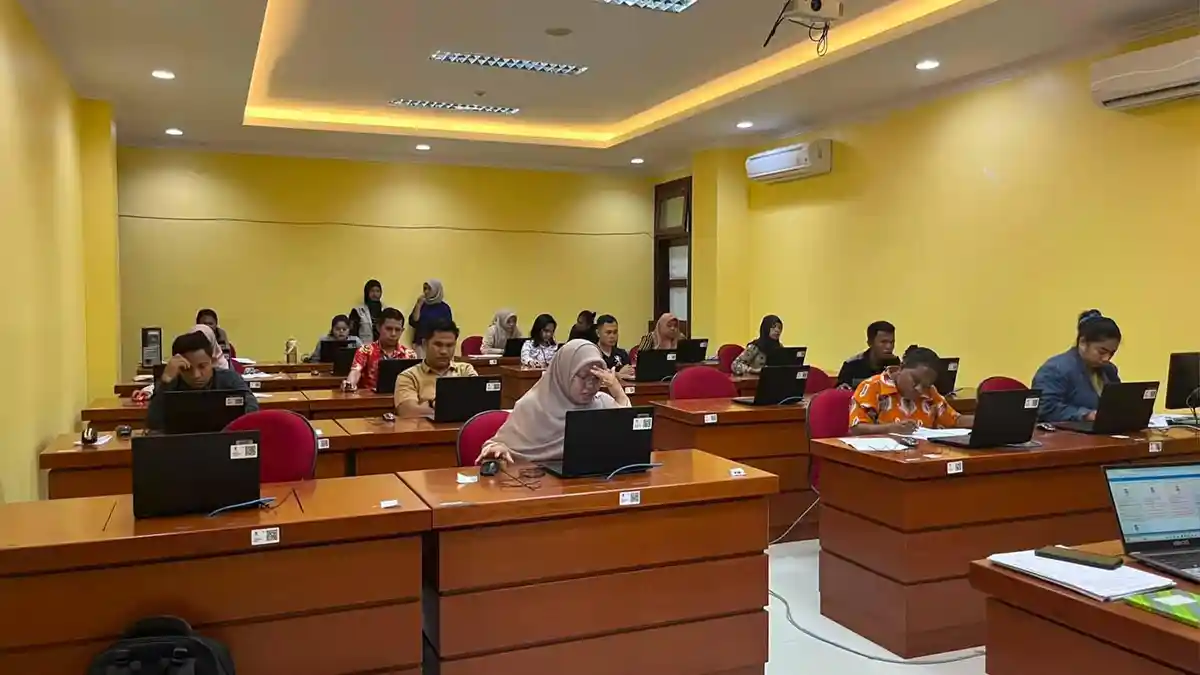
SORONG – For many people, final examinations are synonymous with classrooms, fixed schedules, and the requirement to be physically present at a designated location. However, that experience has changed for thousands of students at Universitas Terbuka (UT) Sorong. Through a flexible, technology-based examination system, students can complete their Final Semester Examinations (UAS) without having to leave their jobs, families, or daily responsibilities. This reflects UT Sorong’s commitment to providing higher education that is increasingly inclusive and accessible.
This commitment was demonstrated through the implementation of the Final Semester Examinations for the 2025/2026 Academic Year, Even Semester, held from June 20 to July 5, 2026. During this period, UT Sorong offered various examination schemes, ranging from in-person examinations to online examinations, allowing students to choose the method that best suited their circumstances and location.
UT Sorong Director, Michel Jacson Nalawo Potolau, said the examination system was designed to provide greater convenience without compromising the quality of academic assessment.
“UT offers several examination schemes, including in-person and online examinations. The online examinations consist of various methods, such as Live Online Proctoring (LOP), Automatic Online Proctoring (AOP), mobile-based online examinations, and Take Home Exams (THE) for master’s and doctoral programs,” Michel said on Sunday (July 5, 2026).
The variety of examination methods received a positive response from students. This was reflected in the smooth implementation of the examinations, which ran for more than two weeks with high participation across all UT Sorong service areas. To support the process, UT Sorong prepared eight in-person examination venues and 22 online examination locations.
A total of 1,962 examination participants (student-course registrations) took the in-person examinations, while 11,270 student-course registrations participated in the online examinations. These figures reflect the growing adoption of digital technology in supporting distance learning.
Among the available methods, Automatic Online Proctoring (AOP) emerged as one of the most popular innovations. The system enables students to take examinations from their respective locations without having to travel to a designated examination center.
“Students can take their examinations from wherever they are and even choose their examination time from the available schedule. This flexibility is one of UT’s key advantages,” Michel said.
For students, the majority of whom are working professionals, this flexibility is more than just a convenience, but it is a practical solution that allows them to continue their academic journey without sacrificing their jobs or family responsibilities. The innovation also demonstrates how digital transformation can expand access to higher education for people from diverse backgrounds.
“We want to ensure that students can complete both their learning process and examinations smoothly without having to leave their daily routines. This flexibility is one of UT’s defining characteristics,” he added.
In addition to ensuring the smooth implementation of the examination system, UT Sorong reminded students to prepare thoroughly before taking their examinations. Preparations include reviewing course materials, completing independent practice exercises, maintaining good health, and ensuring that all administrative requirements, such as examination cards and identification documents, have been fulfilled.
“We hope all students will not only complete their examinations successfully but also achieve the best possible results so they can continue their studies successfully at UT, particularly at UT Sorong,” he said.
The successful implementation of the 2025/2026 Even Semester Final Examinations reflects Universitas Terbuka’s commitment to continuously providing higher education that adapts to evolving societal needs and technological advancements. Innovations in the examination system not only offer greater convenience for students but also reinforce UT’s role as Indonesia’s open and distance learning university, committed to expanding access, maintaining quality, and promoting equitable education. These efforts are aligned with the Sustainable Development Goals (SDGs), particularly SDG 4 (Quality Education), SDG 9 (Industry, Innovation and Infrastructure), and SDG 10 (Reduced Inequalities) by providing increasingly inclusive educational services that reach all segments of society.