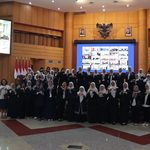


Thousands of kilometers away from Indonesia, amid demanding work schedules and challenging time differences, hundreds of Indonesian diaspora members share one common choice: staying connected to a state university from their homeland. On 21 February, Universitas Terbuka Overseas Learning Services (UT LLN) held its online Orientation for New Students (OSMB) for the 2025/2026 even semester, welcoming participants across Asia, Europe, Australia, and Africa.
A total of 112 new students joined the session, reflecting the wide reach of Indonesia’s diaspora: 50 in Asia, 54 in Europe—38 of them based in Germany—five in Africa, and three in Australia. The orientation introduced students to UT’s open and distance learning system, the university’s core approach to delivering higher education beyond geographical boundaries.
Interest in UT’s overseas program continues to grow. According to the university’s Directorate of Academic Administration and Student Affairs (DAAK), UT LLN recorded 8,447 active students in the 2025 even semester registration period, including 1,878 new students.
UT Vice Rector for Research, Partnership, and Business, Hendrian, noted that the university’s flexible learning system allows professionals abroad to pursue higher education without leaving their jobs. “UT offers a practical solution for Indonesians building careers overseas. Our system enables students to earn a degree while continuing to work,” he said.
While flexibility is a key advantage, distance learning also requires strong adaptation. Students often experience a shift from traditional classroom learning to a more independent academic rhythm. UT LLN Director Pardamean Daulay emphasized the importance of time management, self-discipline, and proactive problem-solving to succeed in this learning environment.
Support also came from Roniyus Marjunus, Education and Cultural Attaché at the Indonesian Embassy in Berlin, who praised diaspora students for choosing an Indonesian public university for their studies. He encouraged them to maintain discipline, independence, and academic integrity throughout their educational journey.
The orientation also introduced UT LLN’s management team who will support students throughout their studies, reinforcing the message that geographical distance does not limit academic services.
This initiative aligns with the Sustainable Development Goals, particularly SDG 4 (Quality Education) and SDG 10 (Reduced Inequalities). Through its flexible and inclusive learning model, UT continues to expand access to higher education while strengthening the global competitiveness of Indonesian human resources.