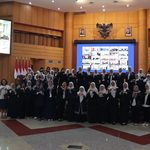

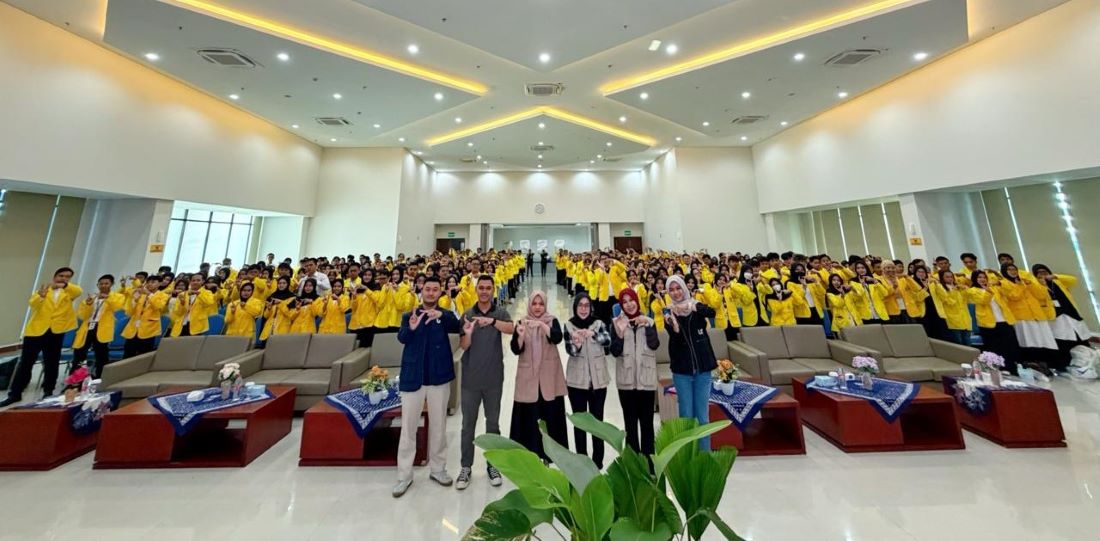
Studying from anywhere certainly offers flexibility. However, without the ability to manage themselves, flexibility can become a challenge in itself. Therefore, new students of Universitas Terbuka (UT) Purwokerto were equipped with independent learning skills, an understanding of academic services, and the ability to utilize technology through the Distance Learning Skills Training (PKBJJ) held on Saturday (August 8, 2026), at the 4th-Floor Hall of the UT Purwokerto Office.
PKBJJ was not merely an opportunity to introduce students to the university. From the beginning, students were encouraged to understand the characteristics of learning at UT as well as the skills needed to pursue distance education effectively.
The activities began interactively in the morning. After registration, students were introduced to UT through a profile presentation and information about the university, followed by the opening session, group formation, games, and group video content creation activities.
The series of activities served as an introduction before students moved on to the main material on strategies for becoming independent learners.
Independent Learning Does Not Mean Learning Alone
The morning session featured Rani Darojah, S.Pd., M.Pd., Lecturer/Lector at FKIP UT Purwokerto. Students were equipped with an understanding of independent learning strategies, which are among the keys to success in distance education.
Going beyond concepts, students were invited to explore the PKBJJ scenario, the characteristics of independent learning, effective reading techniques, ways to take reading notes, concept mapping, and various academic skills needed throughout their studies.
Students were also introduced to various forms of learning at UT, ranging from Online Tutorials (Tuton) and Face-to-Face Tutorials (TTM) to practical courses, practicums, and learning assignments.
The message was simple: the flexibility of distance learning needs to be accompanied by independence and discipline. These skills are also in line with SDG 4: Quality Education, particularly in promoting learning processes that support students in becoming active and independent learners.
Getting to Know UT’s Digital Services
In the afternoon session, the training continued with Hendy Yudoko, S.P., Manager of Outreach, Registration, and Examinations at UT Purwokerto.
Students were introduced to various UT Online services and learning resources that they would use throughout their academic journey. The material covered the use of online services, learning resources, online examinations, and a simulation of the Mobile-Based Online Examination (UOM).
This understanding is important because UT students’ academic activities are closely connected to digital services. By becoming familiar with the system from the beginning, students are expected to be better prepared when they officially begin their studies.
For new students, PKBJJ serves as an initial step in adapting to UT’s learning environment. The ability to manage time, utilize technology, find learning resources, and take responsibility for the academic process are essential skills to ensure that the flexibility of distance education can be utilized optimally.
The training also supports the spirit of SDG 4 on Quality Education by strengthening access to and learning experiences that are relevant to students’ needs in the digital era. Ultimately, being a UT student does require independence. However, being independent does not mean having to walk alone. Systems, services, technology, and support have been prepared, students simply need to learn how to make the most of them to grow into active, disciplined, and adaptive learners.