
TANGERANG SELATAN — For some people, 856,444 may be just a number. For Universitas Terbuka (UT), the figure represents hundreds of thousands of people who have chosen to pursue higher education while balancing work, family, distance, and lives that continue to move forward.
Among them are 180,125 new students who began their academic journey with UT in 2026. The figure is not merely a sign of growth, but also reflects the significant demand for higher education that can be brought closer to people’s everyday lives.
The more people choose UT, the greater the responsibility it must fulfill. Student growth needs to go hand in hand with improved quality so that wider access to education can truly deliver meaningful benefits to those pursuing it.
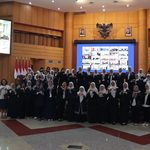
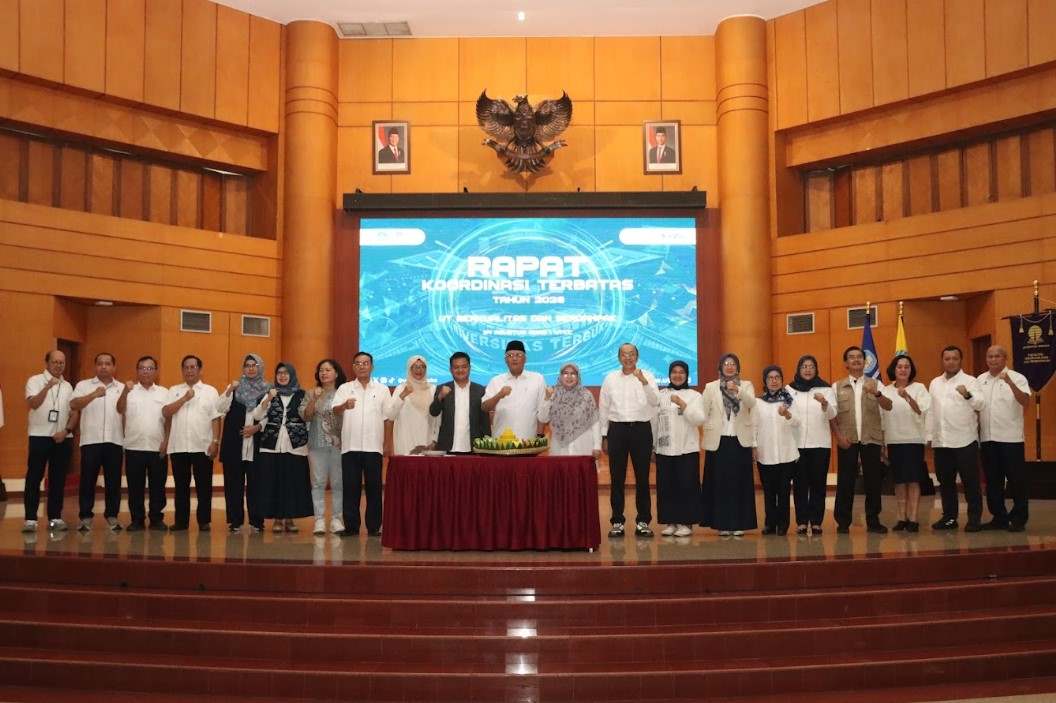
This spirit became one of the key themes of the 2026 Limited Coordination Meeting and Thanksgiving event, titled “Quality and Impactful UT,” held at the Universitas Terbuka Convention Center (UTCC) on Monday (24/8/2026). The event also marked one year of leadership under UT Rector Prof. Dr. Ali Muktiyanto, S.E., M.Si., providing an opportunity to review achievements and prepare for the next steps.
“It is special because it marks one year of leadership. It is a marker of the success we have achieved up to this day,” Prof. Ali said.
856,444 Students, Greater Challenges for UT
Student growth has become one of the clearest indicators of UT’s development. The number of paying students increased from 412,697 in 2022 to 525,419 in 2023, 671,967 in 2024, 768,248 in 2025, and reached 856,444 students in 2026. Meanwhile, the number of new students this year reached 180,125.
However, such a large figure also brings a new challenge: how can UT ensure that this growth is accompanied by quality capable of meeting the needs of hundreds of thousands of students?
For Prof. Ali, the answer must begin with the core of higher education itself: academics. Therefore, the presence of heads of study programs at the coordination meeting was important to reorganize and reaffirm that academic affairs remain at the center of all UT activities.
“We need to reorganize and reaffirm that academics are our core product,” Prof. Ali said.
In response to this need, various continuous improvement agendas have been developed to keep pace with the increasingly large scale of services. In the registration process, UT has strengthened integrated service systems, service time standards through Service Level Agreements (SLAs), and an Admissions Nurturing System through WhatsApp reminders and assistance with course registration. Cancellation and registration revision mechanisms, as well as data reconciliation, are also continuously being improved by strengthening the roles of study programs and UT Regional Offices.
Once students are connected to academic services, attention turns to their learning experience. The Online Tutorial (Tuton) recorded a 7.6 percent increase in the number of classes and a 4.2 percent increase in course registrations, while the number of tutors increased by 22.7 percent, improving the tutor-to-Tuton-class ratio from approximately 1:3 to 1:2.7.
Further improvements have focused on learning quality through learning analytics, integration of the Learning Management System (LMS) with examination systems and LENTERA, year-round LMS access, and AI-based development for tutors and students. In examination administration, UT has also developed more user-friendly automated online proctoring, mobile proctoring, improved question quality, modular examination systems, and integration of regular and remedial examinations.
The growth of services also requires increasingly efficient resource management. In the distribution of learning materials, the integrated procurement model presented at the coordination meeting recorded an average cost of approximately IDR 52,336 per copy, compared with around IDR 105,509 under the previous model when all cost components were taken into account, making it approximately 50.4 percent more efficient.
From Distance Education to Expanding Impact
However, an increasingly sophisticated system still requires people capable of operating and developing it. Therefore, strengthening human resources has become an important part of UT’s journey, ranging from competency improvement to capacity development and employee welfare.
From August 25, 2025, to August 24, 2026, a total of 517 lecturers obtained certification, with a certification application success rate of 97.4 percent. As many as 39 lecturers participated in international seminars or conferences in 12 countries, 114 employees were actively pursuing further studies, and 79 training activities were conducted.
These efforts also extended to the work environment. A total of 5,839 people received health insurance coverage, 84 promotions were processed through SIASN, and flexible working arrangements were facilitated through SISMA. These initiatives form part of UT’s efforts to maintain quality, global competitiveness, and the welfare of its human resources.
At the institutional level, UT has also strengthened its foundations to ensure sustainable growth as a State University with Legal Entity status (PTN-BH). The development of services through Klinik UT, the Training & Certification Institute, MICE Hospitality, and IT Solution is aimed, among other things, at strengthening non-tuition revenue and the university’s financial resilience.
At the same time, the development of UT Regional Offices, the restructuring of SALUT, investment in information technology, the development of the International Convention and Exhibition (ICE) facility, and the utilization of endowment funds have become part of UT’s strategic agenda moving forward. All of these initiatives are being prepared to strengthen UT’s capacity to fulfill its higher education mandate while reaching an increasingly wider population.
However, amid all these changes, one thing must not shift: UT’s identity as a public university with its distinctive focus on distance education (PJJ).
“We are changing the way we work, operate, and think, but we remain grounded in distance education. We are a different kind of public university, and UT is a distance education institution. UT’s uniqueness and distinctiveness are our fundamental assets for growth and development,” Prof. Ali said.
This distinctiveness also means that UT’s journey is far from over. Many parts of Indonesia still need access to higher education, requiring UT to move faster and on a larger scale while maintaining the highest quality, efficiency, and measurable outcomes.
At this point, UT’s growth meets the meaning of impact. Expanding access while strengthening educational quality reinforces UT’s contribution to SDG 4 on Quality Education, particularly by opening inclusive learning opportunities for communities across different regions.
For Ali, the achievements of his first year in leadership should not be viewed as the end of a period.
“Success is not only about a change in leadership, but about becoming part of sustainable progress,” he said.
He concluded his message by highlighting five qualities that leaders need to possess: competence, acceptability, integrity, loyalty, and the ability to set priorities.
Ultimately, 856,444 students and 180,125 new students are not merely numbers. Behind them are people working while studying, families striving to pursue education, and communities across Indonesia seeking opportunities to move further forward.
Therefore, UT’s task ahead is not simply about becoming bigger. The challenge is to ensure that every stage of growth delivers better quality and more meaningful opportunities. Because when distance is no longer a reason to stop learning, UT’s success should not be measured only by how many people it reaches, but by how far education enables them to move beyond where they started.