
PANGIAN — For the people of Nagari Pangian, a learning space now carries a broader meaning. In facing life after a disaster, access to information, technology, and knowledge has become an important part of strengthening both community preparedness and resilience.
This spirit has encouraged Universitas Terbuka (UT), together with Universitas Negeri Yogyakarta (UNY), Universitas Negeri Padang (UNP), Universitas Pendidikan Indonesia (UPI), and several partners, to strengthen the capacity of the people of Nagari Pangian through a collaborative Community Service Program (Pengabdian kepada Masyarakat – PkM).
One of its initiatives is the development of the “Medan Nan Balinduang” Smart Learning Center, based on the BASAMO digital platform. The learning center is designed as a space that brings together technology, knowledge, and the learning needs of the community, including materials on preparedness and psychological support in a post-disaster context.
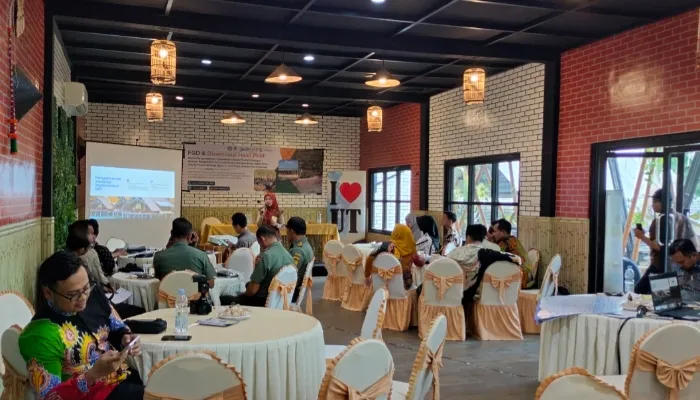
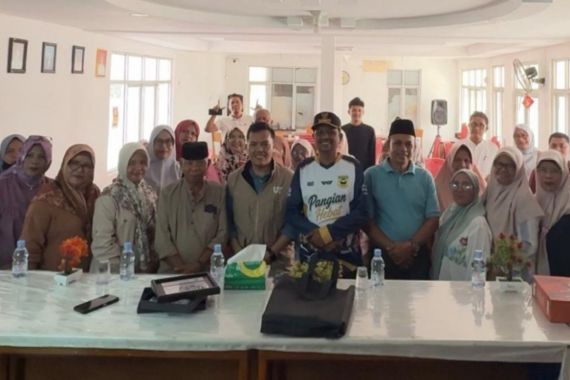
To ensure that the learning space can be utilized over the long term, strengthening the capacity of local cadres has become one of the program’s main priorities. UT lecturer Apri Kasman, M.Pd., provided training for Nagari Pangian cadres on the use of technology and various digital learning resources.
“Through this capacity-building effort, the Smart Learning Center is expected not only to function as a physical facility, but also to develop into a community learning center that can be managed and utilized sustainably,” he said on Tuesday (August 25).
This approach places cadres and community members at the center of the program’s sustainability. They are not merely facility users, but also have the opportunity to manage, utilize, and develop the learning center according to the needs of their respective communities.
The role of the nagari government is also an inseparable part of the initiative. Wali Nagari Pangian, Hijraj Adi Syukria also supports the implementation of the program, particularly in maintaining the sustainability of the facilities and learning system after the PkM activities have ended.
At the same time, UT and its partners are developing a Learning Management System (LMS) to be used in the targeted nagari areas. The platform is being prepared as a digital learning space that enables community members to access learning materials and support resources in a more structured and flexible manner. In this way, the learning process is expected to continue even after the series of PkM activities has ended.
“This approach places post-disaster recovery not only on the reconstruction of physical infrastructure,” he said.
The development of the Smart Learning Center is in line with SDG 4 on Quality Education through expanded access to technology-based learning, as well as SDG 11 on Sustainable Cities and Communities through strengthening community capacity to build more resilient and adaptive communities.
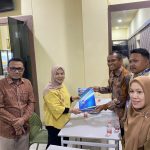
To support the use of the technology, UT provided Nagari Pangian with a grant consisting of laptops and a projector. The equipment is expected to expand access to digital-based learning while supporting various educational activities at the Smart Learning Center.
“With this support, the community is expected to be able to manage the Smart Learning Center independently and sustainably,” he said.
Nagari Pangian is one of three nagari selected as locations for the collaborative PkM program. The initiative brings together higher education institutions, nagari governments, community cadres, and various partners to combine expertise, resources, technology, and academic experience in addressing community needs.
The UT team involved in the program consists of Erna Risnawati, M.Si., Siti Utami Dewi Ningrum, M.A., Apri Kasman, M.Pd., Mutia Kamalia Mukhtar, M.Si., and Dola Suciana, M.Pd.
Ultimately, what the program seeks to leave behind is not merely a room equipped with digital devices. It is a learning ecosystem that is expected to remain active: cadres capable of driving it, technology that can be utilized, and a community with a space to continue sharing knowledge.
After all, the sustainability of a program is not always measured by what is provided on the day it is implemented, but by what continues to grow afterward. In Nagari Pangian, the “Medan Nan Balinduang” Smart Learning Center is expected to become one of the spaces that keeps this process moving, for today, tomorrow, and beyond.