
KUPANG — For some prospective regional students for the university, pursuing higher education is not simply a matter of choosing a study program. Distance, access to services, and the availability of supporting facilities are often part of the journey that must be considered. Therefore, when educational access is expanded closer to where people live, opportunities to continue their studies become more accessible.
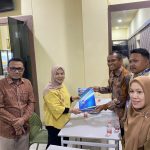
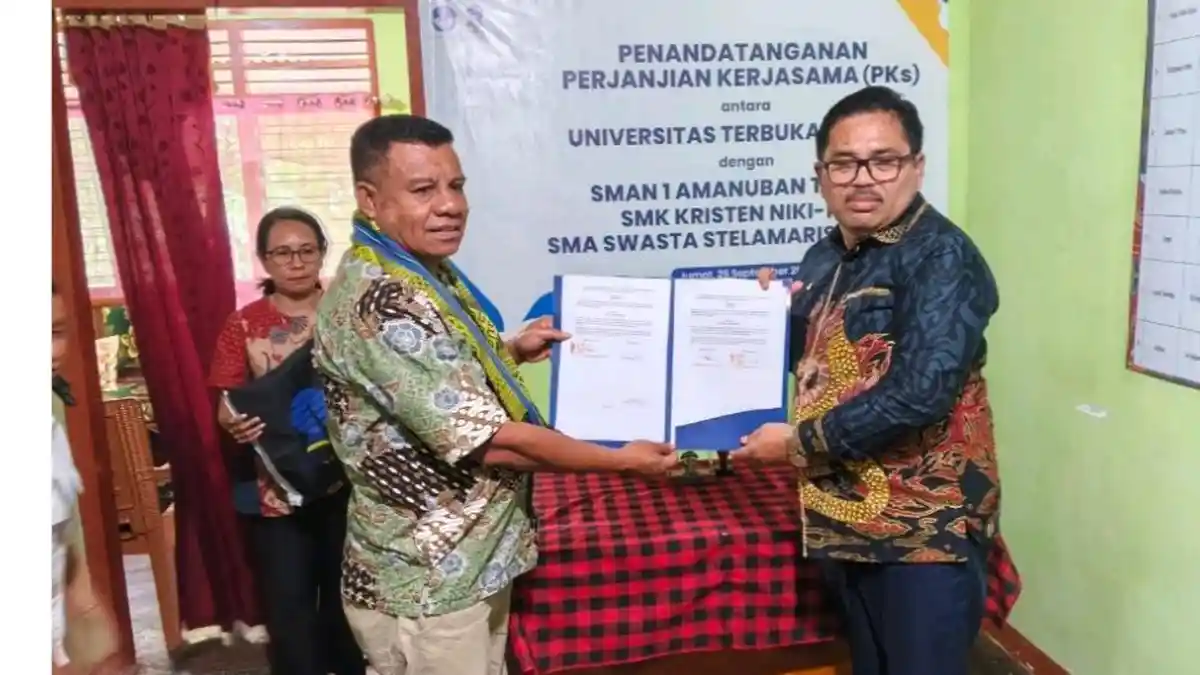
This effort was carried out by Universitas Terbuka (UT) Kupang together with the UT Service Center (SALUT) Niki-Niki through the signing of a Cooperation Agreement (Perjanjian Kerja Sama – PKS) with three schools in Kabupaten Timor Tengah Selatan (Timor Tengah Selatan), Nusa Tenggara Timur, on Friday (September 25, 2026). The three schools were SMAN 1 Amanuban Tengah, represented by Principal Ebenhaizer H. Kase, S.Pd., M.Pd., SMKS Kristen Niki-Niki, represented by Principal Muti Nakamnanu, S.Pd., and SMA Swasta Stella Maris Niki-Niki, represented by Principal Fransiskus Rivandi Koa, S.Fil. Representing UT Kupang was Director Dr. Albert Gamot Malau, S.Si., M.Si., accompanied by operational and service staff.
The cooperation covers support for new student recruitment, the learning process, the utilization of partner school facilities, and student participation in various campus activities. With this scope, the collaboration is not only aimed at introducing higher education options to students but also at providing closer academic support for UT students in the Timor Tengah Selatan area.
Principal of SMAN 1 Amanuban Tengah Ebenhaizer H. Kase welcomed the cooperation. According to him, synergy among educational institutions can help create continuity from secondary education to higher education.
“Our school has entered into many cooperation agreements in line with the direction of the Governor of Nusa Tenggara Timur to continue promoting educational synergy. We fully support this cooperation so that secondary school graduates have certainty and greater ease in continuing their studies at the higher education level,” Ebenhaizer said.
From UT Kupang’s perspective, the collaboration is aimed at supporting the improvement of human resource quality while also encouraging student enrollment growth in Niki-Niki and surrounding areas.
“The main objective of this cooperation agreement is to improve the quality of local human resources while also encouraging growth in the number of students in Niki-Niki and surrounding areas,” Dr. Albert said.
The strengthened cooperation also builds on the role of SALUT Niki-Niki in supporting UT services in Timor Tengah Selatan. Currently, SALUT Niki-Niki serves 324 active students. Its educational network has also been established for many years. During the 2005–2019 period, SALUT Niki-Niki recorded partnerships with eight schools in Kabupaten Timor Tengah Selatan.
Following the signing of the cooperation agreement, the UT Kupang team continued the activity with a field visit to the three partner schools. The visit was conducted to verify the readiness of school facilities and infrastructure that could potentially be used as UT Final Semester Examination (UAS) venues.
This step serves as a concrete follow-up to the newly established cooperation. If the partner schools can be used as examination venues, UT students living around Niki-Niki will no longer need to travel long distances to the city center to take their semester examinations.
For students, this convenience means more than simply changing the examination location. The time and energy normally spent traveling can be reduced, while existing school facilities can be utilized to support academic services. By bringing services closer in this way, opportunities to participate in higher education are made available not only to those living near service centers but also to communities in more remote areas.
For schools, meanwhile, this involvement creates broader opportunities to contribute to the sustainability of education in their communities. Schools are not only places where secondary education takes place but can also become part of an ecosystem that helps students and communities continue their education at a higher level.
This collaboration also demonstrates how an educational network can be built upon existing local potential. Schools serve as spaces connecting prospective students with information and opportunities for higher education, SALUT supports services at the local level, while UT ensures that learning opportunities remain accessible to the people of Timor Tengah Selatan.
This collaborative approach reflects the spirit of SDG 4 on Quality Education, particularly in expanding access to inclusive and equitable education. At the same time, efforts to bring academic services closer to students’ places of residence also address the challenge of unequal access to education highlighted by SDG 10 on Reduced Inequalities.
Ultimately, expanding access to education is not merely about increasing the number of services but ensuring that learning opportunities can genuinely be reached by those who need them. From Niki-Niki, UT Kupang, together with SALUT and its partner schools, is working to bring these opportunities closer so that distance does not become a reason to stop pursuing higher education.