
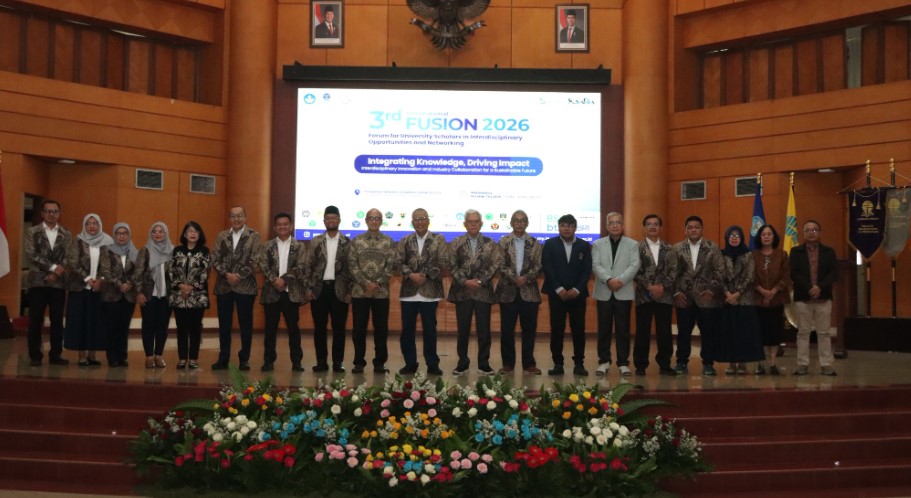
SOUTH TANGERANG — Research may begin in a classroom, laboratory, or at a researcher’s desk. However, its true value is only felt when that knowledge moves beyond the academic space, is applied, and addresses societal challenges. The spirit of bringing research to that stage became the common thread of The 3rd International Conference on Forum for University Scholars in Interdisciplinary Opportunities and Networking (FUSION) 2026, an international forum organized by Universitas Terbuka (UT) to bring together various disciplines and open opportunities for collaboration among higher education institutions, research institutions, industry, government, and other partners.
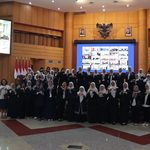
Carrying the theme “Integrating Knowledge, Driving Impact: Interdisciplinary Innovation and Industry Collaboration for a Sustainable Future,” FUSION 2026 provided a space for bringing together diverse areas of expertise to address increasingly complex challenges. The event, organized by UT Graduate School on Wednesday (October 7, 2026), involved 32 higher education institutions as co-hosts and was attended by approximately 230 participants, both in person and online.
UT Rector Prof. Dr. Ali Muktiyanto, S.E., M.Si., viewed FUSION not merely as an academic forum, but as part of UT’s efforts to build a tradition of impactful research. According to him, successful research in the future cannot be achieved alone. Higher education institutions need to build networks with research institutions, industry, government, and international partners.
“This is not merely a seminar, but proof that UT is concerned not only with being a teaching university, but also with research that creates impact,” Ali said.
The message found its relevance in the presentation by Head of BRIN Prof. Dr. Arif Satria, who emphasized the importance of changing how knowledge is produced, connected, and utilized. According to him, technological advances such as artificial intelligence, biotechnology, and digital technology are emerging alongside cross-sectoral challenges, ranging from food security, health, and climate change to energy and social inequality.
Therefore, research must not stop at publications, patents, or prototypes. Knowledge must move toward application, adoption, and impact.
“It is not only about what knowledge we have produced, but also who uses it, what problems it solves, and what value it creates,” he said.
Deputy for Human Resources, Science, and Technology at BRIN Prof. Edy Giri Rachman Putra, Ph.D., then opened opportunities for more concrete collaboration between BRIN and UT. Such support could be provided through research funding, the utilization of infrastructure and laboratories, talent mobility, and the development of collaborative research.
Edy also encouraged stronger cooperation through professors’ research groups and the Institutional Collaborative Research (Riset Kolaborasi Institusi – RKI) scheme. The possibility of establishing a joint research collaboration center between UT and BRIN was also discussed as a follow-up to FUSION 2026.
Director of the UT Graduate School Prof. Drs. Ojat Darojat, M.Bus., Ph.D., also welcomed the opportunity as a momentum to strengthen UT’s position within the national and international research ecosystem. According to him, collaboration is essential so that research developed by higher education institutions can have a broader reach and greater benefits.
This spirit also strengthens FUSION 2026’s contribution to SDG 4 on Quality Education. The gathering of academics and researchers at this forum demonstrates the importance of education that not only produces graduates, but also builds human capacity to continue learning, adapt, and respond to future challenges.
On the other hand, the drive to transform knowledge into applications and innovations is in line with SDG 9 on Industry, Innovation, and Infrastructure. Research connected with technology, industry, and community needs creates opportunities for academic outcomes to move beyond publication spaces and develop into solutions with real value and impact.
Meanwhile, the involvement of UT, BRIN, higher education institutions, industry, and various partners in FUSION 2026 reflects the spirit of SDG 17 on Partnerships for the Goals. Addressing increasingly complex challenges requires strength built collectively rather than through isolated efforts.
Ultimately, FUSION 2026 conveyed a simple yet important message: major challenges do not recognize the boundaries of academic disciplines. When knowledge is brought together, talent is strengthened, and institutions are willing to collaborate, research has a greater opportunity to evolve into innovations that are truly felt by society. From UT’s conference space, the idea found its foundation that the future is not enough to be studied, it needs to be created together.