
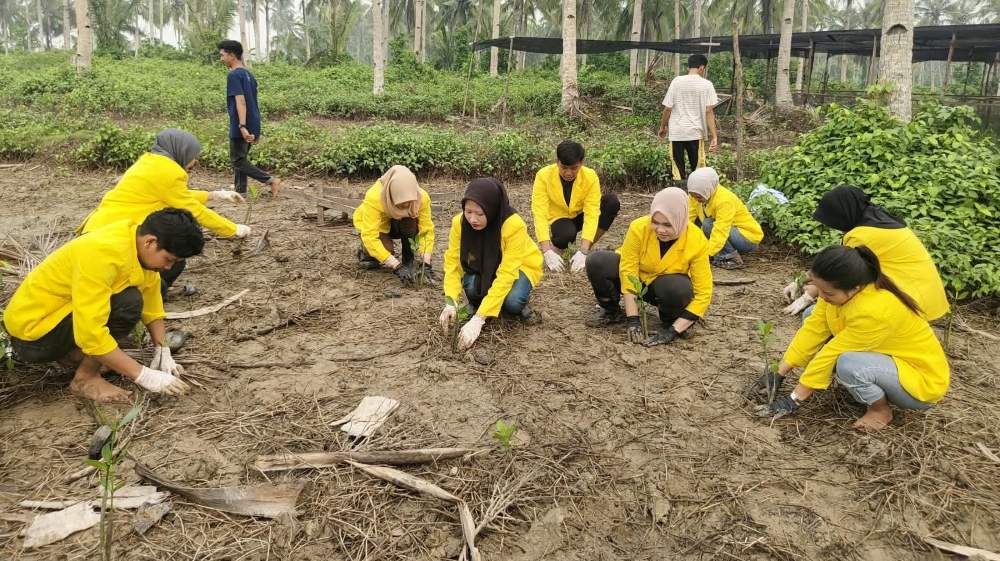
MEMPAWAH — Protecting coastal areas requires more than simply recognizing the importance of the environment. Concrete action and collaboration are needed to preserve nature for future generations. This spirit was put into practice by Universitas Terbuka (UT) through SALUT Mempawah in collaboration with Akar Tanjung Lestari in a mangrove-planting activity in Mempawah, Kalimantan Barat, on Sunday (October 18, 2026). More than just planting trees, the activity served as a shared learning opportunity for students and the community to gain a closer understanding of the importance of protecting coastal ecosystems.
As part of the Community Empowerment Program, the activity was designed to foster environmental awareness while strengthening education about mangrove conservation. Through direct fieldwork, students and community members exchanged knowledge. Students shared their understanding of the role mangroves play in protecting coastal areas from the threat of erosion, while community members shared their experiences in dealing with environmental issues and the various conservation efforts already undertaken in their local area.
This collaboration is important because academic knowledge and community experience can complement one another. Akar Tanjung Lestari Chair Muhammad Iqbal described the activity as a positive step toward building shared awareness of the importance of environmental conservation, particularly the preservation of mangrove ecosystems in coastal areas.
“In my opinion, this activity is not merely about planting mangrove trees, it also provides a space for students and community members to share knowledge and educate one another. Students bring academic knowledge, while community members have firsthand experience in dealing with various environmental issues in coastal areas,” Muhammad Iqbal said.
From Planting to Protecting Coastal Areas
Beyond the planting activity itself, the initiative also demonstrates that higher education can deliver tangible benefits when learning is applied directly within communities. Muhammad Iqbal emphasized that student involvement should not end with the implementation of an academic program but should continue through education, mentoring, and actions that benefit the surrounding environment.
This spirit aligns with Sustainable Development Goal (SDG) 4 on Quality Education. Through this activity, students not only gain knowledge in the classroom but also learn to apply it to address real-world challenges in society. In this way, field experience becomes an important part of both the learning process and community service.
However, efforts to protect coastal environments cannot be entrusted to a single party. According to Muhammad Iqbal, environmental issues require the involvement of various stakeholders, including universities, community organizations, young people, and local residents. Therefore, sustained collaboration is essential to ensure that mangrove conservation does not end as a ceremonial activity.
This cross-sector collaboration reflects the spirit of SDG 17 on Partnerships for the Goals. At the same time, efforts to protect and maintain mangroves also support SDG 14 on Life Below Water, particularly in preserving the sustainability of coastal ecosystems. This means that the success of the initiative is determined not only by the number of trees planted but also by the shared commitment to maintaining them.
“Our hope is that this activity will not stop at planting mangroves. There must be continuity, maintenance, and shared awareness to protect the trees that have been planted,” he added.
This hope serves as a reminder that planting mangroves is only the first step in the long-term effort to protect the environment. Through this initiative, SALUT Mempawah and Akar Tanjung Lestari are expected to continue strengthening their partnership to improve public understanding, foster environmental awareness, and encourage young people to take an active role in coastal conservation. The benefits of mangroves do not end on planting day, they grow alongside the commitment to care for them, to protect coastal areas, sustain life, and leave a better environment for future generations.