
PURWOKERTO – The journey toward graduation is always filled with targets: completing assignments, passing examinations, finishing coursework, and finally earning the degree that has been pursued. However, behind that achievement lies another journey that is just beginning, bringing the knowledge gained to understand change and create benefits for society.
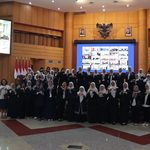
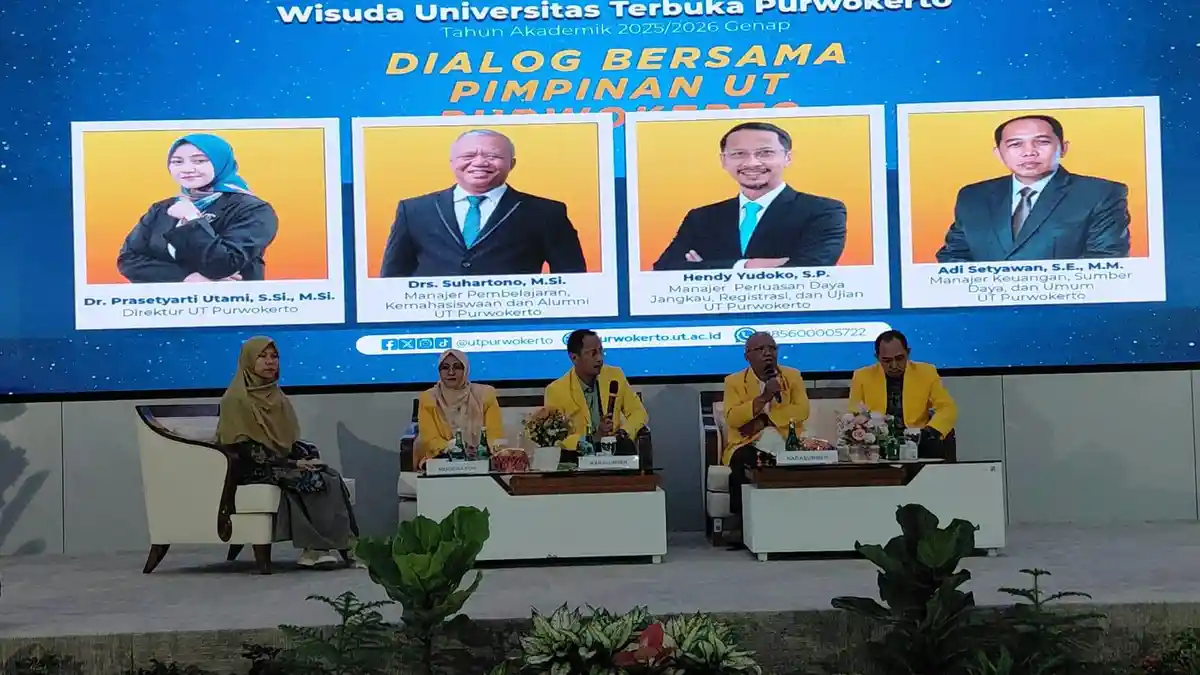
This message became the common thread of the Academic Seminar held as part of the Universitas Terbuka (UT) Purwokerto Graduation for the 2025/2026 Academic Year, held on the fourth floor of the UT Purwokerto Building on Monday (October 5, 2026). Carrying the theme “The Role of the Academic Younger Generation in Driving Regional Innovation and Sustainable Economic Independence,” the seminar invited 875 prospective graduates to view education not merely as a path toward a degree, but as a foundation for understanding change and delivering solutions.
Director of UT Purwokerto, Dr. Prasetyarti Utami, S.Si., M.Si., said that the challenges facing the younger generation are becoming increasingly complex. Developments in digital technology, artificial intelligence (AI), as well as transformations in the world of work and the global economy require university graduates to continue adapting.
“Therefore, we need a younger generation that is able to keep up with these changes, while also having the ability to create innovations and make real contributions. Universitas Terbuka is committed to opening the widest possible access to education,” Prasetyarti said.
According to her, these challenges also create opportunities for alumni to take on a greater role. With the knowledge, experience, and networks they have built throughout their education, UT graduates have the foundation to recognize the potential around them while responding to problems faced by society.
At this point, problems do not always have to be viewed as obstacles. Instead, issues within society as well as the potential possessed by regions can become spaces to try new ideas, experiment, and eventually produce impactful innovations.
“We hope that our alumni will have greater awareness and sensitivity, as well as the experience and networks to create change,” she said.
However, driving innovation and building regional economic independence is certainly not the responsibility of a single party. Collaboration among local governments, higher education institutions, businesses, and the younger generation is needed to build an ecosystem capable of transforming local potential into sustainable economic strength.
This perspective was enriched by the presence of two speakers from different backgrounds. Prof. Dr. Icuk Rangga Bawono, Professor at the Faculty of Economics and Business (FEB) of Universitas Jenderal Soedirman (Unsoed), delivered a presentation entitled “Re-Think, Re-Use, Re-Grow: A New Direction for Regional Innovation from a Green Economy Perspective,” encouraging participants to view regional development through a green economy approach.
Meanwhile, Customer Success Associate at Kinobi, Najla Afiyah Hijrina Hadiyansah, delivered a presentation entitled “Empowering Potential to Driving Innovation,” emphasizing the importance of empowering potential as a foundation for encouraging innovation.
The two perspectives reinforced one message: education does not end when a diploma is received. Instead, once a degree has been earned, the responsibility to create meaning becomes even greater.
Therefore, prospective graduates of UT Purwokerto are encouraged to take home more than just knowledge. They are expected to have the courage to see opportunities, remain sensitive to problems, dare to try, and turn ideas into actions that benefit their surrounding communities.
This spirit is in line with SDG 4 (Quality Education), as well as SDG 8 (Decent Work and Economic Growth) and SDG 9 (Industry, Innovation, and Infrastructure). Ultimately, education is not merely about how far a person advances, but about how far their knowledge can contribute to driving change.