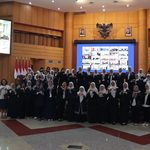

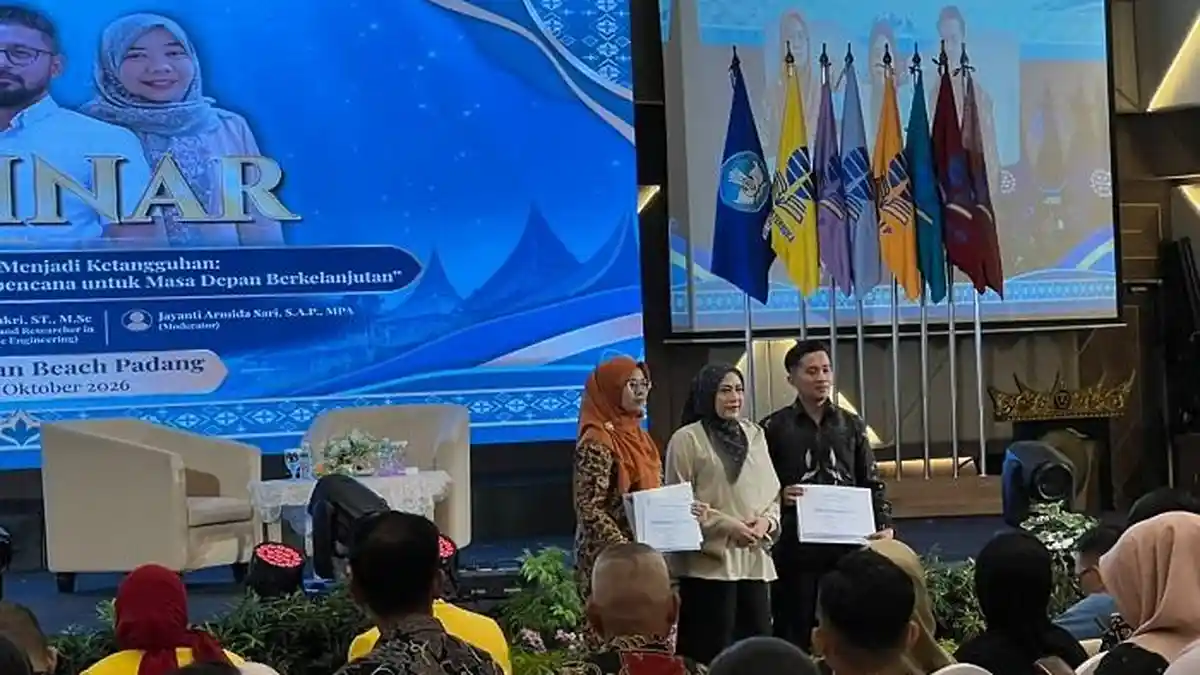
PADANG — Education finds its meaning when knowledge does not remain a personal achievement but is transformed into actions that benefit the environment and society. Ahead of its graduation ceremony, Universitas Terbuka (UT) Padang brought this message to a public seminar themed “From Knowledge to Resilience: Education, Environment, and Disaster Mitigation for a Sustainable Future” at Pangeran Beach Hotel on Saturday (October 3, 2026).
The seminar, attended by hundreds of students, provided prospective graduates with an opportunity to broaden their perspectives on the role of education in addressing real issues in society, particularly environmental issues and disaster mitigation, which are highly relevant to the conditions in West Sumatra.
Director of UT Padang, Mery Berlian, said the activity served as a momentum for students to enrich their knowledge while understanding how the knowledge they acquired during their studies could be applied after returning to their communities.
“Today, we are gathering to enrich our knowledge, and tomorrow we will hold the UT Padang Graduation Ceremony,” Mery said in her remarks.
According to Mery, West Sumatra has abundant natural resources as well as potential disaster threats that require community preparedness. Under these conditions, education should not merely produce knowledge but also build awareness that encourages people to recognize and respond to risks.
“Education plays a very important role. Knowledge must be transformed into awareness. Awareness must become preparedness,” she stressed.
This perspective broadens the meaning of the academic achievements that prospective graduates will carry with them. The degrees they receive are not merely markers of successful completion of education but also provide a foundation for taking part in addressing issues in their respective communities.
“This message is very important. The degree received is not the end of the learning process, but brings new responsibilities and calls on graduates to be present in society through what they have gained from UT,” she said.
The application of knowledge can begin with things close to everyday life, such as identifying disaster risks in residential areas, developing environmental awareness, and helping communities obtain accurate and accountable disaster-related information.
This expectation is in line with the spirit of the Sustainable Development Goals (SDGs), particularly SDG 4 on Quality Education, which places education as a foundation for increasing knowledge and community capacity. At the same time, environmental awareness and preparedness for disaster risks are also related to SDG 11 on Sustainable Cities and Communities, which promotes safer and more resilient communities and environments.
“We hope that students will become agents of change, build environmental awareness, understand disaster risks in their communities, and disseminate accurate information,” Mery continued.
The perspective on preparedness was further explored by Andi Syukri, an engineer and researcher in earthquake engineering and a lecturer in Civil Engineering at Politeknik Negeri Padang (PNP). During an interactive discussion moderated by Jayanti Armida Sari, Andi encouraged participants to understand disasters as risks that need to be identified and anticipated, rather than merely problems to be addressed after they occur.
“Disasters are beside us, we will coexist with disasters. A disaster occurs when it intersects with the economy and infrastructure,” Andi said.
Therefore, preparedness needs to be built before a disaster occurs. Communities, including the academic community, need to develop awareness to assess environmental conditions, understand potential risks, and take appropriate preventive measures.
“We must remain alert to disaster situations. We have to prepare ourselves before a disaster occurs, rather than focusing only on disaster response,” he concluded.
Through the seminar, UT Padang positioned education as part of efforts to build a more resilient society. For prospective graduates, the knowledge acquired during their studies is expected not to remain merely an academic achievement but to develop further into awareness, preparedness, and concrete action within their respective communities.