
Tangerang Selatan – A ship is not built to remain anchored at the dock forever. It must sail, navigate the waves, face changing winds, and then find a new destination.
Likewise, Universitas Terbuka (UT) as it enters its 42nd year. For a higher education institution established from the outset to open access to higher education as widely as possible, growing older is not a reason to stop. Instead, it is a momentum to look again at how far education can reach more people and create a broader impact.
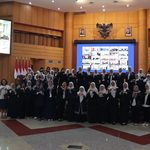
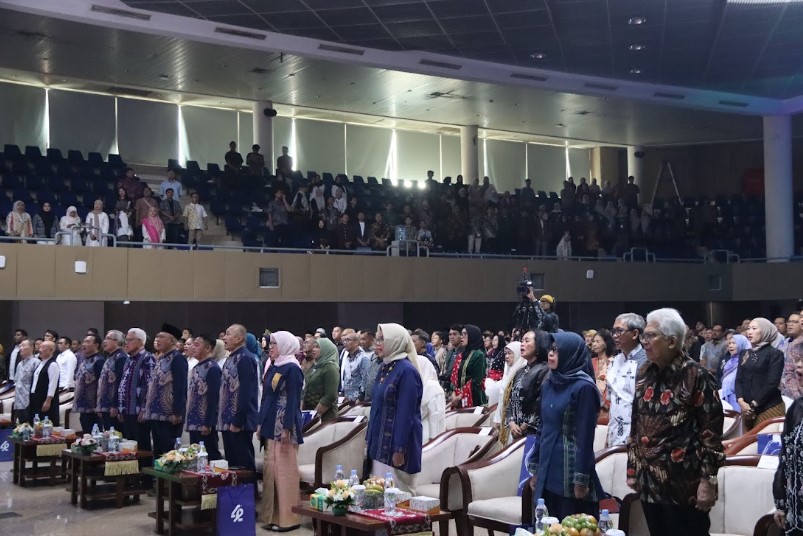
That spirit was evident at the peak of UT’s 42nd Dies Natalis, themed “Going Global with Innovation, Making an Impact for the Nation.” UT Rector Prof. Dr. Ali Muktiyanto, S.E., M.Si. emphasized that UT must not become complacent with its achievements. Amid rapid technological changes and evolving societal needs, higher education institutions must be able to bring the future into the present.
The change is now visible in UT’s increasingly digital landscape. Students can access academic processes, from admission and learning to examinations, through a continuously strengthened digital ecosystem. Even as the number of students continues to grow, tutorial and examination services are also being developed to accommodate learning needs on a large scale.
Behind this transformation, there is one thing that must not be lost: quality.
UT continues to improve its curriculum, update teaching materials, strengthen its learning system, while also encouraging lecturers and researchers to produce more scholarly works. These efforts are part of UT’s journey to ensure that education accessible from anywhere continues to maintain strong academic standards.
Public trust is also reflected in UT’s current student population, which has reached 856,444. This figure also brings UT closer to the ambitious target set by the Rector: serving 1 million students.
However, one million is not merely a number. Behind it are one million journeys, aspirations, and different reasons why someone chooses to continue learning. Some work while studying, live far from educational centers, or need a more flexible learning environment. This is where UT’s original mission once again finds its relevance: providing higher education for those who need access.
The spirit of expanding access also goes hand in hand with UT’s commitment to sustainable development. In the THE Sustainability Impact Ratings 2026, UT was ranked 801–1000 globally and has contributed to all 17 Sustainable Development Goals (SDGs).
This means that for UT, education does not stop at teaching and learning activities. Education becomes a gateway to expanding opportunities, reducing inequality, encouraging innovation, opening up employment opportunities, and building a more sustainable society. This value is particularly aligned with SDG 4 on quality education, while also intersecting with SDG 8 on decent work and economic growth and SDG 10 on reduced inequalities.
The next steps are also being prepared. UT will develop a Vocational School designed to be more closely aligned with the needs of the workforce. Partnerships with industries and various institutions will be an important part of ensuring that students not only learn theory but also gain relevant practical and internship experience.
For Ali, such a major journey cannot be undertaken alone. He described the UT extended family as a superteam. “There is no superman at UT, there is a superteam. We are all a superteam!”
The message served as a simple yet important closing. After 42 years, UT’s journey is, in fact, far from over.
From Tangerang Selatan, the great ship is once again preparing to sail. Its goal is not merely to become a higher education institution with the largest number of students, increasingly sophisticated technology, or a higher ranking. More than that, UT wants to ensure that more people have the opportunity to learn, grow, and change their future.
Because ultimately, going global is not about how far UT can go, but how broadly the benefits it brings home can serve the nation.