
DEPOK — When violence occurs within the home, the phrase “settle it as a family” is often seen as the easiest solution. However, for victims of domestic violence, deciding to reconcile does not always mean the problem has truly been resolved. In certain cases, pressure to reconcile should not come at the expense of victims’ rights to protection and justice.
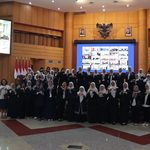
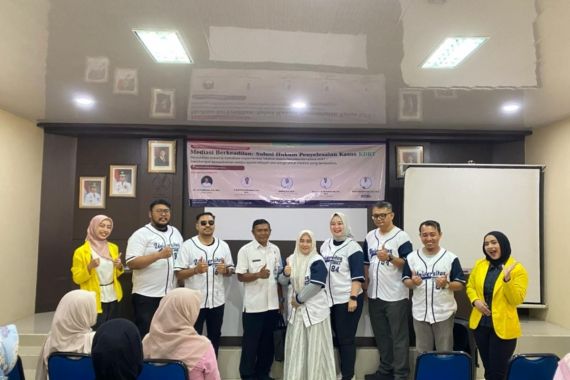
This is the issue Universitas Terbuka (UT) sought to address when it provided legal education to dozens of residents in Kelurahan Bojongsari Baru, Kota Depok. Through a public legal education session titled “Mediation with Justice: Legal Solutions for Resolving Domestic Violence Cases,” residents were equipped with practical knowledge to recognize domestic violence, understand victims’ rights, and determine the appropriate legal steps when violence occurs.
Head of the Law Study Program at Universitas Terbuka, Madiha Dzakkiyah Chairunnisa, S.H., LL.M., said that the public needs to understand that domestic violence cases do not always end with mediation.
“This is so that the public can not only recognize the forms of domestic violence, but also understand victims’ rights and the available legal resolution options,” Madiha said recently.
This knowledge is important because in everyday life, people may find themselves as victims, victims’ families, neighbors, or the first people to become aware of violence. Misunderstanding legal procedures and available options can make victims even more vulnerable.
During the forum, moderated by Bahir Mukhammad, S.H., M.H., Dr. Seno Wibowo explained various forms of domestic violence based on Law No. 23 of 2004 on the Elimination of Domestic Violence. Residents were invited to understand the position of mediation in resolving domestic violence cases, as well as situations in which legal proceedings still need to be pursued.
The discussion was then continued by A. Rachmat Wirawan, S.H., M.H., who reviewed the basic principles and techniques of mediation. He emphasized the importance of maintaining a balance between the parties while protecting the interests of victims. In this way, mediation does not become a space that instead pressures victims to accept agreements that disadvantage them.
A legal issue does not automatically end simply because both parties say they have reached an agreement. Head of the Community Service Program (PkM) Team, Meliza, S.H., M.H., explained that agreements reached through mediation must still be properly drafted to have legal force.
“The issue does not end when the parties reach a reconciliation. An agreement arising from the mediation process also needs to be properly drafted so that it has legal force,” Meliza said on Wednesday (August 19).
Meanwhile, Rivaldhy N. Muhammad, S.H., M.H., provided an understanding of the validity and binding force of a settlement deed, including legal remedies that can be pursued if one of the parties fails to carry out the agreement.
The material then developed into a discussion that was more closely connected to residents’ realities. Various questions about experiences and concerns regarding domestic violence in the surrounding community emerged during the forum. The enthusiasm demonstrated that the community’s needs go beyond simply knowing the definition of domestic violence, residents also need to understand what to do when such situations actually occur.
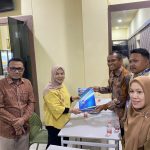
Kelurahan Bojongsari Baru representative Sabilahuli, M.SE., welcomed the legal education provided by UT.
“We would like to thank UT for providing this education to the community,” Sabilahuli said.
For UT, bringing legal knowledge into the community means opening access so that residents do not have to face domestic violence issues with limited information. In situations where someone is at their most vulnerable, knowing their rights, understanding their options, and having the courage to take appropriate action can be the beginning of real protection.
This is where legal education finds its meaning: not merely in helping people become familiar with legal provisions and procedures, but in ensuring that such knowledge is available when someone truly needs it. This effort is in line with SDG 5 on gender equality and SDG 16 on peace, justice, and strong institutions.