
In an island region of Sulawesi Tenggara, coconuts are not difficult to find. The fruit grows close to people’s daily lives and has long been part of their livelihoods. However, behind the abundance of coconuts lies a bigger question: how can these agricultural resources be processed into products with higher economic value?
That is the question that Universitas Terbuka (UT) Kendari and Universitas Halu Oleo (UHO), together with Ahbab Maju Small and Medium Enterprise (SME) in Kabupaten Konawe Kepulauan (Konkep), Sulawesi Tenggara (Sultra), sought to answer.
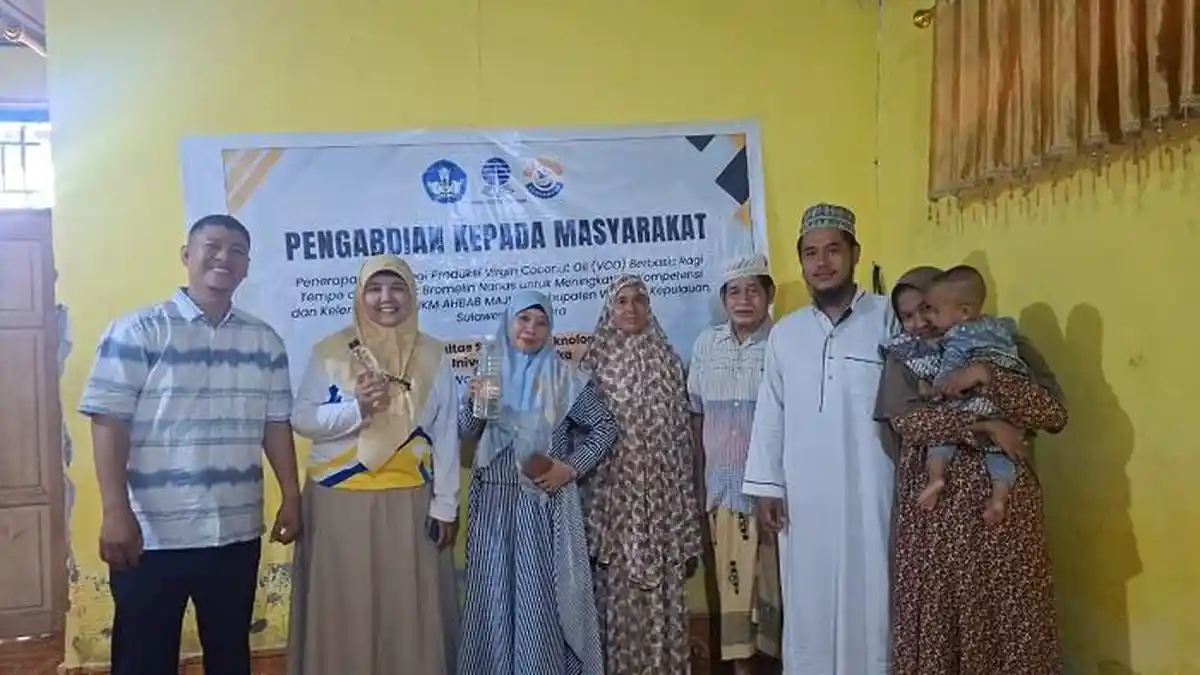
On Saturday (July 25, 2026), a team of lecturers from the two universities visited the Ahbab Maju SME’s business premises to provide assistance through a community service activity entitled “Implementation of VCO Production Technology Based on Tempeh Starter and Pineapple Bromelain Extract to Improve the Competence and Institutional Capacity of Ahbab Maju SME in Kabupaten Konawe Kepulauan.”
The activity served as a form of inter-university synergy in encouraging business operators in island regions not merely to rely on raw materials but to process local resources into products with added value and competitiveness.
One of the focuses was processing coconuts into virgin coconut oil (VCO). Interestingly, the team introduced a fermentation method using tempeh starter combined with bromelain extract from pineapples as a natural enzyme to help accelerate the oil separation process.
For SME operators, such technology is not merely a matter of production methods. Efficiency, cost, quality, and ease of implementation are crucial factors in determining whether an innovation can actually be used in daily business activities.
Head of the Implementation Team, Dr. Rina Astarika, S.P., M.P., explained that the method was selected because it is more efficient, affordable, and easier to implement than conventional heating methods.
“Therefore, it can reduce costs while providing better results in terms of both oil quality and quantity,” she said in a written statement received by TribunnewsSultra.com on Sunday (August 9, 2026).
A total of 15 members and administrators of Ahbab Maju SME participated in the activity. They not only listened to the presentation but were also invited to practice the process of producing VCO using tempeh starter and pineapple bromelain extract.
The learning process was then expanded. The lecturer team also provided assistance in institutional development and business management so that the production skills acquired could serve as a foundation for the SME’s sustainable development.
Discussions were also held on market development and product quality improvement. Thus, the assistance went beyond the question of “how to make VCO” and moved toward a broader question: “how to turn it into a business that can survive and grow.”
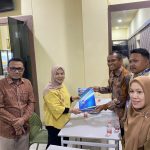
Agus Dede, Head/Representative of Ahbab Maju SME, expressed appreciation for the assistance provided. The involvement of the universities provided business operators with an opportunity to gain new knowledge and experience that could be applied to develop their businesses.
For UT Kendari and UHO, the activity represents a concrete implementation of the Three Pillars of Higher Education (Tri Dharma Perguruan Tinggi), particularly community service. This cross-institutional collaboration also demonstrates that universities are not only present in classrooms but can work alongside communities, listen to their needs, and provide knowledge that can be used to address real-world challenges.
For island communities, processing coconuts into VCO is not simply about producing a new product. It offers an opportunity to increase the value of local agricultural resources, strengthen local businesses, and create new sources of income for the community. Through the assistance provided by UT Kendari and UHO, resources that were previously available as raw materials are being developed into products with added value and broader market potential.
From Konawe Kepulauan, the journey from coconut to a bottle of VCO demonstrates that innovation does not always have to begin with complex technology. With the right knowledge, materials readily available within the community, including tempeh starter and pineapples, can become part of the path toward more independent, productive, and sustainable local businesses.