
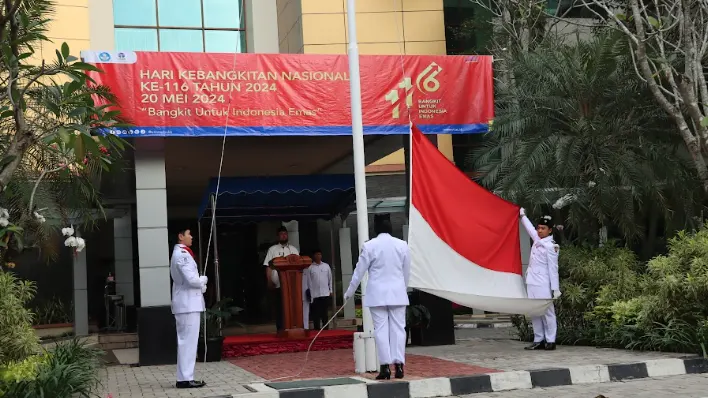
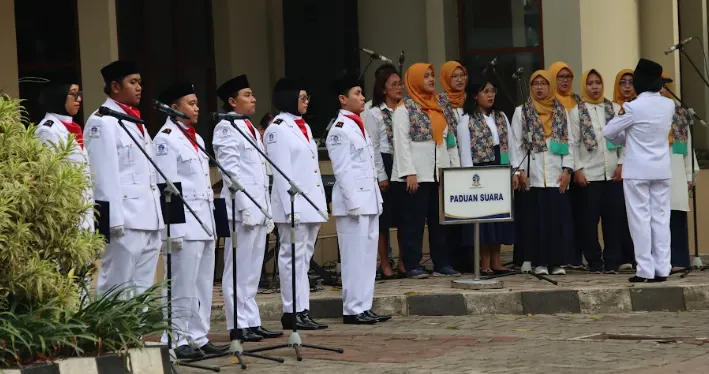
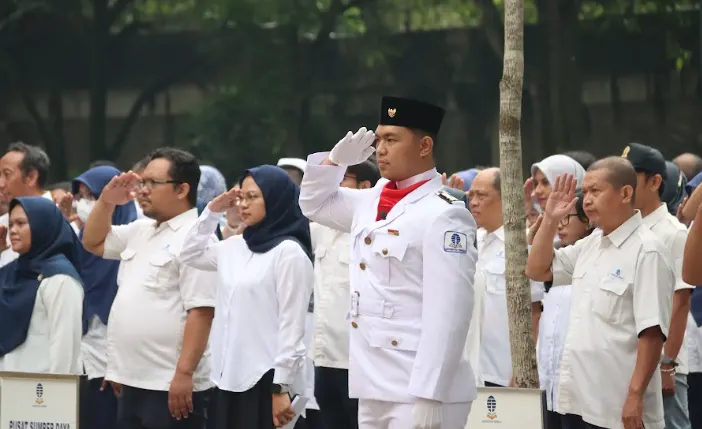
TANGSEL, May 20, 2024 – The 2024 National Awakening Day ceremony (Upacara Hari Kebangkitan Nasional) took place at UT Pondok Cabe library courtyard, starting at 8:00 AM WIB. The event began with the national anthem, “Indonesia Raya,” a moment of silence, the reading of Pancasila led by the ceremony inspector, Pembukaan UUD 1945, and concluded with a prayer.
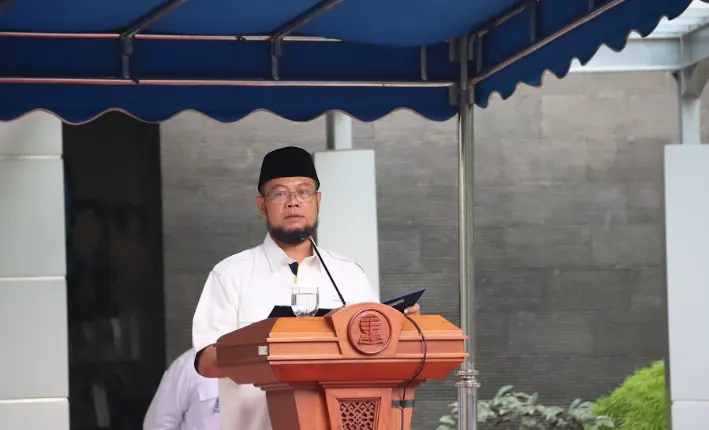
UT Rector, Prof. Ojat Darojat, M.Bus, Ph.D., served as the ceremony inspector, attended by all staff and the academic community of UT Pondok Cabe. The theme for the commemoration of this year was “Rise for Indonesia Emas.” The full speech by the Minister of Communication and Information Technology on the 116th National Awakening Day is as follows:
Assalamualaikum warahmatullahi wabarakatuh,
Shalom, Om Swastiastu, Namo Buddhaya, Salam Kebajikan, Salam Sejahtera bagi kita sekalian.
Dear fellow citizens, today, we are faced with the undeniable reality of rapidly advancing technology. We have chosen not only to participate but to become key players in this progress to reach the global stage. The next two decades are crucial for determining our steps toward achieving this goal.
Reflecting on this choice, we revisit the initial idea of forming Indonesia and how history has shaped our nation. History is essential, not for its political sensations or merely as a source of values but for ongoing conversations about progress, humanity, and welfare. Exemplary conduct is not solely attached to the past but can be determined to be in the future, with ideas that open the space for imagination of civilization.
More than a century ago, on May 20, 1908, Budi Utomo organization was established, cultivating the seeds of the dream for the independence of Indonesia. The founding of Budi Utomo has become the symbol of National Awakening Day, which we celebrate today.
Budi Utomo began with a group of doctors and medical students in Batavia forming a modern organization. Many people placed their hopes in this organization, seeing it as a driving force for the independence movement in the Dutch East Indies.
Even Van Deventer, a Dutch Ethical Policy figure, stated: “Something miraculous is happening. The beautiful Insulinde that was asleep has awakened.” Budi Utomo became the initial place for people to learn and debate about many issues, such as the importance of Western education for the people of the Dutch East Indies and spreading education to all societal levels regardless of noble status. This sparked thoughts on expanding membership to include all people of the Dutch East Indies.
Dear fellow citizens, what Budi Utomo initiated was continued by many subsequent organizations. The Javanese nationalism of Budi Utomo expanded to embrace all people in the Dutch East Indies. Education, once aimed only at Javanese nobility, was broadened to include all rakyat Bumiputera (indigenous people).
The struggle to advance Javanese culture evolved into a political struggle to drive out Dutch colonialism. The ideals nurtured by Budi Utomo culminated in the proclamation of independence.
Before Budi Utomo, there was Kartini, a woman from the small town of Jepara, who sparked the ideas of independence, freedom, equality, justice, brotherhood, and progress through her writings that spread worldwide. She articulated the aspirations for progress in Indonesia over a century ago.
In her hands, progress was formulated, detailed, and fought for, eventually becoming the property of the entire Indonesian nation. She was fully aware that in the modern era, the most powerful tool is education. Education is a means to liberate individuals and the nation from the shackles of colonialism. For Kartini, education was a pathway to unlocking new horizons and civilization for the indigenous people.
Kartini was a pioneer in imagining a societal order that was free and independent and a new ideal vision of a nation larger than its social origins. What Kartini envisioned has far surpassed her own life story.
She inspired the “small sparks,” the young “embryos of the nation,” who gradually ignited what we know as the National Awakening movement.
Indonesia’s embryo was born from modern progress and enlightenment, from educated young people who did not lose their Indonesian identity. The diverse thoughts of these young people as “embryos of the nation” formulated and fought for the ideals of independence and freedom.
The realm of independence can only be achieved if people are equal and free. Freedom and equality are possible only if people are educated. From them, the spirit of national awakening was born.
National awakening signifies the birth of a new era. It sparks new ways of thinking. The spirit of national awakening formulated independence as a means to fight for human dignity and sovereignty. What Budi Utomo, Kartini, and the nation’s embryos envisioned was later articulated by Bung Karno as the “golden bridge.”
Bung Karno envisioned independence as a golden bridge that would enable Indonesians to enjoy a prosperous life in their own land.
Bung Karno also emphasized that at the end of the golden bridge, there would always be possibilities leading Indonesia to either happiness or sorrow, which he described as “crying together or delighting together.”
Here, Bung Karno reminded us of the importance of moments for making the right and precise decisions to lead us to the path that benefits all Indonesian people.
Dear fellow citizens, today we are in the second phase of awakening, continuing the spirit of the first awakening established by the nation’s founders. Unlike the struggles initiated over a century ago, we now face new challenges and opportunities. Technological advancement marks a new era.
Technological advancement has integrated into our daily lives and become part of our civilization today. Innovations in technology have revolutionized human life. Many difficulties have been solved by technology.
The proverb of this era is clear: those who master technology will dominate civilization. At this point, it becomes evident that mastering technology is essential for us to achieve “Indonesia Emas.”
Digital technology innovation grows daily. Its pace is like a quantum leap. In the past two decades, the changes have been rapid. Digital technology, for instance, has advanced far beyond many people’s imaginations. It was unimaginable three decades ago that today would be like this.
Digital technology has overcome many human limitations. The world seems to shrink. Everything appears close, right before our eyes. Distance becomes irrelevant. Visual presence complements the presence of sound.
Meanwhile, we have immense potential and are ready to conquer the world. The demographic bonus shows that 60% of Indonesia’s population in the next two decades will be productive-age workers ready to develop new innovations for technological advancement and economic growth.
As President Joko Widodo has repeatedly stated, our chance to become an advanced country lies in the next 10 to 15 years by maximizing the demographic bonus.
The President also emphasized that in the history of civilizations of nations and countries, such opportunities come only once, so we must not make the wrong choices.
Dear fellow citizens, Indonesia’s demographic bonus must be managed wisely. One potential pillar is the adoption of digital technology. The internet penetration rate in Indonesia has reached 79.5% of the total population. This is reinforced by the potential of the ASEAN digital economy, which is expected to rise to 1 trillion USD by 2030.
In business, social, and economic aspects, digital transformation can create new jobs, support economic growth, and increase business productivity and profitability. Meanwhile, in social and environmental aspects, digital transformation can improve access to various technologies for climate change mitigation and adaptation.
These potentials support the acceleration of digital transformation, opening opportunities for Indonesia to escape the middle-income trap. Indonesia’s economy must grow around 6 to 7% to achieve the target of becoming a high-income or advanced country by 2045.
With the national digital transformation acceleration initiated by President Joko Widodo in recent years, we can collectively overcome obstacles. Joint efforts from all components of the nation have steadily driven the wheels of transformation. The results are beginning to be felt in urban and rural areas across the country.
The second awakening is our most crucial moment today. We must look at the future with optimism, confidence, and conviction. Progress is visible before us. We must seize this moment to move steadily towards our dream as a nation. We can no longer move slowly, for we are racing against time.
At this point, all our natural resources, demographic bonuses, and digital transformation potential are our foundational assets for achieving “Indonesia Emas 2045.” Let us celebrate the second national awakening towards Indonesia Emas!