
The more rapid development of technology in digital era has created numerous innovation and transformation in the communities. One of which is the emergence of Metaverse. Metaverse can be defined as a virtual space where a person can interact with other users without being necessary for him or her to physically present in the same room or space.
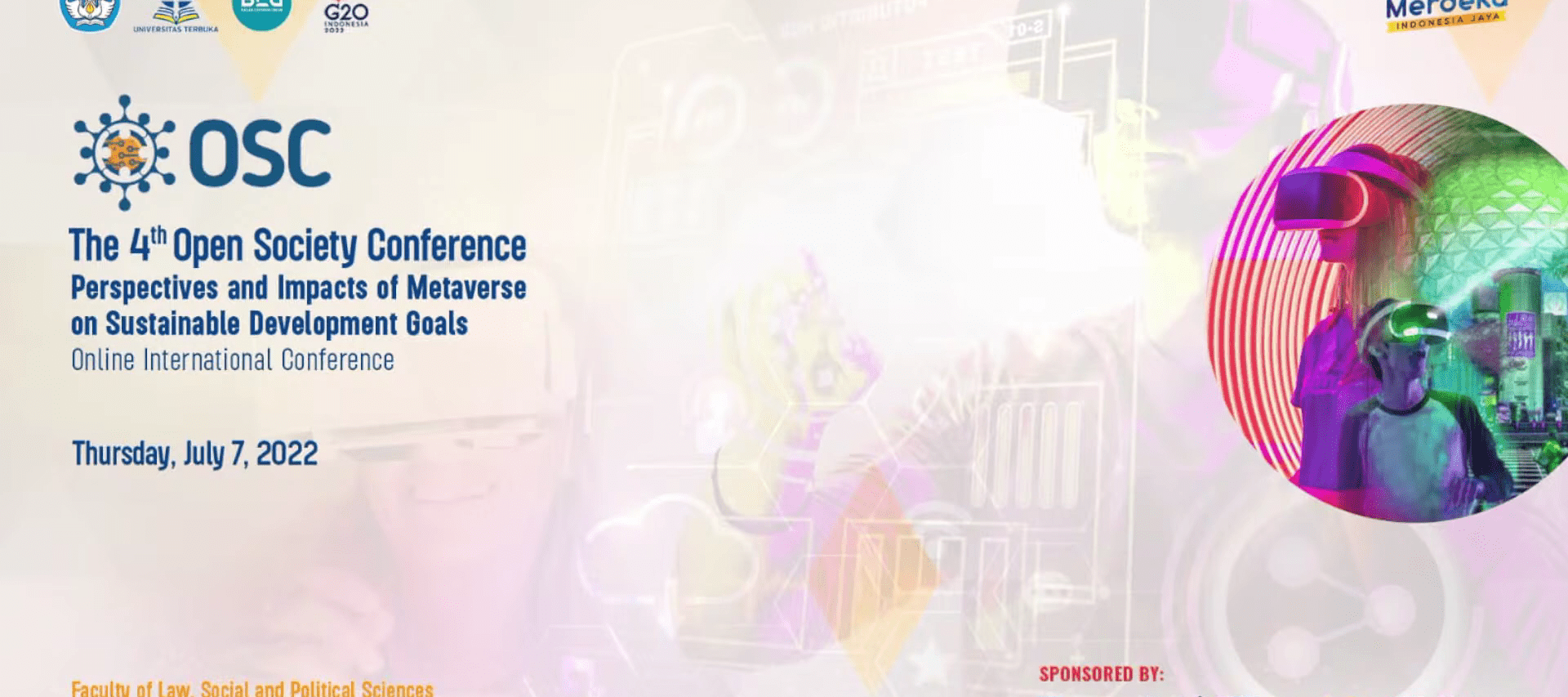
Universitas Terbuka as the education institution that applies Distance Education System (PTJJ) has always put forward the use of technology and participated in every step of the ways in the course of its development. In line with this, Faculty of Law, Social Sciences, and Political Sciences, Universitas Terbuka (FHISIP-UT) once again held the 4th Open Society Conference. This annual international Conference was held online on the date of 7 July 2022 through Zoom and broadcast live on UT TV channel by bringing up the theme on “Perspectives and Impacts of Metaverse on Sustainable Development Goals”.
The program was opened with the report presentation by the Chairperson of the Committee, Megafury Apriandhini, S.H., M.H. and continued with the addresses presented by the Dean of FHISIP, Dr. Sofjan Aripin, M.Si. The opening remarks was also given by UT’s Rector, Prof. Ojat Darojat, M.Bus., Ph.D.
It is expected that the conference will bring about the awareness and knowledge about Multiverse to education practitioners and public in general, provide information on the impacts of Multiverse, as well as the progress on the research of Multiverse, especially the relationship with the realization of SDG (Sustainable Development Goals).

Subsequently, Dedy Permadi, SIP, M.A., Ph.D., who is an academician and a Special Staff for Minister of Communication and Information Technology on Digital and Human Resources was also present as the honorary speaker. He addressed that currently various industries have shifted to start utilizing Metaverse, such as fashion industries that can organize fashion shows and sale transactions in Metaverse. However, the presence of Metaverse has also produced a large amount of carbon traces. Hence, the development of this technology must be coupled with the application of ICT Ecosystem. This ecosystem puts forward the use of low carbon and green development for the sake of the realization of connected and sustainable Indonesia.

The sequence of the events continued with the first panel discussion session presenting two speakers. The first speaker, Dr. Liew Voon Kiong, the Co-Founder & Chief Business Officer Centriverse Malaysia, gave a presentation on the definition and characteristics of Metaverse, which are synchronization and direct connection; fixed; unlimited users; sense of existence; functioning economics; data inter-operability, digital assets, and contents; and user-generated content. He also illustrated that the presence of Metaverse will not only give some benefits and positive impacts, but also negative impacts on the users’ psychological conditions. Therefore, it is expected that the people in general will use it wisely.
The program continued with the presentation by Dr. Indrawan Nugroho who is the CEO & Co-Founder of CIAS (Corporate Innovation Asia). The presentation was focused on how the metaverse impacts the learning and development of cooperative. The presence of Metaverse in Augmented Reality (AR), Virtual Reality (VR), and Mixed Reality (MR) will be able to give some learning experience which exceeds traditional learning. It certainly creates many benefits and advantages for the students. In Metaverse, the students would be able to obtain in-depth interactive guidance, obtain adaptive learning experience, as well as be able to freely experiment and create works. According to Indra, it is very important because he believes that the best way to learn is through experience instead of only reading and understanding the content materials from the books.
Furthermore, the program continued with parallel discussions which were divided into seven sub-themes: (1) Cyber Security Challenges in Law Perspective; (2) Digital Transformation and the Changing Social Lifestyle; (3) Human Capital Development through Metaverse; (4) Library and Information System in Metaverse Society; (5) Creative Digital Economy through the World of Metaverse; (6) Trends and Directions of Translation in Metaverse; (7) The Future of Governance in the Metaverse World.

The second panel discussion session presented two speakers who are relevant and experienced in the theme brought up. Dr. Utz Johann Pape as Senior Economist, Poverty & Equity Global Practice and Global Lead for Data for Operational Impact of the World Bank gave his presentation on Harnessing Digital Technologies for Inclusion in Indonesia. In his illustration, he stated that in order to be connected to the metaverse, there should be equality in terms of internet connection so that all parties can participate in the development of the technology. The digital capability should also be developed so that the digital economy in Indonesia can operate accordingly. The It is suggested that people of Indonesia have an adequate amount of digital literacy. It is deemed that this digital opportunity is likely to be the breakthrough of the digital economy in Indonesia.
The presentation continued with Prof. Dr. Daryono, S.H., M.A., Ph.D., the Professor of FHISIP-UT focusing on the legal frameworks and legal issues on Metaverse. Legal is one of the most crucial factors on metaverse as there are transactions among the users. Avatar in Metaverse will become the replacement of the original users when transactions are conducted virtually. He also stated that in the future the legal grounds for the virtual estate must be established because the sale and purchase of virtual estate will continue to increase.
The 4th Open Society Conference was closed by the Dean of FHISIP-UT coupled with the announcement on the winning Best Papers that were received by Andre Iman Syafroni & Vica Ananta Kusuma and Bani Pamungkas as well as the Best Presenter who were earned by Arif Darmawan and Dewi Nilam Tyas.