
TANGERANG SELATAN — What if pursuing higher education not only leads someone to a bachelor’s degree but also opens the way to creating employment opportunities for themselves and even for others? This question has become increasingly relevant as the world of work and the economy face increasingly rapid changes.
Global economic uncertainty, the development of digital technology, and growing demands for sustainability mean that higher education institutions need to prepare graduates who are more adaptable. Education should not stop at the transfer of knowledge but should also provide access to skills, networks, and new opportunities.
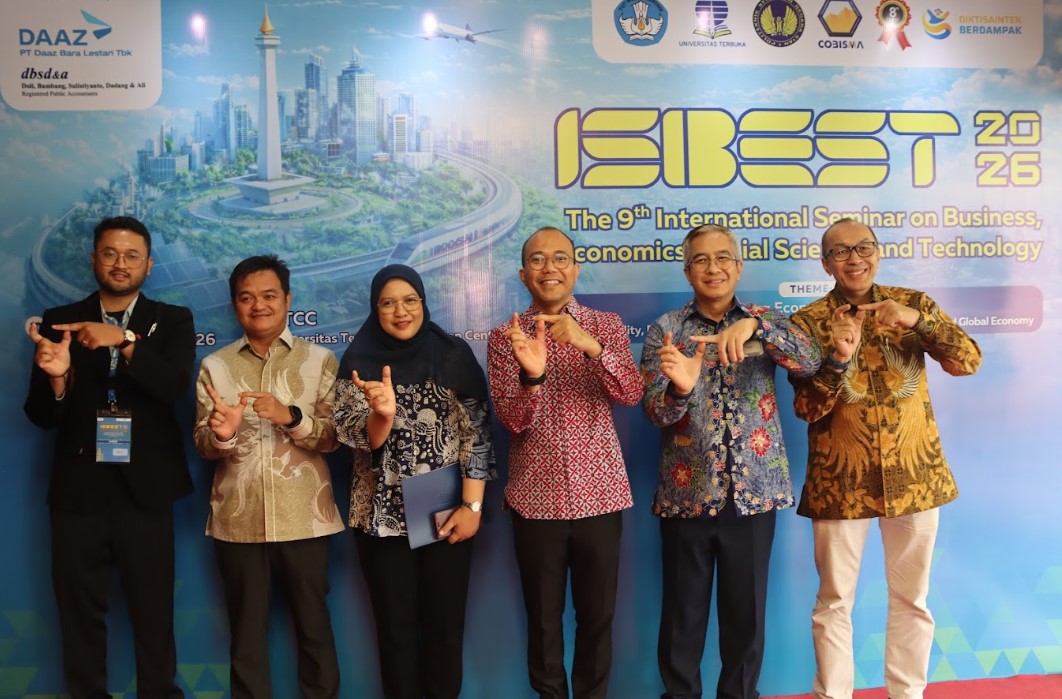
This spirit is among the concerns addressed by Universitas Terbuka (UT) through the 9th International Seminar on Business, Economics, Social Science, and Technology (ISBEST) 2026. Carrying the theme “Navigating Economic Uncertainty: Sustainability, Digital Transformation, and Inclusive Growth in a Fragmented Global Economy,” ISBEST 2026 brought together academics, government representatives, industry players, entrepreneurs, researchers, and students to discuss challenges and opportunities amid changes in the global economy.
Beyond presenting academic perspectives, the forum, organized by the Faculty of Economics and Business of UT, also brought the discussion closer to the real needs of the business world. A total of 130 presenters participated in both onsite and online presentation sessions to share ideas, research findings, and solutions related to economic uncertainty, digital transformation, sustainability, and inclusive growth.
Among these various issues, entrepreneurship emerged as one of the key themes receiving attention. M. Riza Adha Damanik, S.T., M.Si., Ph.D., IPU, Deputy for Entrepreneurship of the Republic of Indonesia, representing the Minister of Micro, Small, and Medium Enterprises, said UT holds a strategic position in strengthening Indonesia’s human resource capacity.
According to Riza, higher education institutions have an important role in producing a generation that is not only oriented toward finding jobs but is also capable of creating quality employment opportunities. This view also demonstrates that education and entrepreneurship can go hand in hand when universities provide sufficient space for students to develop their potential.
“Universitas Terbuka has a very strategic role in producing outstanding generations who not only seek employment but also create quality employment opportunities,” said Riza.
This role is increasingly relevant given the characteristics of UT’s student body, which is spread across various regions and comes from diverse backgrounds. In her statement, Dean of UT’s Faculty of Economics and Business, Dr. Meirani Harsasi, S.E., M.Si., said UT’s current student body numbers approximately 850,000 students, with around 85–87 percent of them being workers. Many of them are also already running businesses.
Therefore, flexible access to education at UT does not stop at providing opportunities to pursue higher education. The university also seeks to provide students with opportunities to develop their businesses through annual MSME mentoring and funding, including through the strengthening of business laboratories and incubators.
This initiative is part of UT’s efforts to ensure that education has a broader impact. Students not only acquire academic competencies but are also encouraged to develop the courage and ability to create economic opportunities.
“The hope is that higher education institutions will eliminate the stigma that university graduates, particularly bachelor’s degree holders, contribute to unemployment,” said Meirani.
This spirit is then translated more concretely through UT’s Entrepreneurship Study Program. The study program, which has been running for only three semesters, has been opened at 10 UT regional offices and now has 1,026 students. Its curriculum was developed with the involvement of stakeholders from the government and industry to ensure that graduate competencies remain aligned with the needs of the business world, including through practical training and internships.
Thus, ISBEST 2026 is not merely a forum for exchanging ideas. The forum demonstrates how higher education can serve as a bridge between knowledge, skills, the business world, and community needs.
The idea is also in line with SDG 4 on Quality Education, through expanding access to learning and competency development. Strengthening entrepreneurship and creating employment opportunities also supports SDG 8 on Decent Work and Economic Growth, while the involvement of government, academia, industry, and international partners reflects the spirit of SDG 17 on Partnerships for the Goals.
Ultimately, education is not only about degrees but also about the ability to move forward, adapt, and create opportunities. Through ISBEST 2026 and the strengthening of its entrepreneurship ecosystem, UT encourages students not only to be prepared to become job seekers but also to grow as creators of opportunities and employment.