

KUPANG — Advances in technology have given students greater flexibility in accessing learning materials, academic services, and various educational resources. However, behind this flexibility, one principle must remain a guide: academic ethics.
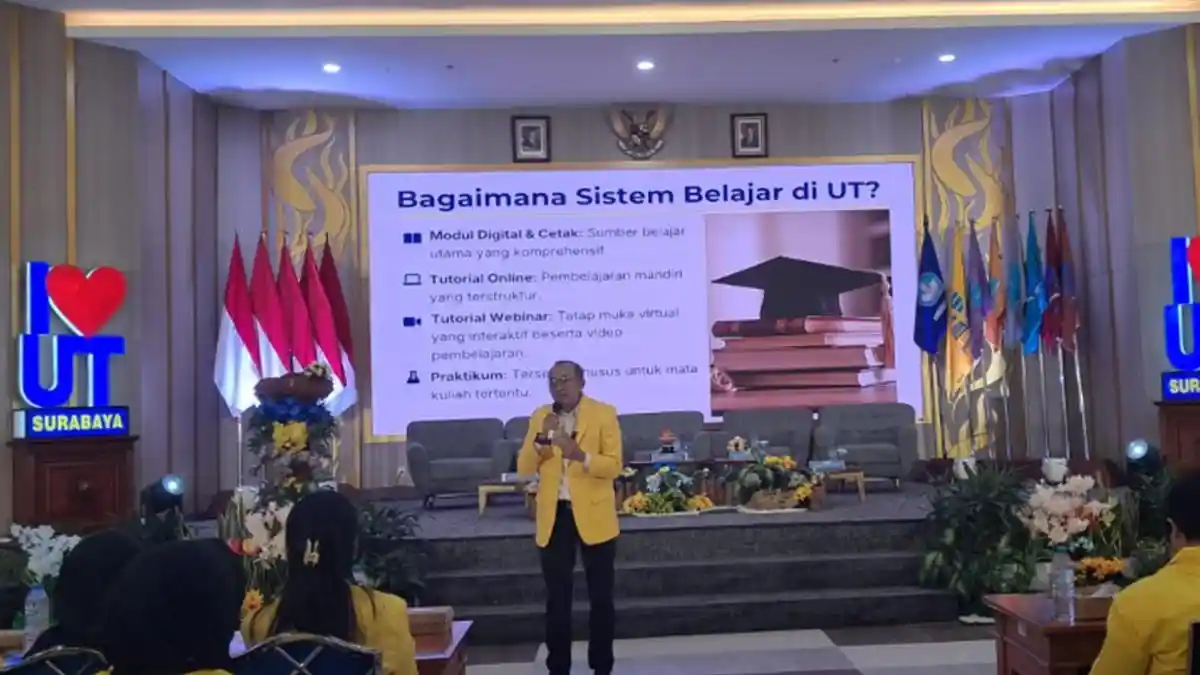
The message was delivered by the Director of Universitas Terbuka (UT) Kupang, Dr. Albert Gamot Malau, S.Si., M.Si., during the UT Kupang New Student Study Orientation (OSMB) at Aston Kupang Hotel on Sunday (August 23, 2026). He emphasized that access to education and technology must go hand in hand with academic integrity.
According to Albert, academic ethics is an essential part of student life that cannot be separated from the learning process. Integrity in education is not merely about the grades students achieve, but also about honesty, responsibility, and respect for the academic process.
The message is particularly relevant amid UT’s distance learning system. Flexible learning gives students the opportunity to manage their time and academic activities independently. However, this flexibility also requires greater maturity and responsibility from every student.
When the learning process does not always take place in a face-to-face classroom, students are expected to remain committed to academic principles. Independence does not mean being free to do anything, but rather having the ability to fulfill academic responsibilities with accountability.
Albert has also been actively helping UT students understand the learning system, including the use of digital services such as myUT. The platform is one of the facilities that helps students access various academic services online.
At the same time, strengthening academic ethics is part of efforts to build a quality education culture. Higher education is not merely about completing courses and earning a degree, but also about shaping individuals who are able to think critically, act responsibly, uphold honesty, and carry these values into their professional and social lives.
For UT Kupang, strengthening academic integrity is particularly important because higher education is not simply about completing courses and obtaining a degree. It is a long process of shaping individuals who are capable of thinking critically, taking responsibility, and respecting honesty.
This commitment is in line with the spirit of the Sustainable Development Goals (SDGs), particularly SDG 4 on Quality Education. Quality education is not only about expanding access to learning, but also about ensuring that the educational process produces human resources with integrity and competence.
As a higher education institution that implements a distance learning system, UT provides broad opportunities for the public to access higher education. Therefore, strengthening academic values is essential to ensure that expanded access and learning flexibility continue to go hand in hand with quality and integrity.
Ultimately, academic ethics is not merely a set of written rules within a university environment. It is a compass that keeps students on the right path throughout their educational journey.
In a fast-paced world, obtaining information may require only a few taps on a screen. However, becoming a knowledgeable and integrity-driven individual requires a much longer process. That is where the true meaning of education lies: not only in producing intelligent people, but also in shaping individuals who are able to use their knowledge responsibly and correctly.