
KULON PROGO — In Sidomulyo, Kulon Progo, a home garden is no longer seen as merely part of a house’s yard. Behind land that may not have been fully utilized, there is an opportunity to cultivate something more valuable: an asset that can be cared for today and generate economic benefits in the years to come.
That opportunity is being developed by Universitas Terbuka (UT) Yogyakarta through the cultivation of Genjah Entok coconut trees in collaboration with the Giri Mantep Forest Farmers Group (KTH). Through a Community Service Program (PkM) themed “Community Empowerment through Genjah Entok Coconut,” UT is bringing not only seedlings but also knowledge to help residents manage them and turn them into productive resources.
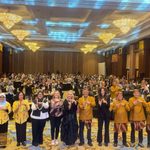
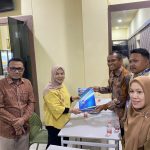
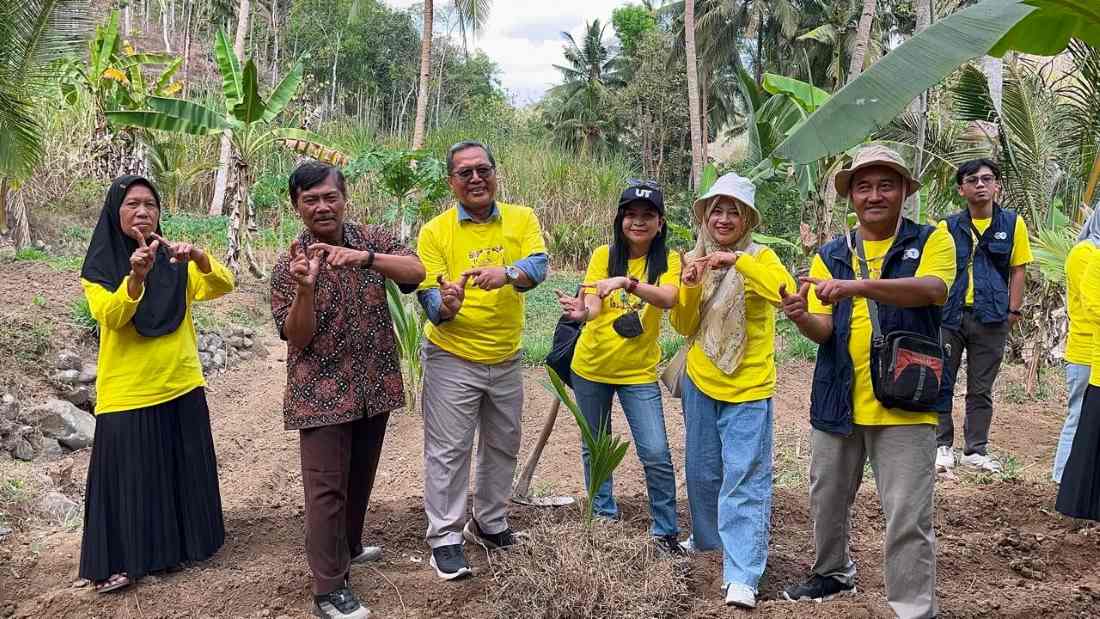
Around 50 members of KTH Giri Mantep participated in the program. A total of 522 Genjah Entok coconut seedlings and 30 sacks of manure were distributed as initial support to optimize the use of available home gardens and land.
The number may sound modest. However, for a community empowerment program, what matters far more is not how many seedlings are distributed, but what happens after the seedlings reach the hands of residents.
For this reason, the program, led by Dwi Riyanti, S.Pd., M.Pd., was designed not to stop at planting. The community was also provided with education on cultivation, maintenance, and the economic potential of Genjah Entok coconuts.
“We want the seedlings provided to become more than just plants. We want them to become productive assets managed by the community. Therefore, knowledge about cultivation, maintenance, and the utilization of the harvest is an important part of the program,” said Dwi Riyanti (August 19, 2026).
For Dwi, the seedlings are only the beginning. The real challenge starts after the plants begin to grow. The community needs to ensure that the plants remain productive, understand how to manage them, and then identify opportunities to add value to the harvest.
“Community empowerment is a process. After the seedlings are planted, what matters more is how the community can care for and manage them so that in the future they can generate yields and provide economic benefits,” Dwi said.
All of the seedlings will be planted when the rainy season begins so that soil conditions and water availability are more supportive of growth. In this way, the process that begins with the distribution of seedlings can continue into collective plant management.
This is where collaboration becomes important. The assistance program also involves UT Yogyakarta, the local government, forestry extension officers, and the farmer group. UT Yogyakarta Director Prof. Dr. Agus Santoso, M.Si., attended the activity together with Head of Development Affairs/Ulu-ulu Eni Harwati, DIY Provincial Forestry Extension Officer Beja, and KTH Giri Mantep representative Kriyanto. The involvement of various parties is expected to ensure that assistance does not end once the seedlings change hands.
In the long term, KTH Giri Mantep is expected to develop Genjah Entok coconuts as productive crops while creating business opportunities based on agricultural and home-garden products. Once the trees begin producing, the benefits are expected to go beyond household consumption and develop into value-added products and a source of regular income.
The idea is also in line with the spirit of SDG 1 on poverty eradication, SDG 8 on decent work and economic growth, and SDG 12 on responsible consumption and production.
True empowerment is not about how much assistance is provided on a single day, but about how far a community can stand on its own potential after the program ends. In Sidomulyo, the 522 Genjah Entok coconut seedlings are now the starting point. The rest is a story the residents will write themselves, a story of land coming to life, plants growing, and economic opportunities gradually taking root.