
TANGERANG SELATAN — There was something more than just a document signing when Universitas Terbuka (UT) and The Open University of Japan (OUJ) came together once again. The two open and distance-learning institutions have known each other for years and have now chosen to take their relationship to a stronger level.
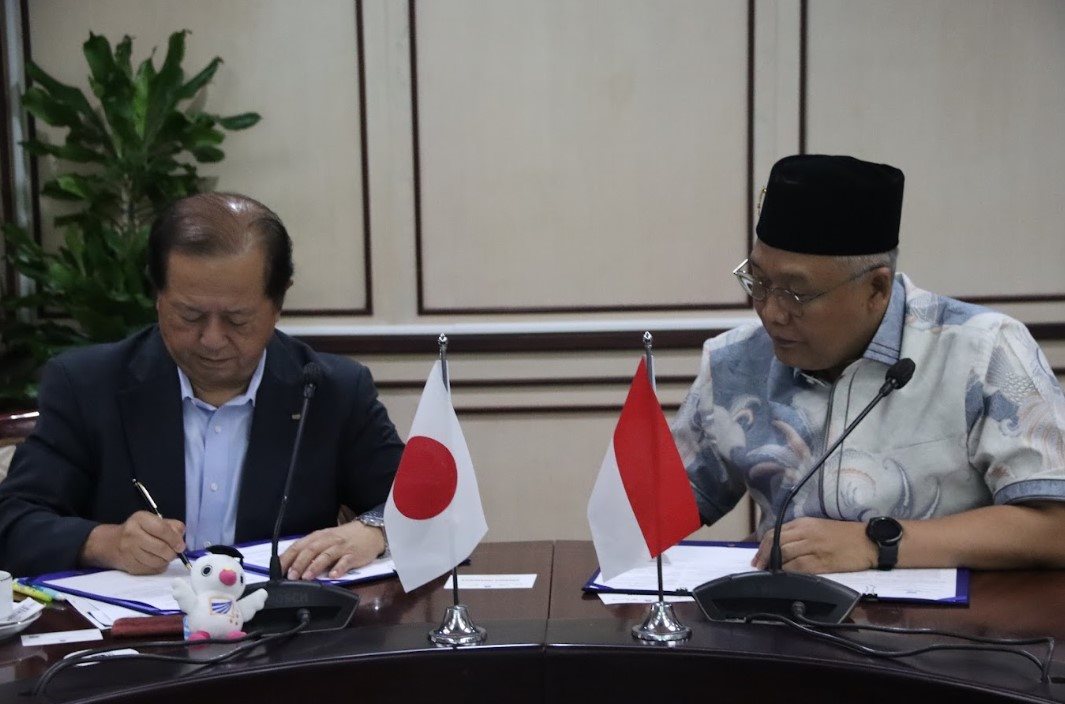
That spirit was reflected in the signing of a Memorandum of Understanding (MoU) between UT and OUJ at Universitas Terbuka on Thursday (August 27, 2026). The MoU was signed by UT Rector Prof. Dr. Ali Muktiyanto, S.E., M.Si., and OUJ President Prof. Dr. Masaya Iwanaga as a foundation for strengthening strategic partnerships in the fields of academics, education, research, and institutional development.
“Alhamdulillah, this afternoon we are meeting with our old friends, The Open University of Japan. It is a distance-learning university, just like UT in Japan, and we have had a very long-standing partnership. Today, we are renewing this collaboration so that it can become more powerful and have a greater impact,” Prof. Ali said.
For UT, the similarities between the two institutions provide an important foundation for building more meaningful collaboration. Both share a vision of expanding access to quality higher education through open and distance-learning systems, while also facing similar challenges, ranging from technological developments and changing learner needs to the growing demand for lifelong learning.
Prof. Ali said that the relationship between UT and OUJ over the years had resulted in various academic and research collaborations. This experience, he said, had become a foundation of trust and mutual understanding that could now be developed through a stronger agreement. “The signing of the Memorandum of Understanding today marks a new chapter built on the meaningful collaborations that have been carried out by the two universities over the years,” he said.
Through the MoU, the collaboration will cover seven key areas, including faculty exchanges, joint research and development projects, exchanges of educational information, academic resources and educational technology, and the organization of seminars, workshops, conferences, and joint academic meetings. In addition, the two parties will also provide opportunities for the exchange of academic publications and educational materials, collaborative activities in the development of open and distance education, as well as other forms of cooperation mutually agreed upon in writing.
OUJ President Prof. Masaya Iwanaga welcomed the signing as an important moment in the relationship between the two universities. He noted that although UT and OUJ had not had a formal exchange agreement for many years, the two institutions had in fact carried out various forms of exchange and built close ties on numerous occasions.
Personal memories also colored his remarks. Prof. Iwanaga still remembers his first visit to former UT Rector Dr. Atwi Suparman more than 20 years ago. “At that time, I was still young and had much more hair,” he said, drawing laughter from the audience. He also recalled UT Vice Rector Prof. Rahmat Budiman’s visit to OUJ last year to deliver a lecture, as well as his visit to the UT campus with former UT Rector Prof. Dr. Ojat Darojat to attend a seminar and enjoy the mountain scenery and durian.
“It is a great honor for me to sign this international agreement. For such a long time, we did not have a formal agreement between Universitas Terbuka (UT) and The Open University of Japan (OUJ), but in reality, we have carried out a great deal of international collaboration together,” Prof. Iwanaga said.
Now, the relationship that has grown through meetings, knowledge exchanges, and friendship has broader room to develop. Prof. Iwanaga hopes the agreement will encourage more active exchanges of human resources, resources, and ideas between UT and OUJ.
Prof. Ali expressed a similar hope. He wants the agreement to go beyond being a document and lead to more concrete programs while strengthening the academic networks of both universities. The spirit of sharing experiences and best practices in open and distance education is also expected to make a broader contribution to the advancement of education in Indonesia, Japan, and globally.
For two universities that have existed from the beginning to transcend the boundaries of space and time, collaboration should not end on paper. There is knowledge to exchange, experience to strengthen one another, and innovation to develop together. From Indonesia to Japan, this MoU opens a new chapter for a long-standing friendship, not merely to preserve it, but to make it work and create a broader impact.