

Universitas Terbuka (UT), as a pioneer institution in open and distance higher education or “Pendidikan Tinggi Terbuka dan Jarak Jauh” (PTTJJ), actively advocates for the PTTJJ system to the general public. The presence of distance learning has become an increasingly relevant solution and a model for the future of education. Currently, various universities and higher education institutions are adopting distance or blended learning approaches. In a journey, the Indonesian Association of Distance Education Professionals (APPJJI) plays a crucial role as a professional platform for institutions offering distance education in Indonesia. APPJJI contributed well after several years of hiatus since it was established on March 30, 2004.
APPJJI aims to conduct research, development, and dissemination of distance learning that benefits society as one of its mission. Moreover, APJJI intends to serve as a platform for training and communication related to distance learning methods to meet the demands of educational development. It is hoped to create a guide that combines communication technology with learning in a broad multi-disciplinary application by its presence. It also envisions the formation of strong alliances as community platforms for distance learning that implement new concepts in PJJ.
To be known, UT has been honored and entrusted with the role of Chairperson of APPJJI 2023, held by Muhammad Husni Arifin, S.Ag., M.Si., Ph.D., who is also the Dean of the Faculty of Law, Social and Political Sciences (FHISIP) at UT. To introduce and promote the existence of the Indonesian Association of Distance Education Professionals to the public, a webinar was conducted on December 19, 2023. The webinar aimed to provide insights into the APPJJI work program for 2023–2026. The inaugural webinar was themed as “Distance Education in the Framework of Education Regulations in Indonesia”. The event was remarkably interesting as it featured two distinguished education figures as speakers: Dr. Lukman, S.T., M.Hum., Director of Institutional Affairs at the Ministry of Education, Culture, Research, and Technology, and Prof. Ir. Tian Belawati, M.Ed., Ph.D., an expert in distance education.
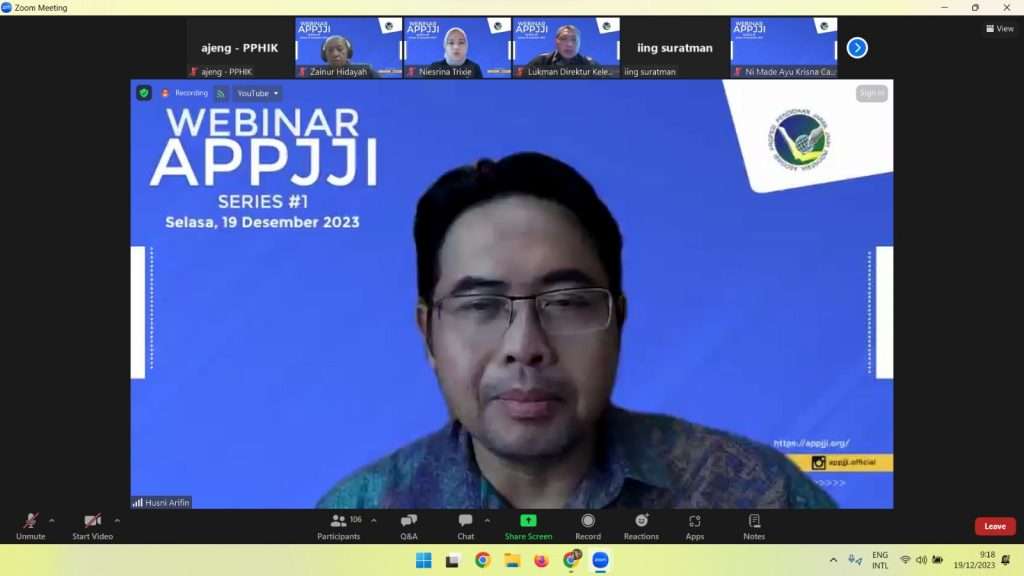
Opening the webinar, Chairperson of APPJJI Muhammad Husni Arifin, S.Ag., M.Si., Ph.D., expressed his gratitude for having two incredibly competent speakers in the field of education. Mr. Husni hoped that the webinar would be beneficial for all participants and contribute to the advancement of distance education in Indonesia. By holding the webinar, APPJJI was expected to be able to emphasize the importance of the government providing legitimacy and extensive space for institutions implementing PTJJ in the education landscape of Indonesia, whether through dual-mode or single-mode schemes.
Under the theme “Distance Education in the Framework of Higher Education Regulations in Indonesia,” Dr. Lukman, S.T., M. Hum., provided an overview of higher education in Indonesia. As of December 1, 2023, Indonesia has 4,368 higher education institutions, consisting of 349 state universities (PTN) and 4,054 private universities (PTS), with a total student population of approximately 10 million, of which 10% are engaged in distance learning. The data presented the high enthusiasm of the public towards distance learning. However, concerning quality, almost 40% of these institutions are not to be accredited yet, and the Gross Enrollment Ratio (GER) for higher education in Indonesia remains low. He also emphasized the need for acquiring solutions, including the promotion of Kampus Merdeka Program. Regarding the provision of distance education meeting the online learning pedagogy standards, Dr. Lukman acknowledged that Universitas Terbuka, as a pioneer in PTJJ, remains the best in conforming the standard of PTJJ implementation in Indonesia.
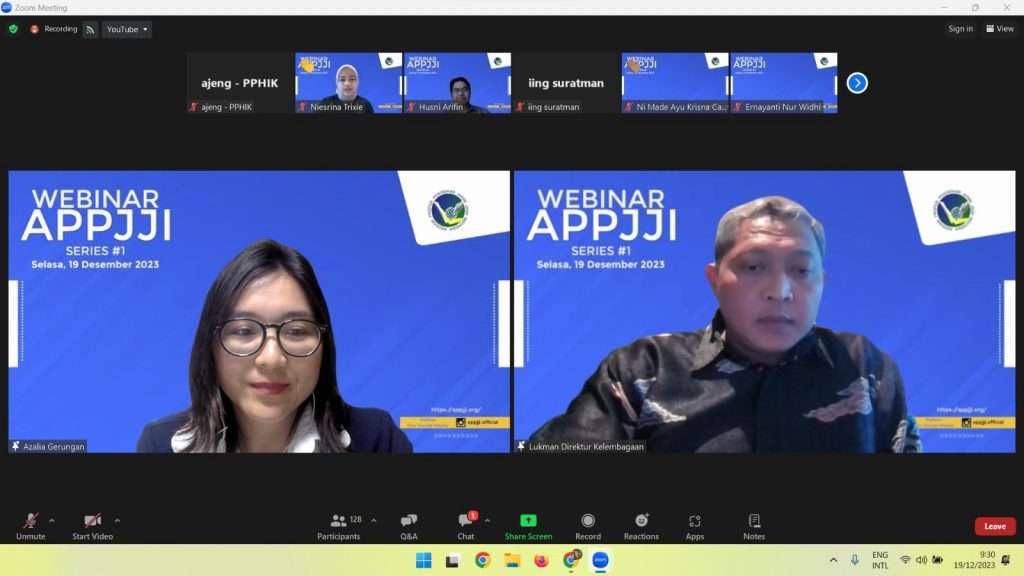
Regarding the increasing number of participations, Dr. Lukman further addressed the challenges and proposed solutions to improve higher education in Indonesia by employing the policy direction and strategy of the Directorate General of Higher Education. These included increasing enrollment rates, enhancing the quality and relevance of higher education, strengthening the quality of lecturers and educational staff, improving governance, and boosting research, innovation, and community service.
Dr. Lukman also concluded by stating, “From all the stages, what matters most is the final result in the form of a transformation in how students graduate and secure suitable employment, whether through distance learning or conventional education.” In the context of PJJ, Dr. Lukman underlined the mandatory requirement of TIK-based (Information and Communication Technology) infrastructure.

Furthermore, Prof. Ir. Tian Belawati, M.Ed., Ph.D., a lecturer at the Faculty of Education and Teaching Sciences at UT with expertise in Open and Distance Learning (PJJ), presented on “Opportunities and Challenges of Opening Distance Learning Programs.” Prof. Tian highlighted opportunities for opening distance learning programs, aligning with Dr. Lukman’s discussion about suboptimal GER levels and infrastructure development in Indonesia. Prof. Tian mentioned that the National Accreditation Agency for Higher Education (SN Dikti) has accommodated standards for offering courses or programs through distance learning.
Prof. Tian emphasized the potential market for higher education in Indonesia, with 70% of the population from 280 million or approximately 224 million people being in the productive age group, presenting opportunities for both formal and non-formal education, including lifelong learning. She stated, “It is important to improve the professional capabilities of the workforce within the productive age group.”
Discussing the challenge and phenomenon of developing distance education, Prof. Tian mentioned the impact of the 4.0 Industrial Revolution, stating that around 85 million jobs will decline or disappear while 97 million new jobs will emerge according to the data. She highlighted the need for reskilling through distance learning, with 40% of the workforce requiring recycling. Prof. Tian added that there are significant challenges in accommodating the development of PJJ, including institutional preparedness, faculty readiness, national infrastructure readiness, and societal readiness for self-directed learning. She pointed out the importance of digital literacy, including adequate internet connectivity at home to facilitate optimal online learning. Prof. Tian concluded, “We can provide services to workers, either through upscaling or recycling.”
At the end of the event, moderator Azalia Gerungan, S.M., M.Sc., a lecturer in Communication Science at University of Pelita Harapan, closed the inaugural webinar of APPJJI, expressing gratitude for the successful event. The webinar aimed to provide insights for the development of the quality of distance education in Indonesia, making it more optimal as a solution for future education in the face of changing times and the increasingly digital behavior of society.