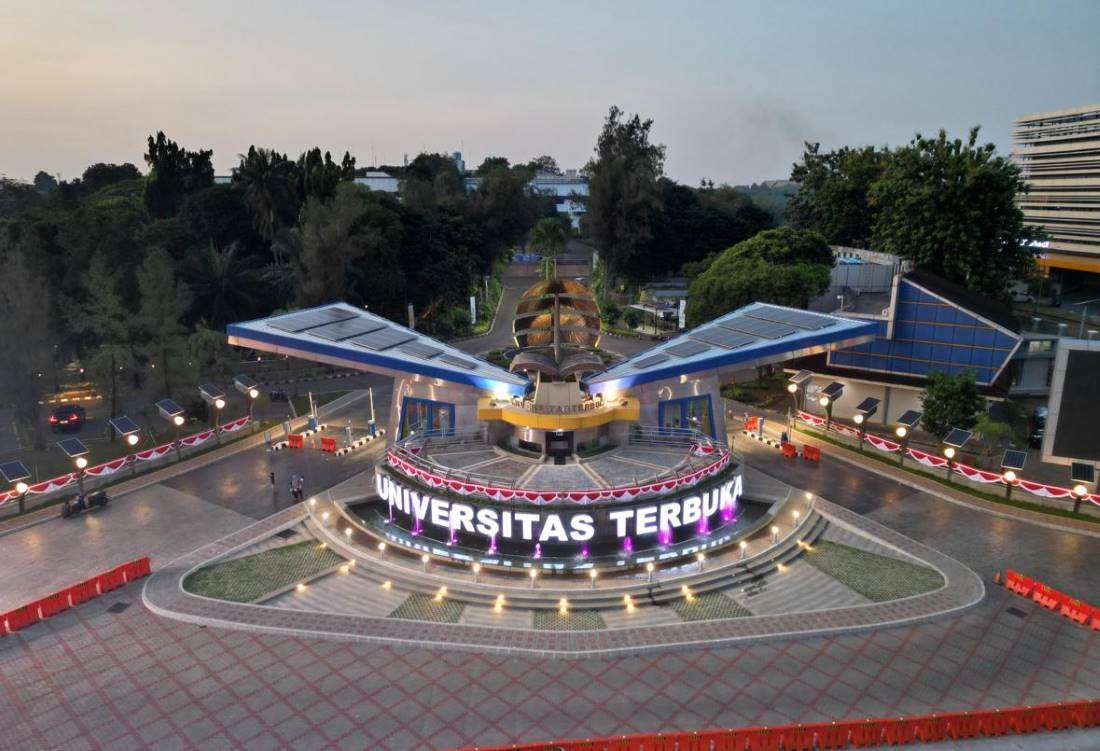


KUPANG – The opportunity to pursue higher education at a public university remains open for residents of Nusa Tenggara Timur (NTT). Amid ongoing challenges in accessing higher education,particularly for those living in the province’s islands and Indonesia’s frontier, outermost, and disadvantaged or 3T (Tertinggal, Terdepan, dan Terluar) regions, Universitas Terbuka (UT) Kupang is once again encouraging the public to take advantage of its flexible, high-quality, and affordable distance learning system. For people living in remote islands, rural areas, or those who are already employed, UT provides an important alternative by allowing them to earn a university degree without leaving their jobs or relocating.
Speaking on the Pos Kupang Podcast on Tuesday (July 7, 2026), UT Kupang Director Dr. Albert Gamot Malau, S.Si., M.Si., explained that the university’s new student admission process began in May through two pathways: Recognition of Prior Learning (RPL) and the regular admission route for high school graduates or equivalent (Non-RPL). The Non-RPL registration remains open until July 22, 2026, while the RPL admission pathway has already closed.
Albert said that increasing student enrollment is part of a broader effort to expand access to higher education across Indonesia. The government expects UT to contribute to raising the country’s Gross Enrollment Rate (GER) in higher education to above 30 percent. At the regional level, UT Kupang has also been assigned a target of approximately 20,000 students, with a minimum goal of enrolling around 17,000 new students this year as one of the university’s key performance indicators.
He encouraged the people of Nusa Tenggara Timur not to miss the opportunity. As Indonesia’s pioneering public university for open and distance learning, UT was established to reach individuals who have traditionally faced barriers to higher education due to geographical challenges or limited time.
“We encourage everyone in Nusa Tenggara Timur, especially those in Kota Kupang, to take advantage of the educational opportunities provided by the government because UT is a public university that was specifically designed from the beginning to deliver distance learning,” he said.
Albert explained that Indonesia’s higher education system consists of both face-to-face and distance learning institutions. To date, UT remains the country’s only university specifically dedicated to developing an open and distance learning model that broadens educational opportunities for people across the nation.
In addition to offering flexibility, UT also provides relatively affordable tuition fees. Students may choose between the Semester Package System (Sistem Paket Semester – SIPAS) or the Non-SIPAS scheme, where tuition is calculated based on the number of credit units taken. Under the Non-SIPAS system, tuition starts at approximately Rp30,000 per credit, excluding learning materials, while the package system costs up to Rp1.3 million, including course materials.
UT Kupang also offers various financial assistance programs. Students who achieve a minimum GPA of 3.0 in their first semester may qualify for academic scholarships, while students from low-income families can apply for the Kartu Indonesia Pintar-Kuliah (KIP-K) and other scholarship programs.
“For people in Nusa Tenggara Timur, we provide several scholarship opportunities. There are scholarships for academic achievement, scholarships for students from underprivileged families, and KIP-K assistance. Education is extremely important because improving one’s life begins with education,” Albert said.
According to him, affordable tuition does not mean lower educational quality. UT continues to maintain academic excellence through an adaptive curriculum and by strengthening graduate competencies to ensure students are well prepared for the workforce.
“Although UT’s tuition fees are affordable, the quality is never compromised. We continue to maintain high standards. We have international accreditation and are currently undergoing ICDE (International Council for Open and Distance Education) reaccreditation. Nationally, most of our study programs have achieved the highest accreditation status,” he said.
He added that program accreditation plays an important role in employment opportunities, including recruitment for Indonesia’s civil service, making institutional quality an important consideration for prospective students.
Throughout their studies, UT students also benefit from a wide range of technology-based learning services, including online tutorials, virtual classrooms, Zoom webinars, educational radio and television broadcasts, and web-based academic support. Students are also encouraged to participate in research, community service, student organizations, skills training, and collaborative programs with industry and business partners.
“We also collaborate with companies. In fact, UT Kupang recently received an offer from one company to recruit our graduates,” Albert revealed.
Beyond opening admissions for new students, UT Kupang is committed to ensuring that every Indonesian, regardless of where they live, has equal access to quality higher education. This commitment also supports the Sustainable Development Goals (SDGs), particularly SDG 4 (Quality Education), SDG 8 (Decent Work and Economic Growth), and SDG 10 (Reduced Inequalities) by expanding access to inclusive, affordable, and workforce-relevant higher education.