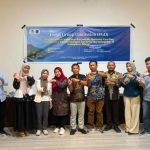

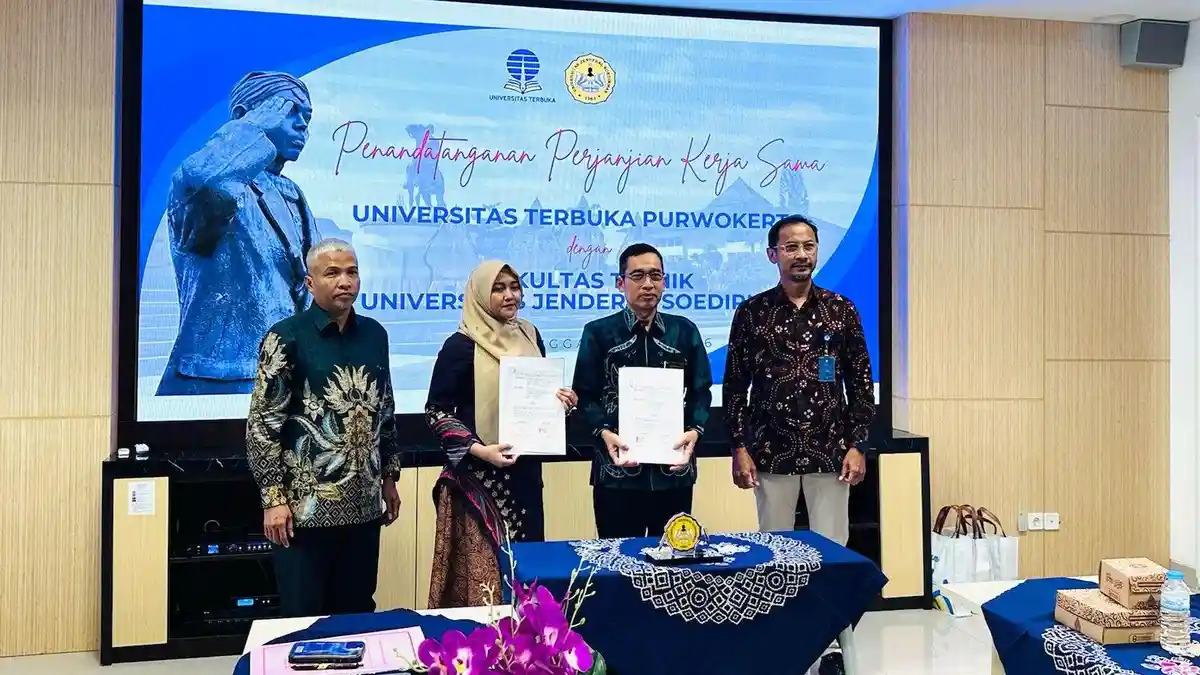
PURWOKERTO — The transformation of higher education in the digital era cannot be achieved by institutions working in isolation. Strong collaboration, innovation, and strategic partnerships are essential for universities to respond effectively to the rapidly evolving demands of the future. Guided by this shared vision, Universitas Terbuka (UT) Purwokerto and the Faculty of Engineering at Universitas Jenderal Soedirman (Unsoed) officially signed a Cooperation Agreement (Perjanjain Kerja Sama – PKS) covering the Tri Dharma of Higher Education on Friday, June 5, 2026.
The signing ceremony, held at the Faculty of Engineering Building F, First Floor, Unsoed, marked a strategic step toward strengthening collaboration between Indonesia’s leading provider of Open and Distance Learning (ODL) and one of Central Java’s largest engineering faculties.
The event was attended by senior leaders from both institutions. Representing the Faculty of Engineering at Unsoed were Dean Prof. Dr. Eng. Ir. Agus Maryoto, S.T., M.T., along with the vice deans and heads of academic programs. UT Purwokerto was represented by Director Dr. Prasetyarti Utami, S.Si., M.Si., accompanied by members of the university’s management team.
In his remarks, Prof. Agus Maryoto introduced the Faculty of Engineering, which currently offers approximately 20 academic programs, serves around 3,200 students, and is supported by approximately 160 faculty members. He emphasized that partnerships between higher education institutions have become increasingly important in addressing the growing complexity of today’s higher education landscape.
He stated that the partnership with UT Purwokerto is expected to create broader opportunities for collaboration in education, research, and community service.
“We warmly welcome this partnership as part of our commitment to strengthening the implementation of the Tri Dharma of Higher Education. The Faculty of Engineering at Unsoed is ready to collaborate on various initiatives that will benefit our faculty members, students, and the wider community,” he said.
Meanwhile, Dr. Prasetyarti Utami, Director of UT Purwokerto, explained that the relationship between Universitas Terbuka and Universitas Jenderal Soedirman dates back several decades. She noted that since UT was established in 1984, its Purwokerto regional office has received institutional support from Unsoed, creating a strong historical connection between the two universities.
According to her, the signing of the cooperation agreement reinforces a partnership that has been built over many years while opening opportunities for broader collaborative initiatives in the future.
“This agreement strengthens a relationship that has existed for many years. Going forward, we hope to develop even more collaborative initiatives in education, research, and community service,” she said.
Dr. Prasetyarti also highlighted that Universitas Terbuka has now achieved the status of a State University with Legal Entity (PTNBH) and continues to expand its technology-driven learning system. For UT, technology is not merely a response to current trends but serves as the foundation of its open and distance learning model.
With nearly 30,000 active students at UT Purwokerto and the support of approximately 36,000 external tutors across Indonesia, maintaining the quality of academic services remains a top priority. She emphasized that collaboration with partner universities has become increasingly important in supporting adaptive and sustainable educational transformation.
Aligned with efforts to expand access to inclusive and high-quality education, the partnership also contributes to the Sustainable Development Goals (SDGs), particularly SDG 4 (Quality Education), by strengthening technology-based learning ecosystems, enhancing academic capacity, and expanding collaboration among higher education institutions.
Under the newly signed agreement, UT Purwokerto and the Faculty of Engineering at Unsoed will collaborate on a wide range of initiatives, including education and teaching, the involvement of faculty members as tutors and academic speakers, instructional material development, joint research projects, scientific publications, community engagement programs, and other academic capacity-building activities.
The partnership is expected to serve as the foundation for concrete collaborative programs that will not only benefit the academic communities of both institutions but also strengthen the quality of higher education to better meet technological advancements and the evolving needs of society.