
GORONTALO — Pursuing a master’s degree no longer has to be limited by distance, work commitments, or place of residence. Supported by digital technology and a well-established distance learning system, people from across Indonesia can now access quality higher education without leaving their jobs or daily responsibilities. This commitment continues to be demonstrated by Universitas Terbuka (UT), including through the Postgraduate Entrance Examination conducted by UT Gorontalo on Saturday, June 6, 2026.
The entrance examination, held from 8:00 a.m. to 3:00 p.m. Central Indonesia Time (Waktu Indonesia Tengah – WITA), marked the first step for prospective students seeking admission to UT’s master’s degree programs. Although organized by UT Gorontalo, the participants were not limited to local applicants. Candidates from both Gorontalo and Yogyakarta took part in the selection process, demonstrating how higher education has become increasingly accessible regardless of geographical location.
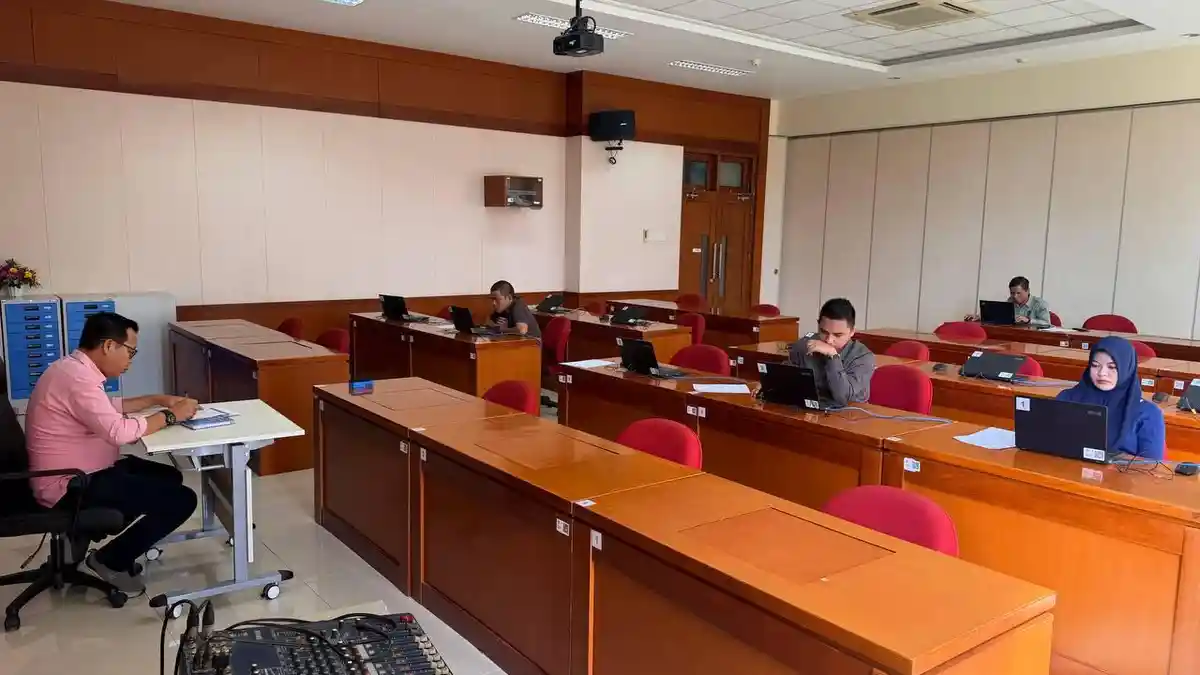
The examination was conducted in the Online Room of the UT Gorontalo Office using the Online Live Proctoring Examination (UO-LP) system, a technology-based testing method that enables candidates to complete the examination from their respective locations while being monitored remotely in real time. The system represents one of UT’s innovations in delivering flexible educational services while maintaining the quality and integrity of the admissions process.
Yasir M. Pidu, S.E., M.M., Manager of Outreach, Registration, and Examinations at UT Gorontalo, stated that the entire examination process was conducted smoothly and in an orderly manner.
“This year, four applicants participated in the UT Postgraduate Program entrance examination. Three candidates took the test from Gorontalo, while one participated from Yogyakarta,” he said.
The three applicants from Gorontalo, Djunardi Ali, Fahirah Nadrah Male, and Ferdiyanto Tuli, applied to the Master of Law program. Meanwhile, Afrizal Novan Fathoni from Yogyakarta applied to the Master of Public Administration program.
According to Yasir, the entrance examination is a mandatory stage for all applicants before they can be admitted to UT’s postgraduate programs. Through the UO-LP system, the selection process can be carried out with greater flexibility without compromising the established academic standards.
“Through the Online Live Proctoring Examination system, applicants can take the test from their respective locations while the examination is monitored rigorously and professionally,” he explained.
As part of the selection process, applicants completed several standardized assessments required for admission to UT’s postgraduate programs. These included the Academic Potential Test (TPA), the English Proficiency Test (TOEFL), and a Subject-Specific Examination tailored to each applicant’s chosen field of study.
Yasir explained that all examination instruments follow the standards established by the Indonesian Test Service Center (Pusat Layanan Tes Indonesia – PLTI), whose assessments are widely used by higher education institutions across Indonesia.
“The examinations are based on PLTI standards, ensuring the quality and credibility of the selection process,” he said.
The successful implementation of the examination was also supported by Mahyudin B. Angio, S.Kom., an Information and Communication Technology (ICT) officer at UT Gorontalo, who ensured that all technical systems and equipment functioned properly throughout the examination.
Beyond serving as an admissions process, the examination illustrates how Universitas Terbuka continues to adapt to technological developments in order to expand access to higher education. For working professionals, civil servants, educators, and members of the general public seeking to enhance their academic qualifications and professional competencies, UT’s postgraduate programs offer a practical solution that enables them to continue their studies without leaving their jobs or relocating.
This initiative also supports the Sustainable Development Goals (SDGs), particularly SDG 4 (Quality Education), which promotes inclusive, equitable, and quality education for all.
Through its flexible learning system, digital academic services, and nationwide educational network, Universitas Terbuka continues to broaden access to higher education across Indonesia, not only in major cities but also in regions that have traditionally faced limited access to advanced educational opportunities.
“We hope all participants achieve the best possible results and will soon join the Universitas Terbuka postgraduate community,” Yasir said.
He also expressed his hope that more people from Gorontalo and other regions would take advantage of the opportunity to pursue postgraduate education.
“Universitas Terbuka is committed to providing the widest possible access to quality higher education. We hope UT’s postgraduate programs will become the preferred choice for individuals seeking to enhance their knowledge, skills, and professional competencies,” he concluded.
As the demands of today’s workforce continue to evolve, education has become an increasingly important investment in professional development and competitiveness. Through its flexible learning approach supported by digital technology, Universitas Terbuka continues to demonstrate that quality higher education can be accessed by anyone, anywhere, and at any time, ensuring that opportunities for lifelong learning are not limited by distance, time, or profession.